On this page
In the early 1950s, Wolfgang Paul's group at the University of Bonn asked what happens to charged particles in a multipole field. The answer was the quadrupole mass spectrometer and a three-dimensional “ion cage” now called the Paul trap, both described in his Nobel lecture, “Electromagnetic traps for charged and neutral particles”, given on 8 December 1989.
The 1989 Nobel Prize in Physics went half to Norman Ramsey and half jointly to Hans Dehmelt and Wolfgang Paul “for the development of the ion trap technique”. Paul (10 August 1913 to 7 December 1993) was at the University of Bonn, according to his Nobel Prize facts page.
Why can't a fixed electric field trap an ion?
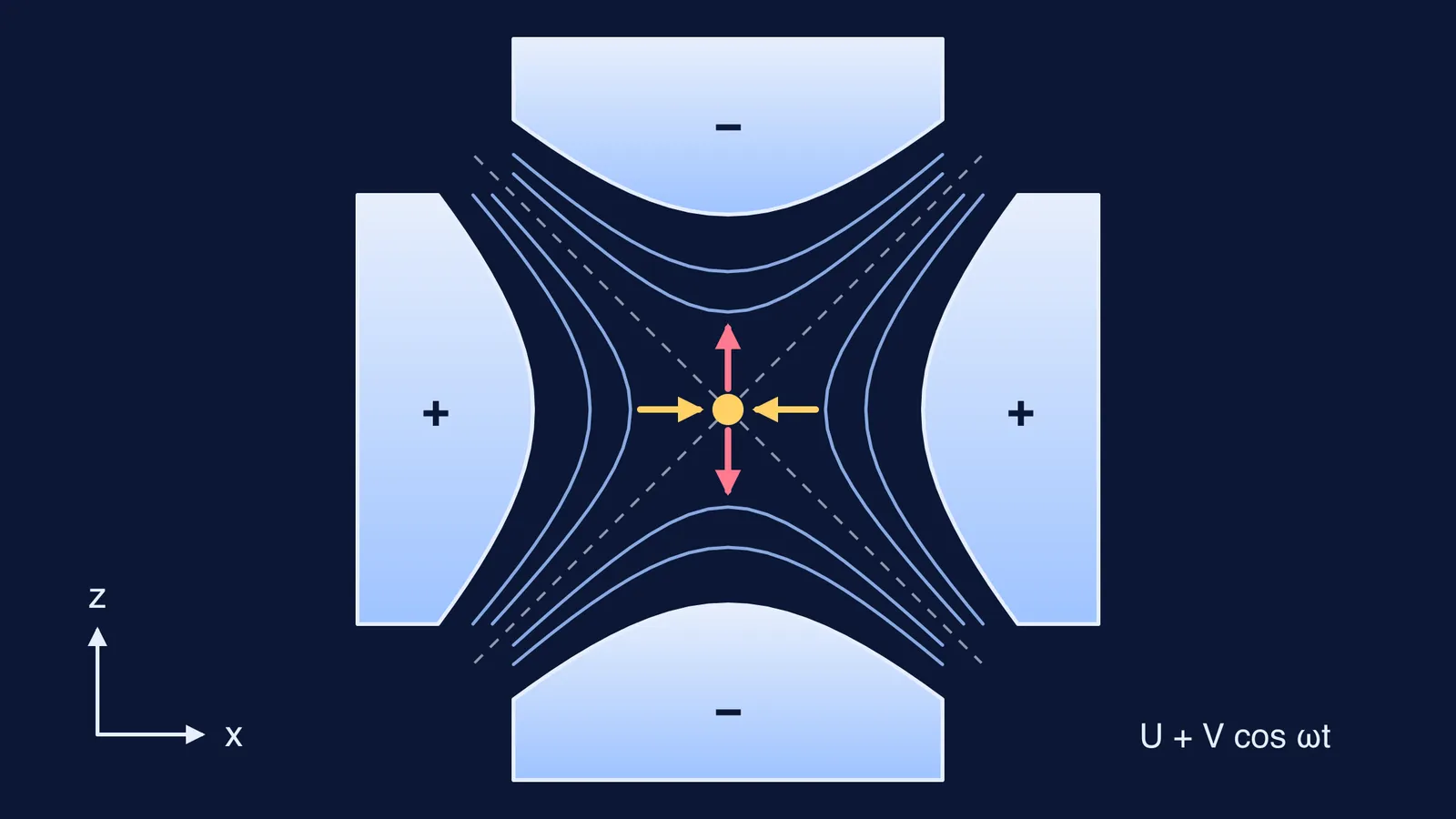
To hold a particle you need a restoring force that grows with distance, F = −cr, as in simple harmonic motion. That needs a potential quadratic in x, y and z. But in empty space the potential obeys Laplace's equation, which forces α + β + γ = 0 for a potential proportional to αx² + βy² + γz², as Paul's lecture shows. The three cannot all be positive: pull an ion inward along x and the field pushes it outward along another axis. The potential is a saddle, not a bowl, and with a fixed voltage the ions drift out and hit the electrodes.
How does the Paul trap work?
Paul's fix was a voltage that changes with time: a steady U plus a radio-frequency V cos ωt. Each direction now switches between focusing and defocusing as the voltage alternates. In a uniform field these would cancel, but Paul's lecture explains that in the non-uniform quadrupole field a small average force remains, pointing toward the weaker field at the centre.
The motion follows the Mathieu equation, and whether it is stable depends only on two numbers, a (set by U) and q (set by V), not on the ion's starting speed. A stable ion makes a slow oscillation with a fast jiggle at the drive frequency on top, called micromotion. The three-dimensional trap is a ring electrode between two end caps, which Paul's group called the “Ionenkäfig”, the ion cage.
How does a quadrupole mass spectrometer sort ions by mass?
The two-dimensional version uses four hyperbolic rods. Ions with the same mass-to-charge ratio sit at one point on the stability diagram, and all masses lie on a line with a/q = 2U/V (Paul's lecture). Put that line through the tip of the stable region and only one mass reaches the detector; raise U and V together and the masses pass one after another. The lecture shows the first mass spectra, obtained in 1954, and a 6-metre Bonn instrument with a resolving power m/Δm of 16,000.
Worked example: what voltages let mass 100 through?
Paul's lecture gives q = 2eV/(m r₀² ω²) and a = 4eU/(m r₀² ω²), with the stable tip near a = 0.237, q = 0.706. Take an ion of charge e and mass 100 u (1.66 × 10⁻²⁵ kg), r₀ = 5 mm and a 1 MHz drive (ω = 2π × 10⁶ rad/s). These are illustrative choices, not a real instrument.
m r₀² ω² ≈ 1.64 × 10⁻¹⁶ in SI units.
V = 0.706 × m r₀² ω² / 2e ≈ 361 V.
U = 0.237 × m r₀² ω² / 4e ≈ 61 V.
Both scale with m, so mass 200 needs about 722 V and 121 V. Sweep the voltages and the masses arrive in order.
Where are Paul traps used today?
In his 1989 lecture, Paul said the ion trap had become the most sensitive mass analyser available, since only a few ions are needed for detection.
Radio-frequency ion traps also hold ions in atomic clocks. In July 2025 NIST reported an aluminium-ion clock, cooled by a neighbouring magnesium ion, with a systematic uncertainty of 5.5 × 10⁻¹⁹. The paper's abstract credits an improved RF ion trap design that reduces excess micromotion, the jiggle Paul described. For an earlier step in timekeeping, see how Warren Marrison built the first quartz clock.
How does the Paul trap connect to JEE and board physics?
Every piece of the trap is in your syllabus:
Force on a charge: F = qE pushes a positive ion away from + electrodes and toward − ones.
Equipotentials: here they are hyperbolas, x² − z² = constant. Compare shapes of equipotential surfaces.
Simple harmonic motion: a restoring force F = −cr gives oscillation.
Mass-to-charge ratio: the same quantity behind how the e/m ratio of cathode rays was measured.
Try this: sketch the four electrodes, mark + and −, and draw the force on a positive ion near the centre along each axis. Flip the signs and draw again. That is one full cycle of the Paul trap.
Fields that change in time are hard to picture from a page. The Fermi Simulation Lab has interactive simulations for ideas easier to see than read. When a problem on charges in fields goes wrong, the Fermi Problem Library has a step-by-step solver that explains the reasoning.