On this page
Atoms in a metal crystal behave, to a first approximation, like hard spheres stacked in a repeating box called the unit cell. How much of that box the spheres fill depends on one thing: the direction along which they touch. Get that direction right and every packing efficiency follows in three lines.
What is packing efficiency?
Packing efficiency is the percentage of a unit cell's volume occupied by its atoms, treated as touching hard spheres. The recipe never changes:
Count the atoms that belong to one cell (a corner atom is shared by 8 cells, a face atom by 2, a body-centre atom belongs to its cell alone).
Find the direction along which atoms touch, and write the edge length a in terms of the radius r.
Divide the volume of those atoms, n × (4/3)πr³, by the cell volume a³.
OpenStax Chemistry 2e gives the atom counts used below: 1 for simple cubic, 2 for body-centred cubic and 4 for face-centred cubic.
How do you find the packing efficiency of simple cubic?
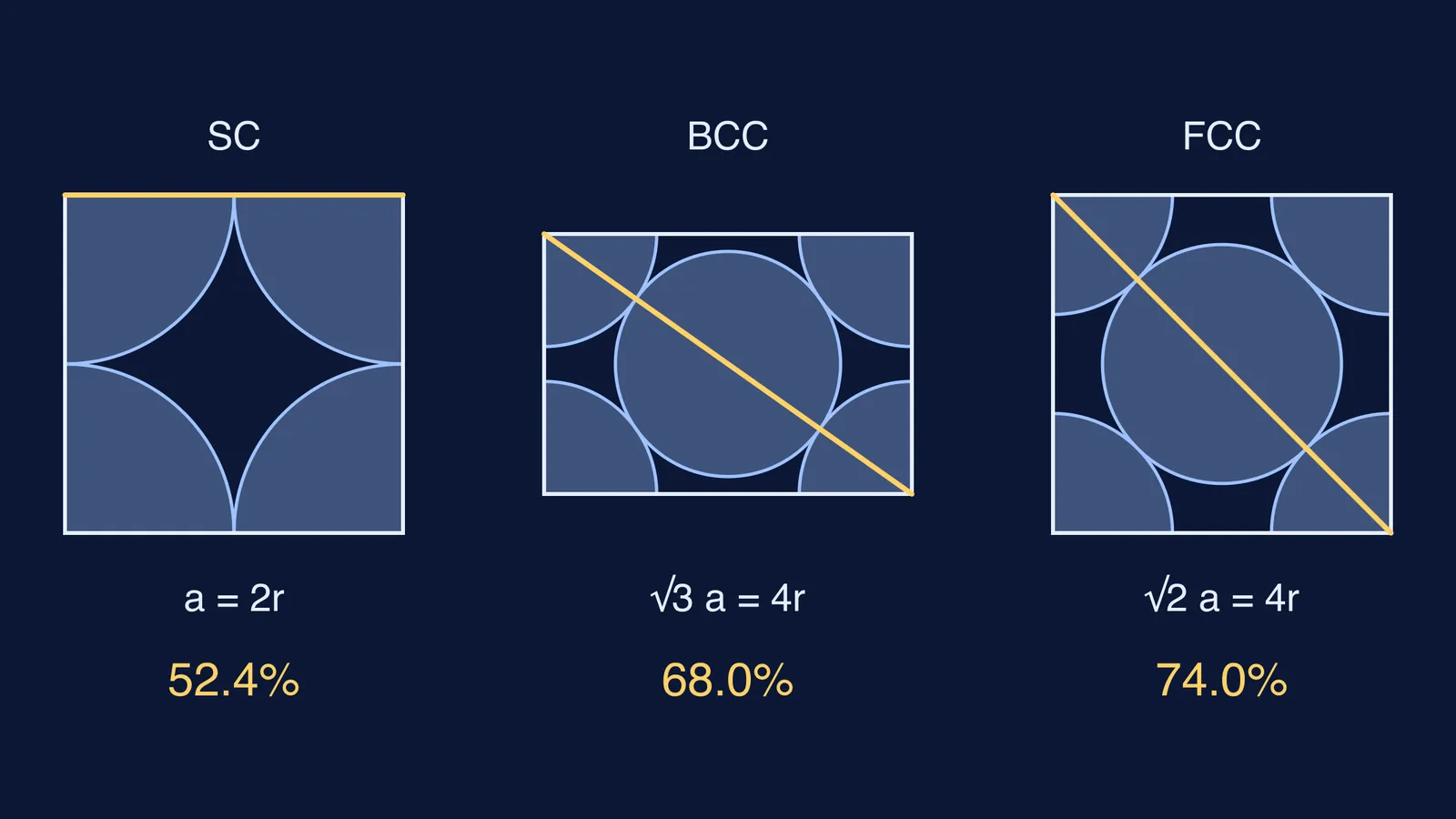
In simple cubic, atoms sit only at the 8 corners and touch along the cube edge, so a = 2r. Eight corners × 1/8 gives 1 atom per cell, the count in OpenStax Chemistry 2e.
Packing efficiency = (4/3)πr³ ÷ (2r)³ = π/6 ≈ 0.524, or 52.4%.
Almost half the box is empty, and simple cubic is rare among metals: OpenStax names polonium as the only metal with this structure and puts the filled volume at about 52%.
Why is the packing efficiency of bcc 68%?
Body-centred cubic adds one atom at the centre of the cube, giving 8 × 1/8 + 1 = 2 atoms. As OpenStax Chemistry 2e explains, the corner atoms no longer touch each other; each touches the centre atom instead. So the contact runs along the body diagonal, which is √3a long and holds one radius, one full diameter and another radius: √3a = 4r, so a = 4r/√3.
Packing efficiency = 2 × (4/3)πr³ ÷ (4r/√3)³ = √3π/8 ≈ 0.680, or 68.0%.
OpenStax gives about 68% for bcc and lists potassium, chromium, tungsten and iron at room temperature among the metals with this structure.
How do you get 74% for fcc, checked with calcium?
Face-centred cubic has atoms at the 8 corners and at the centres of the 6 faces: 8 × 1/8 + 6 × 1/2 = 4 atoms. Atoms touch along the face diagonal, as OpenStax Chemistry 2e shows; the diagonal is √2a long and holds four radii: √2a = 4r, so a = 2√2r.
Packing efficiency = 4 × (4/3)πr³ ÷ (2√2r)³ = (16/3)πr³ ÷ 16√2r³ = π/(3√2) ≈ 0.740, or 74.0%.
Example 10.15 in the same OpenStax section takes calcium, which crystallises in fcc with a unit-cell edge of 558.8 pm, and finds a radius of 197.6 pm. Carry on from there:
Radius from the edge: r = √2 × 558.8 pm ÷ 4 ≈ 197.6 pm.
Volume of one atom: (4/3)π(197.6 pm)³ ≈ 3.23 × 10⁷ pm³.
Volume of the four atoms in the cell: ≈ 1.29 × 10⁸ pm³.
Volume of the cell: (558.8 pm)³ ≈ 1.745 × 10⁸ pm³.
Packing efficiency: 1.29 ÷ 1.745 ≈ 0.74, or 74%.
The measured calcium cell lands on the same 74% as the algebra, because r cancels whatever the metal. To get the packing efficiency you need the contact direction, not the radius.
That limit is a theorem, not a rule of thumb. Johannes Kepler stated in 1611 that no packing of equal balls is denser than the face-centred cubic packing; Ferguson and Hales established it in 1998, and a computer-checked formal proof followed, as Thomas Hales and colleagues describe in Forum of Mathematics, Pi.
Which mistakes cost marks on packing efficiency questions?
The order to remember is fcc > bcc > simple cubic, that is 74% > 68% > 52%, the values in OpenStax Chemistry 2e. Most lost marks come from the steps before that:
Using a = 2r for bcc or fcc. It holds only when atoms touch along the edge, which is simple cubic.
Mixing up the diagonals: the face diagonal is √2a (fcc), the body diagonal is √3a (bcc).
Counting 9 atoms in bcc or 14 in fcc by forgetting that corner and face atoms are shared between cells.
Rounding √2, √3 or π early. Keep the symbols to the last line; π/6, √3π/8 and π/(3√2) are worth knowing as exact forms.
If you get stuck on which diagonal the atoms touch along, the Fermi Problem Library has worked problems with a step-by-step solver that explains the reasoning rather than printing an answer. To go back over unit cells and close packing as ideas, the Fermi Concept Library gives each chemistry concept its own lesson and its place in the map.
Draw the cross-section, mark where the spheres touch, and the number writes itself.