On this page
Halfway through a run, a sharp pain digs in just under your ribs. You probably did nothing wrong: it is one of the most common complaints in sport, and scientists still argue about its cause.
What is a side stitch?
Researchers call it exercise-related transient abdominal pain, or ETAP. In their 2015 review in Sports Medicine, Darren Morton and Robin Callister describe it as a localised pain, most often at the side of the mid abdomen along the lower edge of the ribs.
It feels sharp or stabbing when severe, and cramping, aching or pulling when milder. The same review notes it can come with pain at the tip of the shoulder, the place where pain from tissue supplied by the phrenic nerve is felt. The phrenic nerve also supplies the diaphragm.
It is common. About 70% of runners report a stitch in the past year, and roughly one in five people in a single running event can expect one, the review says. At the 14 km City to Surf community run in Sydney, 27% of 848 runners and walkers surveyed at the finish had a stitch during the event, and reports fell with age (Morton and colleagues, 200580006-4)).
Why do we get a stitch in the side when running?
The diaphragm. The old explanation was that the diaphragm, the dome of muscle you breathe with, runs short of blood or is tugged by the organs hanging below it. (If the diaphragm's job is hazy, our post on how the diaphragm and intercostal muscles drive breathing explains it.) Shoulder tip pain seemed to support this. But when 14 stitch-prone people did lung-function tests while a stitch was present, their breathing in was no weaker than before exercise, just as in 14 people who got no stitch. So the diaphragm does not seem directly involved (Morton and Callister, 2006).
A muscle cramp? Also unlikely. In 14 people with a stitch, electrodes over the painful spot picked up no extra muscle activity while the pain was present (Morton and Callister, 2008).
The lining of the abdomen. The parietal peritoneum is the thin membrane lining the inside of your abdominal wall. The 2015 review concludes that irritation of this lining best explains the features of a stitch, while saying more research is needed. One speculative idea: friction between this lining and the layer covering the organs, worse when a full stomach presses them together.
Some ideas are easier to see than to read; for those, the Fermi Simulation Lab has interactive simulations.
Why does running cause more stitches than cycling?
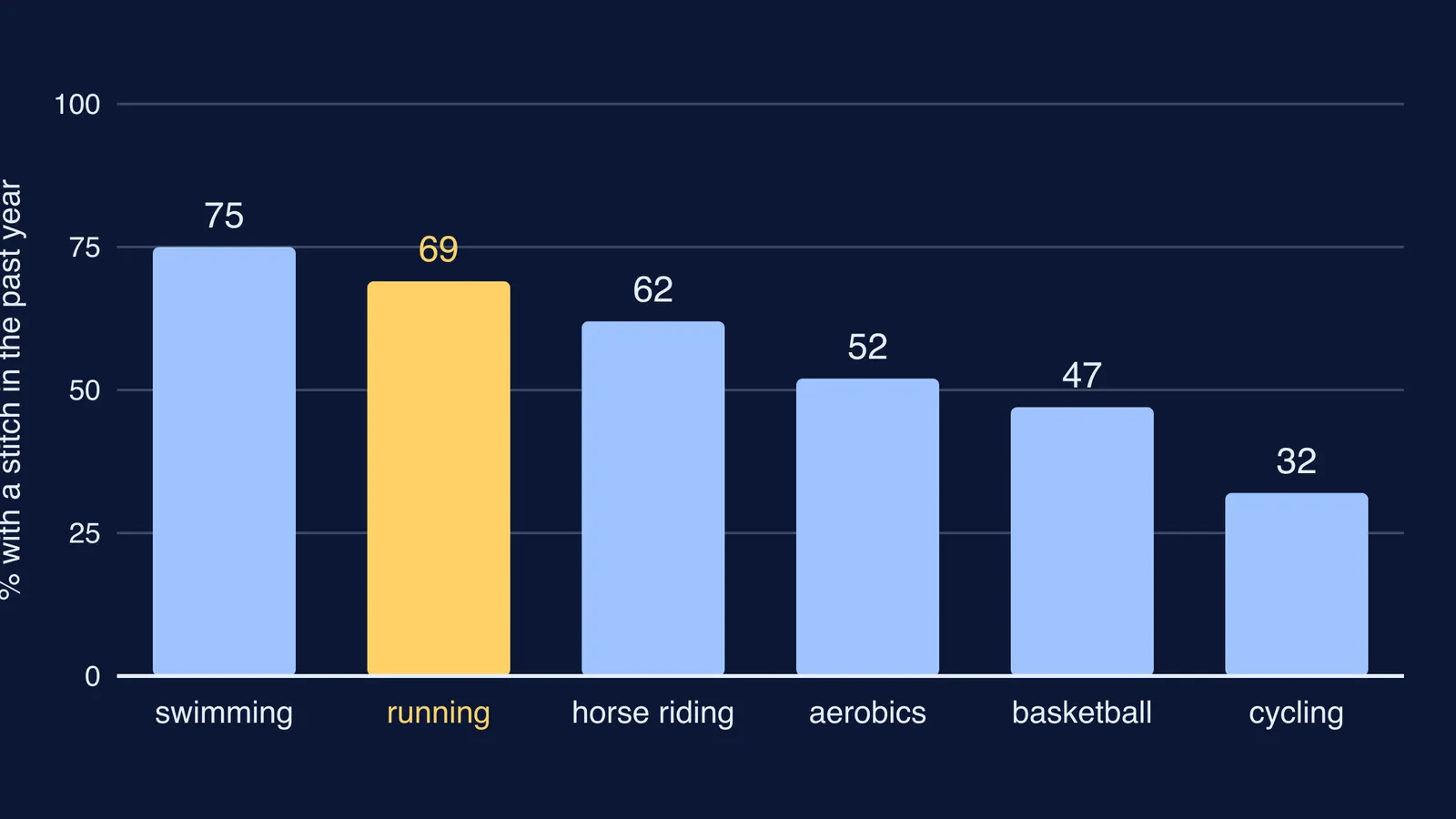
In a survey of 965 regular sportspeople across six sports, stitches in the past year were reported by 75% of swimmers, 69% of runners, 62% of horse riders and 32% of cyclists (Morton and Callister, 2000). After allowing for age and other factors, a stitch was 10.5 times more common in running than in cycling (Morton and Callister, 2002).
The authors linked the pattern to repeated movement of the torso, either up and down (as in running and riding) or twisting (as in swimming); a cyclist's torso stays fairly still on the saddle. The 2002 study also found that people who trained more often got stitches less often.
How can you prevent a side stitch?
The 2015 review says prevention advice is mostly anecdotal. These steps follow what the studies did find.
Avoid large amounts of food and drink in the 2 hours before a run, one of the prevention ideas the review lists. At the Sydney run, runners who ate a large meal 1 to 2 hours before were more likely to get a stitch.
Choose water over fruit juice just before and during exercise. In a treadmill trial with 40 stitch-prone people, reconstituted orange juice brought on more stitch pain than flavoured water, a sports drink or no drink (Morton and colleagues, 2004).
Work on your posture. In 159 young adults, those with a rounded upper back were more likely to get stitches (Morton and Callister, 2010).
Build core strength, another common prevention idea in the review, though it has not been tested directly.
Keep a two-week stitch diary of food, drinks and which side hurt, and look for your own pattern.
If one hits anyway, slow down: the review notes a stitch eases when movement is reduced, while specific relief tricks have mixed evidence. If you are fitting runs around exam prep, our plan for keeping a sport during JEE or NEET preparation helps with timing, and the post on why muscles ache the day after exercise covers a different kind of pain.
When is side pain not a stitch?
A stitch is transient: it settles once you stop. Pain that lasts after rest, comes when you are not exercising, or arrives with chest pain, breathlessness, fever or vomiting does not fit that pattern and should be checked by a doctor. In an emergency in India, call 112.
For the biology behind all of this, the Fermi Concept Library covers every concept in physics, chemistry, biology, mathematics and computing, each with its own lesson.