

On this page
Many JEE and NEET aspirants are told to drop everything else until the exam. A more useful question is how much time your sport needs, and what it gives back.
Can I continue sports or hobbies during JEE preparation?
Yes, for most students, if the sport has a fixed time budget and does not eat into sleep. The World Health Organization advises that people aged 5 to 17 do at least 60 minutes of moderate to vigorous physical activity daily, with muscle- and bone-strengthening activity at least 3 times a week.
Most teenagers fall short: the WHO physical activity fact sheet reports that, worldwide, 81% of adolescents aged 11 to 17 were physically inactive, meaning they did not meet WHO guidelines.
What about marks? A 2019 systematic review in the British Journal of Sports Medicine by Amika Singh and colleagues examined 58 physical activity intervention studies in children and teenagers. It found the evidence on overall cognitive and academic performance inconclusive, but strong evidence of a benefit for mathematics performance. Only 11 of the 58 studies were rated high quality, and they tested activity programmes for children, not exam preparation. So the review gives no sign that a budgeted sport costs you marks, but it will not raise your rank on its own.
A hobby that is not physical, such as music or sketching, does not count towards the daily activity. Give it a smaller, fixed slot, such as two or three short sessions a week.
How much time does one sport really need?
Start with sleep, because it is the block you should never trade. The American Academy of Sleep Medicine consensus says teenagers aged 13 to 18 should sleep 8 to 10 hours per 24 hours, and it links too little sleep to attention, behaviour and learning problems.
In the worked example below, sleep, school, meals and travel leave about 6 hours on a weekday. One hour of sport is a sixth of that; the other 5 hours are study.
How do you schedule study around practice?
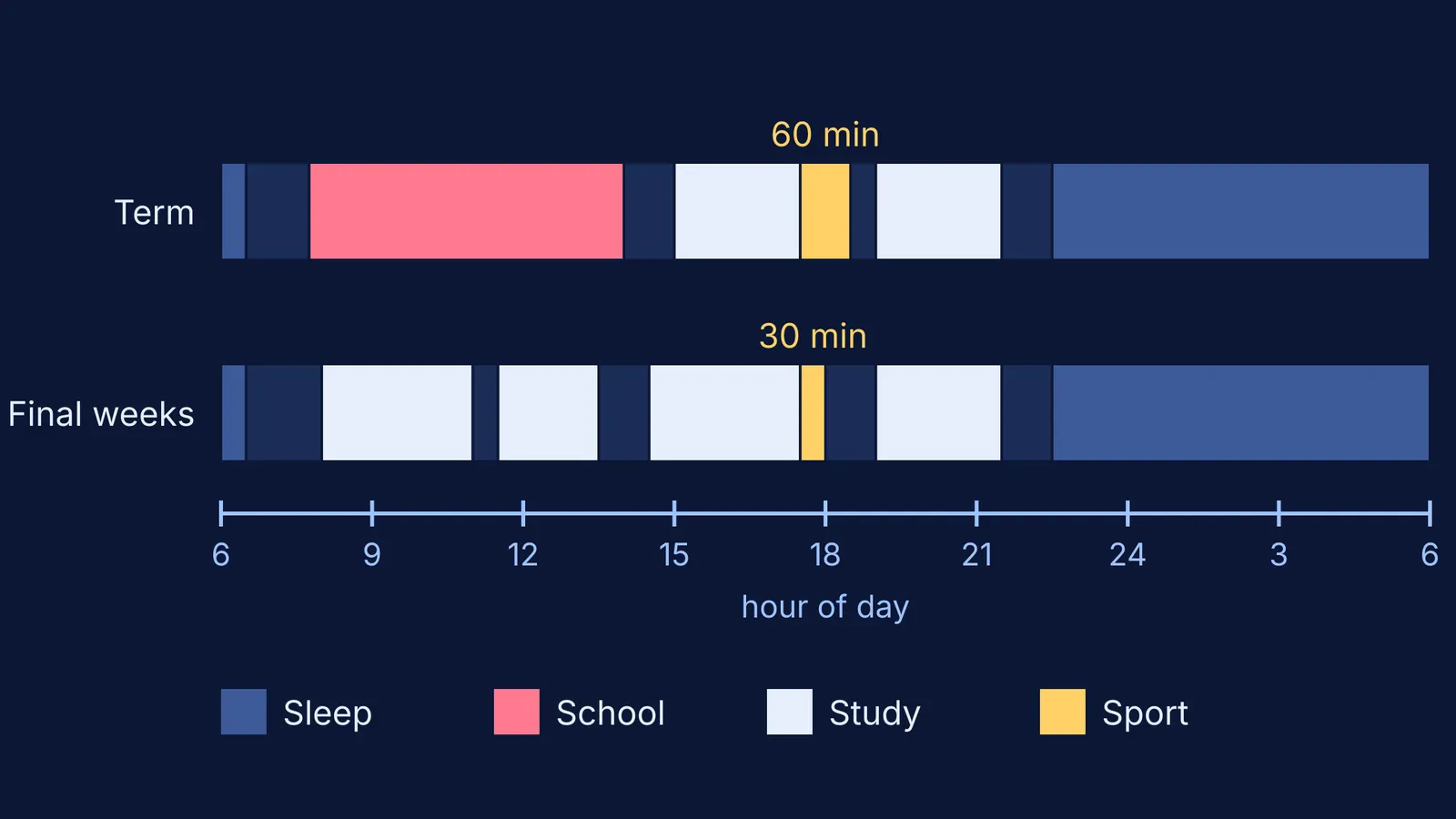
Here is a weekday for a Class 12 JEE student who plays football. It is the Term row in the diagram above.
07:45 to 14:00: school and travel.
15:00 to 17:30: first study block. Put the hardest subject here, before practice, while you are fresh.
17:30 to 18:30: football. Same time every day, so it needs no daily decision.
18:30 to 19:00: wash, snack, no phone.
19:00 to 21:30: second study block. Start with revision or problem types you already know, and keep new theory for the afternoon.
22:30: lights out, for the 8 hours of sleep the AASM consensus puts at the low end of the range for teenagers.
That gives 5 hours of self-study on a school day. Move matches and tournaments to weekends, and keep slack in the week for them; our guide to how much buffer time to keep in your study timetable shows how.
If the slot after practice is short, Fermi's AI tutor can work out what you already know and build a plan for the session, so 45 tired minutes still start with a clear next step.
When should you scale it down?
Cut back because of evidence, not guilt. Every two weeks, check these against the AASM sleep range and your mock results:
Sleep: training pushes you under 8 hours on most nights. Fix this first, by moving or shortening practice.
Mocks: your scores have fallen in three mocks in a row and the sport is the only thing that changed. Halve the sessions for a month, then check again.
Exhaustion or injury: you are too tired to study after practice on most days. Ask your coach for a lighter load.
Final weeks: in the last 6 to 8 weeks before the exam, shrink to about 30 minutes a day of a walk, a jog or light drills. That is the Final weeks row in the diagram. It is below the WHO's 60 minutes, so treat it as short and temporary.
If none of these applies, keep playing. For many students the daily game is the part of the day they look forward to, which matters over a long preparation; see how to stay motivated through two years of JEE preparation.
What can parents say instead of "stop playing"?
If the hour on the field worries you, agree on rules rather than arguing about the sport itself. A script you can adapt:
"You can keep football. Your side of the deal is a full night's sleep and both study blocks done. Every second Sunday we look at your sleep and your mock scores together. If both hold, nothing changes. If they slip, we cut practice down, and we decide how together."
Our post on whether a child should stop hobbies in Class 10 covers the same decision before boards.
If stress, low mood or poor sleep lasts for weeks, talk to a doctor or counsellor, or call Tele MANAS on 14416, a free, 24x7 national mental-health helpline.


