

On this page
Every student preparing for JEE, NEET, or board examinations has built the ideal timetable at least once. It usually features neat blocks from early morning to late night, moving from physics to chemistry and mathematics. Yet by Tuesday evening, a difficult calculus problem set runs longer than expected. The physics block gets delayed, dinner gets pushed back, and fatigue sets in. By Thursday, the backlog feels insurmountable, and the timetable is abandoned.
Study plans do not fail because students lack willpower. They collapse because schedules without elasticity violate basic cognitive and mathematical laws. To keep a timetable functioning across an entire term, you must design it with deliberate slack.
Why do rigid study timetables always collapse?
When we plan our weeks, our brains fall prey to the planning fallacy. In a landmark paper on task completion, Buehler, Griffin, and Ross (1994) observed that only 29.7% of students completed their academic projects within their predicted time frame. Students predicted an average completion time of 33.9 days, but actual completion averaged 55.5 days—almost 64% longer than planned. Even when asked for an absolute worst-case scenario, only 48.7% finished by that pessimistic date.
This optimistic bias is magnified by our perception of the future. Research on resource slack by Zauberman and Lynch (2005) demonstrated that people systematically assume they will have more spare time in upcoming weeks than today. We imagine next week will be free of sudden school tests and fatigue, leading us to book every hour to 100% capacity.
When friction hits an over-scheduled plan, the psychological response is abrupt. As researchers Herman and Polivy (1975) identified in self-regulation studies, falling short of a rigid goal often triggers the "what-the-hell effect." Instead of treating a minor delay as an ordinary variance, a student perceives the entire schedule as ruined and gives up entirely. Overcoming this trap is essential if you want to build a study routine that lasts.
What does queuing theory teach us about study slack?
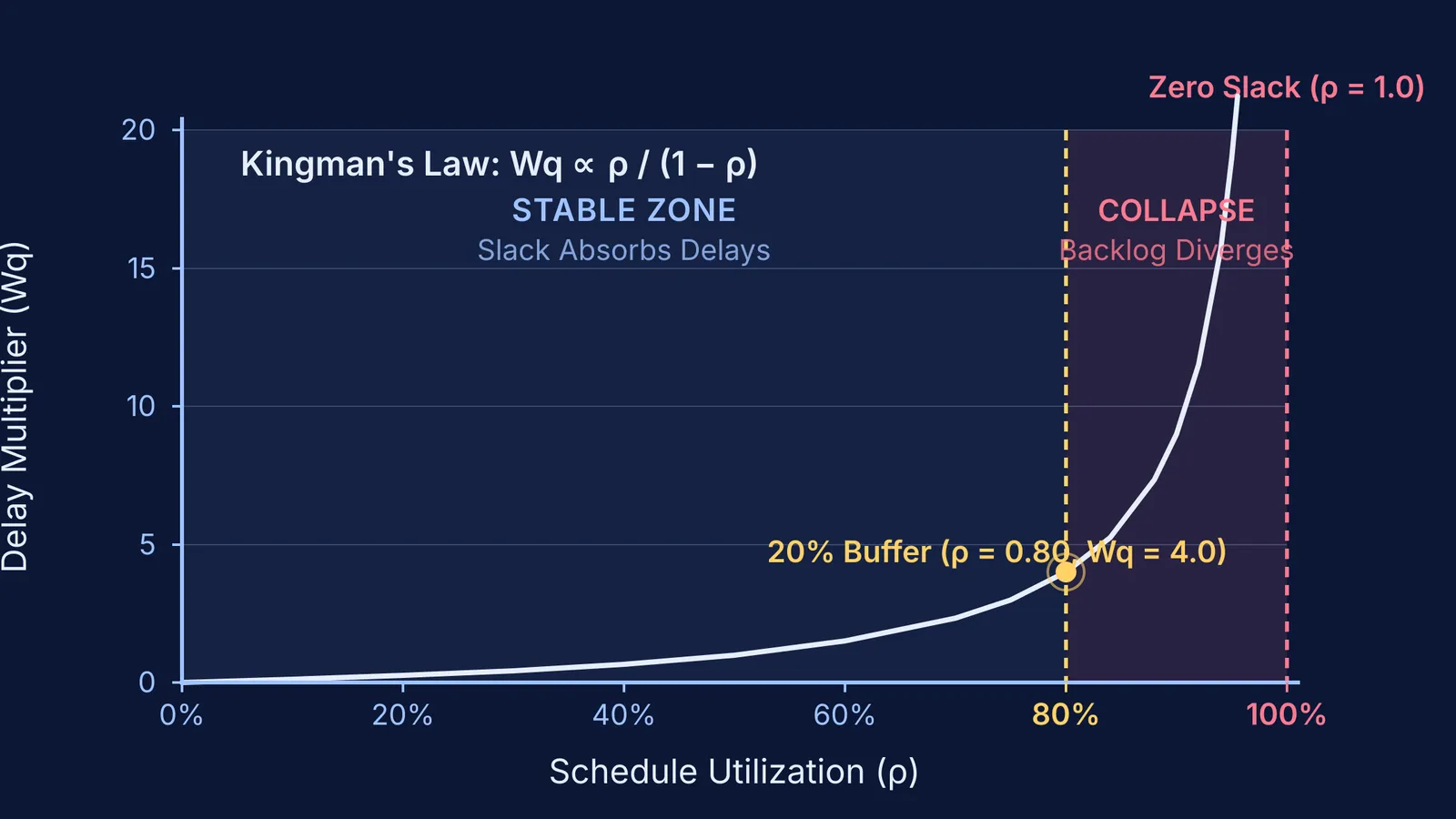
The fragility of a packed schedule is also a mathematical certainty. In operations research, Kingman's heavy-traffic formula (1961) shows that average waiting time in any queuing system scales with the term ρ / (1 − ρ), where ρ represents capacity utilization.
When schedule utilization ρ sits at 0.80—keeping 20% of your time free—the delay multiplier is manageable at 4.0. But as you push utilization toward 0.95 (keeping only 5% slack), the multiplier surges to 19.0. At 1.0 (100% scheduled capacity), mathematical delay diverges toward infinity. When every minute is booked, a modest overrun has nowhere to go; it cascades through every downstream block.
When friction spikes on difficult problems, having targeted tools prevents an afternoon from derailing. The Fermi Problem Library provides worked problems with a step-by-step solver that explains the reasoning rather than printing an answer.
How much buffer time should you keep in your timetable?
To balance progress with resilience, keep roughly a fifth of your study time free—the 20% buffer rule derived from Kingman's queueing formula. For every four hours of planned study, leave one hour unassigned to new topics.
For a student targeting 25 hours of independent study each week outside school and coaching:
Dedicate 20 hours to core subject blocks (such as mechanics numericals, organic mechanisms, and coordinate geometry).
Keep 5 hours as deliberate buffer time.
Split these buffer hours across two layers:
Micro-buffers: Insert open gaps between study sessions. Ending a study block early lets your brain reset, absorbs small delays, and prevents cognitive fatigue.
Macro-buffer: Consolidate the remaining buffer time into a single weekly block.
How do you structure a weekly catch-up slot?
A weekly catch-up slot is an intentional block—typically on a weekend—with zero new syllabus goals. It acts as a pressure relief valve for the entire week.
Operate this slot using these rules:
Absorb overruns first: If an electrostatics assignment took a couple of extra hours on Wednesday, finish it here without disturbing your weekday rhythm.
Clear older bottlenecks: If all weekday tasks finished on schedule, use this time to review tricky topics. If backlog has accumulated over weeks, use an objective triage system to clear a chapter backlog before it disrupts current lessons.
Treat surplus time as earned recovery: If your week went smoothly, never pull next week's chapters forward. Close your books and rest guilt-free. Knowing that efficiency earns real free time creates sustainable motivation.
During your catch-up slot, you do not need to guess where to focus. Fermi's AI tutor can work out what you already know and build a plan for the session, so you sit down to a clear next step instead of feeling lost.


