On this page
A fridge or AC compressor is driven by an electric motor that pumps refrigerant around a loop. When mains voltage moves too far from what that motor was built for, the motor pays in heat. Here is how voltage, current and power connect, and what a stabiliser does.
Why does low voltage overheat a compressor motor?
Start with P = VI. A compressor has to move roughly the same heat whatever the voltage, so it needs roughly the same power. A US Department of Energy motor tip sheet explains that at reduced voltage a motor needs more total current to deliver the same real power, and that higher current brings more I²R loss in the windings, lower efficiency and possible overheating.
Heat in a conductor grows with the square of the current, so a small rise in current becomes a bigger rise in heat. It is the same reason a loose wire connection gets hot.
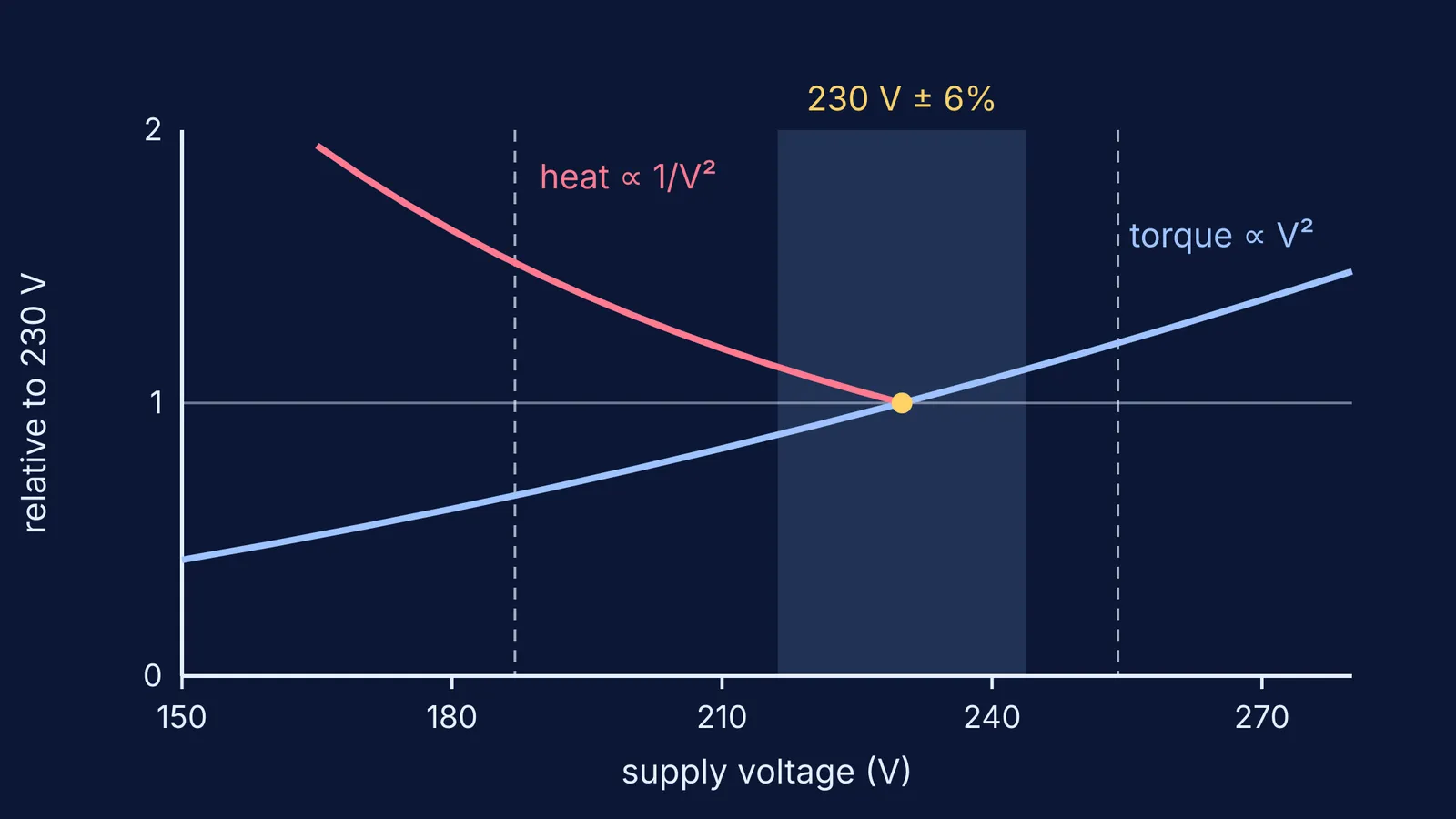
Motors are designed to work within ±10% of their nameplate voltage, according to the same DOE tip sheet. Low voltage also weakens the start, because torque falls with the square of the voltage ratio. The sheet's table for general-purpose induction motors, taken from IEEE Standard 141-1993, shows that at 90% of nameplate voltage, starting torque falls by 19% and full-load current rises by 5% to 10%. While starting, a motor draws four to eight times its full-load current, the sheet notes, and low voltage makes the start slower, so that large current flows for longer.
What does a voltage surge do to a fridge or AC?
Writing in ACHR News, Fluke's Duane Smith explains that line voltage that is too high causes excessive inrush current at motor start, leading to premature failure. The DOE table puts the rise in starting current at about 10% at 110% of nameplate voltage, although full-load current falls slightly at that level. Fluke's guide to motor efficiency adds that at significant over-voltage a motor draws more current, and the result is overheating.
How much can mains voltage in India vary?
Indian state supply codes, such as the Punjab Supply Code 2024, declare household single-phase supply at 230 V. Madhya Pradesh's Electricity Supply Code 2021 also bars the distribution company from letting low-voltage supply vary from 230 V by more than 6% either way. That is roughly 216 V to 244 V at your point of supply.
Compressors usually have some margin beyond that. The data sheet for one Secop compressor rated 220-240 V at 50 Hz lists a voltage range of 187-254 V. Problems are more likely when your supply leaves your appliance's range, for example at the far end of a heavily loaded line, where the voltage drop along a long wire adds up.
A household stabiliser measures the incoming voltage, raises or lowers it towards the normal level, and cuts off when the input is beyond what it can correct. One AC stabiliser sold in India, the V-Guard V 400 Supreme, lists a working range of 170-280 V, high and low voltage cut-off, and a start-up time delay meant to reduce stress on the compressor.
Worked example: what happens to a compressor at 180 V?
Assume the compressor needs the same electrical power at any voltage, and compare 180 V with 230 V.
Current scales as 1/V: 230 ÷ 180 ≈ 1.28, so about 28% more current.
Winding heat scales as I²: 1.28² ≈ 1.63, so about 63% more heat in the copper.
Starting torque scales as V²: (180 ÷ 230)² ≈ 0.61, so about 39% less torque to start with.
Now test the model against the DOE table at 90% voltage (207 V). Torque: 0.9² = 0.81, a 19% drop, which matches. Current: 1 ÷ 0.9 ≈ 1.11, an 11% rise, slightly above the table's 5% to 10%, partly because power factor improves at low voltage. So the model is a fair, slightly pessimistic guide near 90%, and a rougher one at 180 V, which is beyond the table.
If the step from P = VI to I²R heating feels abstract, the Fermi Simulation Lab has interactive simulations for the ideas that are easier to see than to read.
Do you need a stabiliser for your fridge or AC?
Find the operating voltage range in your appliance's manual or on its rating label.
If lights dim sharply when the compressor starts, or evenings are often low-voltage, ask an electrician to measure the voltage at your socket.
If your supply often falls outside the appliance's range, choose a stabiliser rated for that appliance whose working range covers your lowest readings.
If the appliance's range already covers your supply, a stabiliser adds little.
If low voltage persists, complain to your distribution company; your state's supply code sets the limits it must keep.
For practice, work out how many bulbs you can connect before a fuse blows, then redo the 180 V example for 200 V. If you get stuck, the Fermi Problem Library has worked problems with a step-by-step solver that explains the reasoning rather than printing an answer.