On this page
On a dark night far from city lights, a pale, grainy strip stretches across the sky. That strip is our own galaxy, seen edge-on from the inside, and a little geometry shows why.
Why does the Milky Way look like a band across the sky?
NASA's Imagine the Universe puts it in one line: the band comes from seeing the disc of stars that forms the Milky Way from inside the disc. The same NASA page gives the galaxy's diameter as about 100,000 light-years.
The disc is very flat. ESA's Gaia mission describes a thin disc some 700 light-years high, sitting inside a thicker disc of older stars about 3,000 light-years high, with the Sun about halfway between the centre and the edge.
Divide 100,000 by 700 and you get roughly 140. Shrink the galaxy to 1.4 metres across and its thin disc of stars is about 1 centimetre thick. We live inside that centimetre.
How many more stars do you see along the disc?
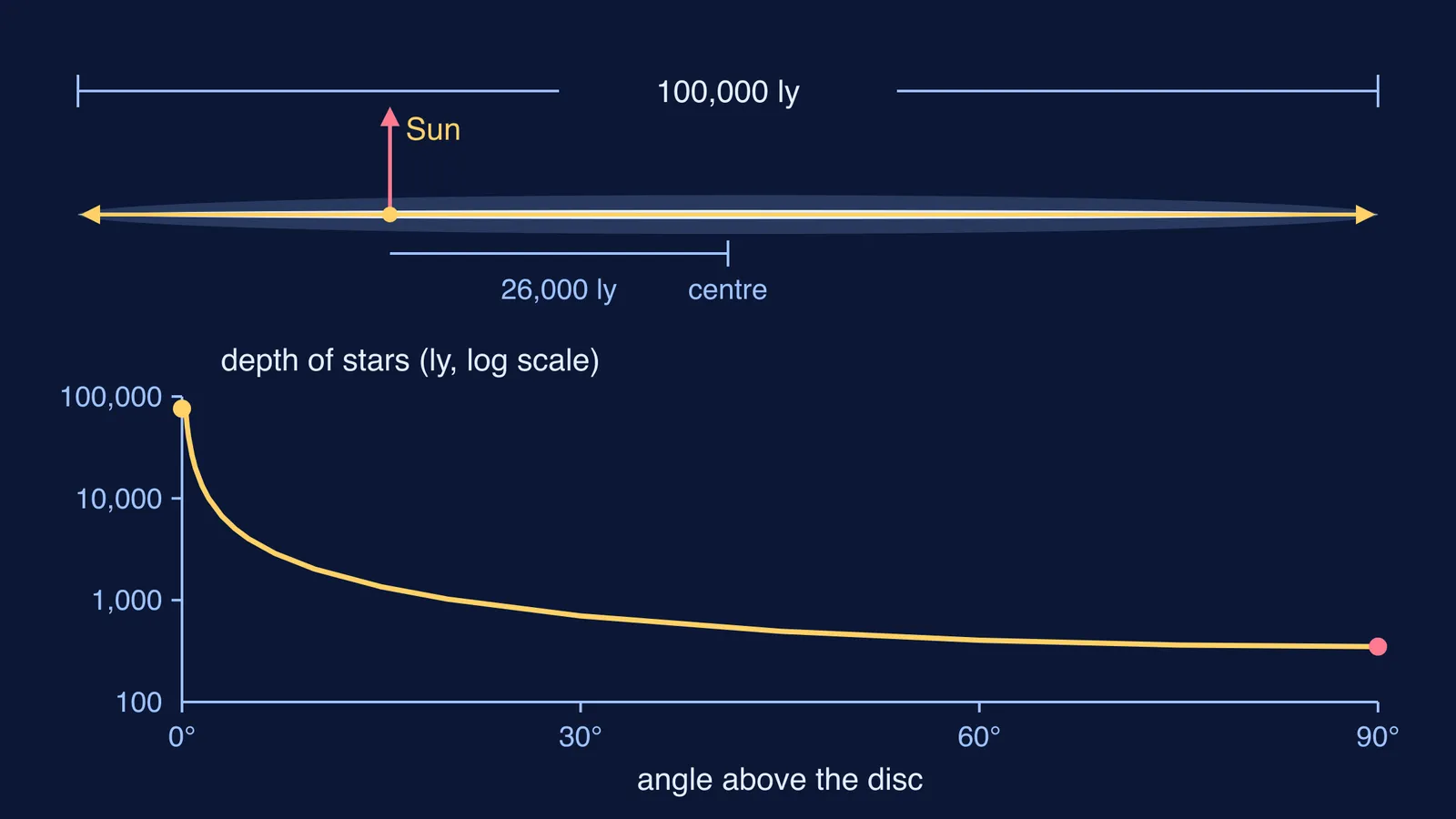
Here is a worked example you can do with a calculator. It uses ESA's Gaia figures for the disc's width and the thin disc's height, and the distance to the galactic centre from ESO, which places the centre in the constellation Sagittarius, about 26,000 light-years away. Treat the disc as an even slab with us near its middle.
Look straight up out of the disc. You leave the thin disc after about half its height: 700 / 2 = 350 light-years of stars.
Look 10 degrees above the disc. The path through the slab is 350 / sin 10° = 350 / 0.174, about 2,000 light-years.
Look along the disc towards the centre. You pass 26,000 light-years to the centre and about 50,000 more to the far edge (half of the 100,000-light-year diameter): about 76,000 light-years.
Compare: 76,000 / 350 is about 217. Along the disc you are looking through more than 200 times as much galaxy as you are when you look straight up.
This is geometry, not what your eye receives: dust mixed into the disc hides much of the distant galaxy in visible light. But the shape of the glow follows the geometry. The depth falls fast as you tilt away from the disc, which is why the glow is a narrow strip and not a wide patch. The strip also wraps all the way round the sky, because the disc surrounds us on every side within its plane.
The hero diagram above plots this same calculation for every angle from 0 to 90 degrees. If you want to see why the curve is steep near zero, the Fermi Concept Library covers the trigonometry and the geometry behind it, concept by concept.
Who discovered that the Milky Way is made of stars?
For most of history the band was simply a glow. Galileo turned an early telescope on it and reported in his Sidereal Messenger of 1610 that, in Edward Stafford Carlos's 1880 translation, "the Galaxy is nothing else but a mass of innumerable stars planted together in clusters."
Working out the disc's shape and our place in it took three more centuries. Jacobus Kapteyn counted stars in different directions to map the Milky Way, and Harlow Shapley later used star clusters to show the Sun is not at the centre of the galaxy.
How does the band connect to other galaxies and the scale of the universe?
Once you know you live in a disc, other galaxies make more sense. NASA's Hubble page on Messier 31 calls the Andromeda Galaxy the nearest major galaxy to the Milky Way, at 2.5 million light-years, and a stand-in for spiral galaxies in general. That distance is 25 times the width of our own galaxy.
NASA's galaxies overview adds that the Milky Way sits in a neighbourhood with over 50 other galaxies called the Local Group, and that our solar system takes about 240 million years to orbit the galaxy once.
The jump from a disc you are inside to galaxies you see from outside is hard to picture from text alone. The Fermi Simulation Lab has interactive simulations for ideas that are easier to see than read.
How can you see the Milky Way band yourself?
City light washes it out, as our explainer on why city skies show so few stars describes. A simple plan:
Go somewhere dark, away from streetlights and towns.
Pick a night without a bright Moon.
Put your phone away and give your eyes time to adjust to the dark.
Look for a faint, uneven strip crossing the whole sky, and find where it is brightest: that is towards Sagittarius and the galactic centre.
Test the worked example: compare how crowded the sky looks inside the strip and well away from it.
The next time you see that pale strip, you are looking sideways through your own galaxy.