

On this page
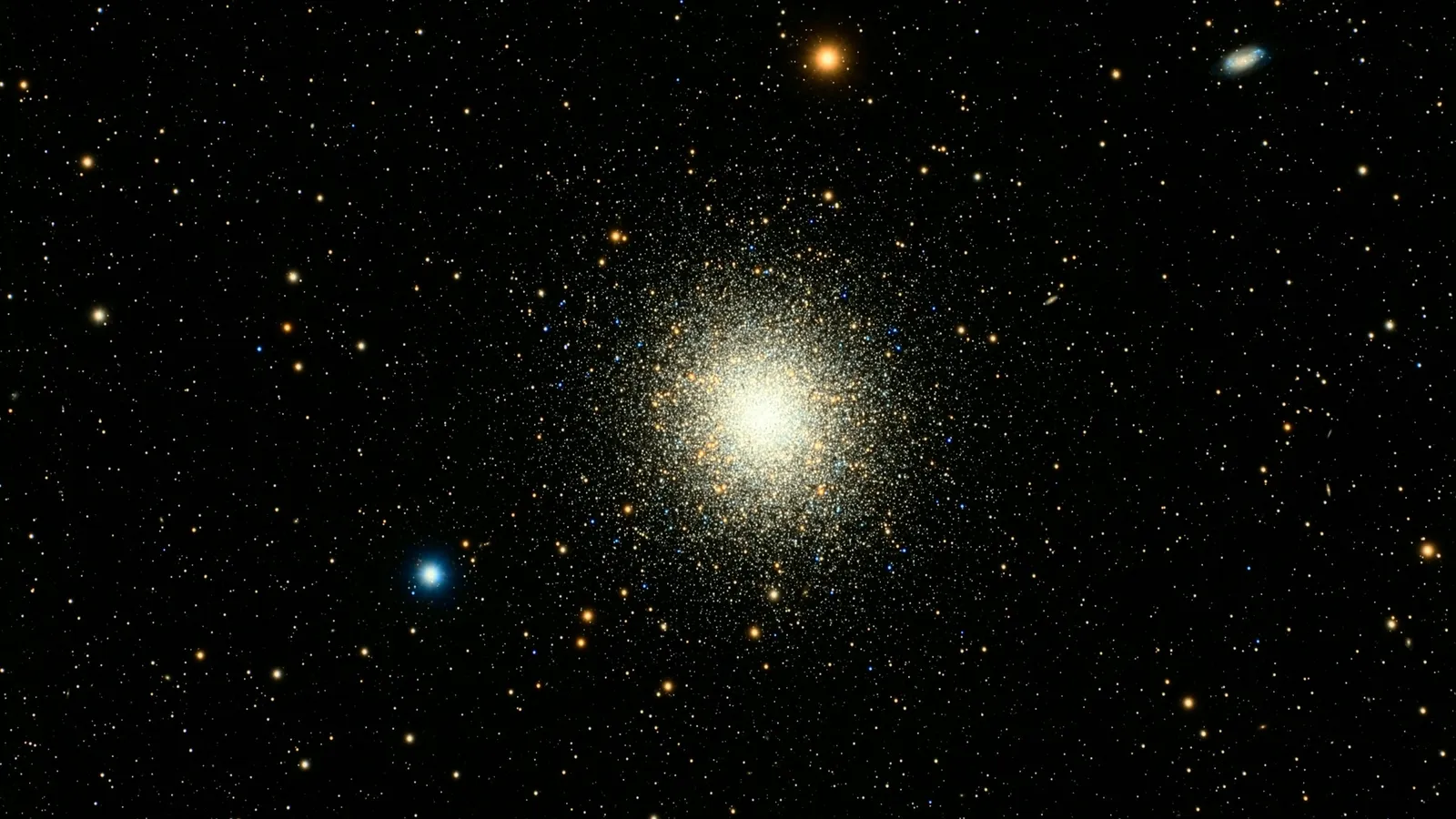
For centuries astronomers assumed the Sun sat near the middle of the Milky Way, because the stars seem spread fairly evenly around us. Harlow Shapley showed in 1918 that this was wrong: we live far out in the disc. He did it by measuring distances to faint balls of stars called globular clusters. This post explains his method, works through the inverse-square reasoning behind it, and shows why his distance was about twice too big.
Who was Harlow Shapley?
The National Academy of Sciences biographical memoir by Bart Bok gives his dates as 2 November 1885 to 20 October 1972. He was born on a farm near Nashville, Missouri, and worked as a crime reporter as a teenager. He went to the University of Missouri in 1907 to study journalism, found that the journalism school did not yet exist, and picked astronomy almost by accident.
He then studied at Princeton with Henry Norris Russell and in 1914 joined Mount Wilson Observatory in California. From 1921 to 1952 he directed Harvard College Observatory. Bok adds that he studied ants as a hobby and published papers on them, including how their running speed depends on temperature.
Why did Shapley study globular clusters?
Before starting at Mount Wilson, Shapley visited Harvard, where Solon Bailey advised him to study variable stars in globular clusters with Mount Wilson's 60-inch reflector. He took the advice, and much of the observing and measuring that followed was shared with his wife, Martha Shapley.
The key stars were RR Lyrae variables, which pulsate with periods mostly between half a day and one day. Bok explains that, through the work of Ejnar Hertzsprung and Henrietta Leavitt, it had become clear that such stars have about the same average true brightness. That made them standard candles: if every one gives out the same light, how bright it looks tells you how far away it is.
What did he find?
Shapley found the globular clusters spread through a huge, roughly spherical system, with the Sun far from its middle. Bok calls his next step courageous: he took the centre of the cluster system to be the centre of the Milky Way. His 1918 papers included one on the distances of 69 globular clusters; in the most important, "Remarks on the Arrangement of the Sidereal Universe", he put the Sun 17,000 parsecs from that centre. As Bok writes, "Shapley did for the Milky Way system what Copernicus had done for the solar system."
The modern distance, measured from a star orbiting the black hole at the centre, is 8,178 parsecs. Shapley was too high by about a factor of two, as Bok says, because nobody yet knew that dust between the stars absorbs light.
Worked example: standard candles and the inverse-square law
Brightness falls with distance as 1/d². For two stars with the same true luminosity:
d₂ / d₁ = √(b₁ / b₂)
where b is how bright each star looks.
Same stars, different clusters. An RR Lyrae star in cluster A looks 100 times fainter than an identical one in cluster B. Then A is √100 = 10 times farther away.
Shapley's distance in light years. 17,000 pc × 3.26 = 55,400 light years. The modern 8,178 pc is 8,178 × 3.26 = 26,700 light years.
How much dimming explains his error? He overestimated by 17,000 / 8,178 = 2.08. If dust makes a star look dimmer by a factor f, you overestimate its distance by √f. So √f = 2.08 gives f = 2.08² = 4.3.
So if dust in the direction of the centre lets through only about a quarter of the light, an astronomer who ignores it doubles every distance. This is a simplified picture, since real dust varies with direction, but it shows how a hidden effect can spoil a careful measurement.
What was the Great Debate?
On 26 April 1920, at the National Academy of Sciences in Washington, Shapley and Heber Curtis gave paired lectures now called the "Great Debate". Bok explains that it had two parts. On the size of the Milky Way and its cluster distances, Shapley came out the winner. On the spiral nebulae, Shapley saw them as minor satellites of the Milky Way; Curtis argued they were separate galaxies, and Curtis was right, as Edwin Hubble later showed using the same kind of standard candle.
Which mistakes does this help you avoid?
Forgetting the square root. 100 times fainter means 10 times farther, not 100.
Mixing parsecs and light years. One parsec is 3.26 light years. Convert once, at the end.
Trusting a result without its assumptions. List what must be true for your method to work.
The JEE (Main) 2026 syllabus does not include galactic astronomy, but ratio reasoning with inverse-square laws appears across gravitation, electrostatics and optics. Check the syllabus for your exam year.
If you are not sure where to begin with a chapter that keeps using these ratio arguments, Fermi's AI tutor can work out what you already know and build a plan for the session, so you sit down to a clear next step.
What can a student take from Shapley's way of working?
Take good advice. One conversation with Bailey set the direction of his career.
Draw the big conclusion your data supports. He moved the Sun off-centre when others hesitated.
Expect to be partly wrong. He won one half of the Great Debate and lost the other, and his work still laid the foundation for Hubble's.
Next step: Jan Oort used Shapley's picture to show the galaxy rotates; read our post on Jan Oort and the cloud of comets next.


