On this page
A little over a hundred years ago, it was not settled that anything existed beyond the Milky Way. As Carnegie Science puts it, Edwin Hubble proved "that the universe was bigger than just our galaxy". He then showed that the Milky Way is one galaxy among many, and that the others are moving away from us faster the farther off they are. This post explains how he did it, works through the arithmetic of his law, flags the mistakes students make with it, and ends with what you can learn from the way he worked.
Who was Edwin Hubble?
The National Academy of Sciences biographical memoir by N. U. Mayall gives his dates as 20 November 1889 to 28 September 1953 and says he was born in Marshfield, Missouri. He took a B.S. at the University of Chicago in 1910, then studied law at Queen's College, Oxford, as a Rhodes Scholar. After returning to the United States he passed the bar examination in 1913 and practised law, half-heartedly, for a year. The memoir reports that he said he "chucked the law for astronomy, and I knew that even if I were second-rate or third-rate, it was astronomy that mattered." He returned to Chicago in 1914 for his doctorate and later worked at Mount Wilson Observatory with its 100-inch telescope.
How did Hubble show other galaxies exist?
The key was a type of star whose brightness changes on a regular cycle, called a Cepheid variable. Henrietta Leavitt had shown that a Cepheid's period reveals how bright it really is, as our post on Henrietta Leavitt and the period-luminosity relation explains. Compare that true brightness with how bright it looks, and you get its distance.
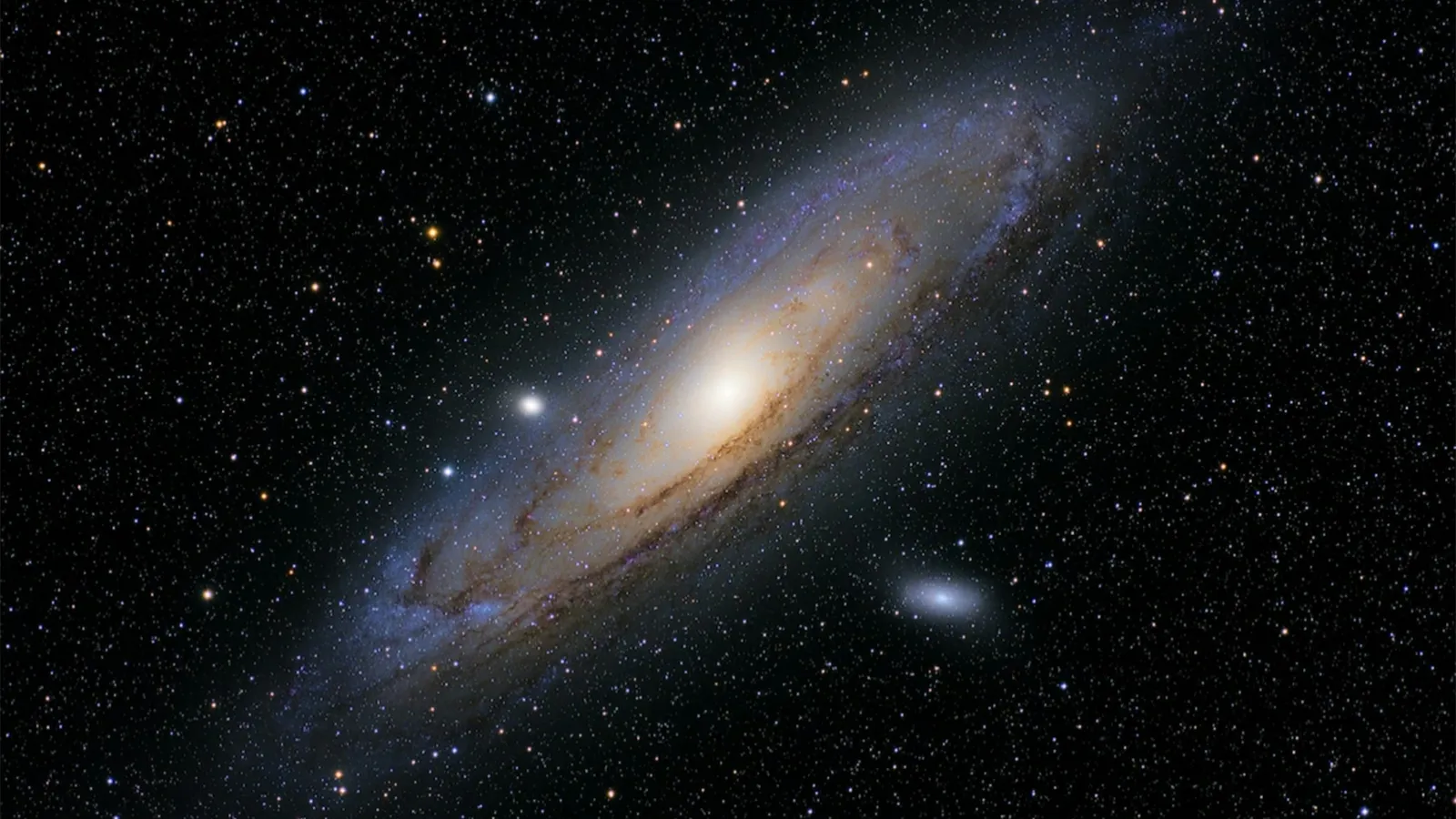
According to the Carnegie Science archive, on the night of 5 to 6 October 1923 Hubble photographed the Andromeda nebula (M31) with the 100-inch Hooker telescope. He first marked one star "N" for nova, then crossed it out and wrote "VAR!" when he realised it was a Cepheid. Carnegie says this plate "established beyond any doubt that M31 was a separate galaxy from our own". The NAS memoir adds that in his 1925 paper on NGC 6822 he identified eleven Cepheids and found a distance of 214,000 parsecs, and that his 1929 paper on M31 identified forty Cepheids.
What did the 1929 paper show?
His short paper A relation between distance and radial velocity among extra-galactic nebulae appeared in the Proceedings of the National Academy of Sciences in March 1929. The NAS memoir explains the method: Hubble combined his own distances with recession velocities measured from spectra by V. M. Slipher and by his colleague Milton Humason. The result was a "straight line relationship": the farther the galaxy, the faster it recedes.
Robert Kirshner's 2004 review in PNAS, Hubble's diagram and cosmic expansion, notes that Hubble quoted values of 530 and 500 km/s per megaparsec for the constant, and that modern Cepheid work with the Hubble Space Telescope gives 72 plus or minus 2 plus or minus 7 km/s per megaparsec.
The IAU press release of 29 October 2018 reports that 78 percent of the members who voted supported the change.
Worked example: using v = H0 x d
Take H0 = 72 km/s per megaparsec (Mpc), as in Kirshner's review.
1. Recession speed. A galaxy is 100 Mpc away. v = 72 x 100 = 7,200 km/s.
2. Redshift. For speeds much less than light, z is about v/c = 7,200 / 300,000 = 0.024. A hydrogen line emitted at 656.3 nm is shifted by 656.3 x 0.024 = 15.8 nm, so it arrives near 672.1 nm, towards the red.
3. The expansion age. If the expansion had always run at today's rate, the time since everything was together is 1/H0.
1 Mpc = 3.086 x 10^19 km.
1/H0 = 3.086 x 10^19 / 72 = 4.29 x 10^17 s.
Divide by 3.156 x 10^7 s per year: about 1.36 x 10^10 years, or roughly 14 billion years, the figure Kirshner gives.
With Hubble's own 500, the same arithmetic gives 6.17 x 10^16 s, or only about 2 billion years.
Common mistakes
Forgetting to convert Mpc into km before inverting H0. The units must cancel to leave seconds.
Using v = cz for very distant galaxies. It works only when z is small.
Thinking galaxies fly away from us as a centre. Every observer in a uniformly expanding universe sees the same law.
The Doppler idea behind redshift is the same one you meet with sound; see our guide to the Doppler effect. If expansion "with no centre" is hard to picture, the Fermi Simulation Lab has interactive simulations for ideas easier to see than read.
What can a student learn from how Hubble worked?
Build on someone else's tool. Hubble's distances rested on Leavitt's relation; his velocities on Slipher's and Humason's spectra.
Treat numbers as provisional. His relation survived, but his constant was off by a large factor. A correct pattern can sit on imperfect measurements.
It is not too late to switch. He trained in law before choosing astronomy.
Practice routine: compute v, z and the shifted hydrogen line for galaxies at 20, 50 and 200 Mpc, then work out 1/H0 for H0 = 67 and H0 = 74.
Next step: look up the Andromeda galaxy's distance today and compare it with what Hubble's 1920s measurements implied.