On this page
Chapter 8 of the Class 7 science book is the first place most students meet real calculations in science: time periods, speeds and unit conversions. The ideas are simple, but the sums are where marks go missing, usually through units. This guide explains what the chapter covers, works through the key calculations step by step, and shows the traps to avoid.
What does Chapter 8 of Class 7 Curiosity cover?
Measurement of Time and Motion is Chapter 8 of NCERT's *Curiosity* for Grade 7 (first edition April 2025, reprint 2026-27). It covers:
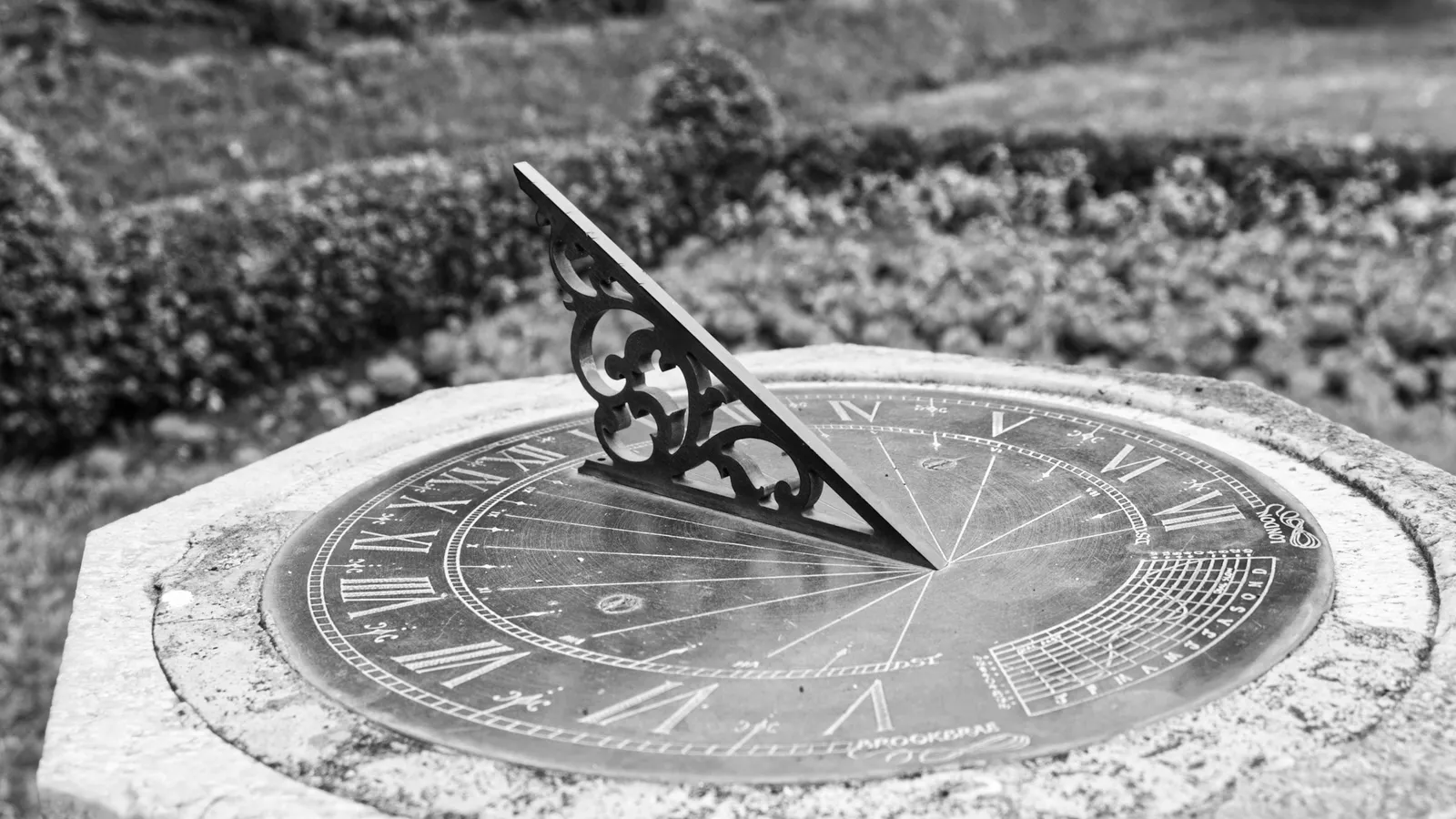
Old ways of measuring time: sundials, water clocks, hourglasses and candle clocks, including India's Ghatika-yantra, a sinking bowl that took 24 minutes to fill and sink.
The simple pendulum: oscillation, time period, and what it does and does not depend on.
Units of time: the second (s) is the SI unit; 60 s = 1 min and 60 min = 1 h.
Speed: total distance divided by total time, in m/s or km/h.
Uniform and non-uniform linear motion.
The chapter also gives a writing rule worth copying: write "s", "min" and "h", never "sec" or "hrs", and leave a space between the number and the unit.
How do you measure a pendulum's time period?
One oscillation is a full swing: from one extreme position to the other and back again. The time period is the time for one oscillation. A single swing is too quick to time accurately by hand, so the chapter has you time 10 oscillations and divide by 10.
Worked example. A 100 cm pendulum is timed three times for 10 oscillations: 20.2 s, 19.8 s and 20.1 s.
Time periods: 20.2 ÷ 10 = 2.02 s, 19.8 ÷ 10 = 1.98 s, 20.1 ÷ 10 = 2.01 s.
Average of the three timings: (20.2 + 19.8 + 20.1) ÷ 3 = 60.1 ÷ 3 ≈ 20.03 s.
Average time period: 20.03 ÷ 10 ≈ 2.00 s.
The readings are nearly the same, which is the chapter's point: a pendulum of a given length has a nearly constant time period at a place. Change the length and the period changes. Change the mass of the bob and it does not.
How do you calculate speed and convert units?
Speed = total distance ÷ total time. Rearranged, distance = speed × time and time = distance ÷ speed.
Example 1, from the chapter. Swati rides 3.6 km to school in 15 min. Speed in m/s?
Convert: 3.6 km = 3,600 m and 15 min = 15 × 60 = 900 s.
Speed = 3,600 ÷ 900 = 4 m/s.
Example 2: the same speed in km/h. 15 min is 0.25 h, so speed = 3.6 ÷ 0.25 = 14.4 km/h. A useful check: 1 m/s means 3,600 m in an hour, which is 3.6 km/h. So 4 m/s × 3.6 = 14.4 km/h. Both methods agree.
Example 3: a sprinter. A runner covers 200 m in 25 s. Speed = 200 ÷ 25 = 8 m/s, which is 8 × 3.6 = 28.8 km/h.
What is the average speed trap?
The chapter says that when we divide total distance by total time, we get the average speed, because real objects speed up and slow down.
Example 4. A bus goes 60 km at 30 km/h, then another 60 km at 60 km/h. What is its average speed?
The tempting answer is (30 + 60) ÷ 2 = 45 km/h. It is wrong. Work out the times:
First part: 60 ÷ 30 = 2 h.
Second part: 60 ÷ 60 = 1 h.
Total distance 120 km, total time 3 h, so average speed = 120 ÷ 3 = 40 km/h.
The bus spends longer at the slow speed, so the average is pulled towards 30.
What mistakes do students make with speed?
One error is surprisingly common even at university. When Trowbridge and McDermott (1980) interviewed students in introductory physics courses about two objects moving at the same time, they found that nearly every wrong comparison of speeds came from using position instead: deciding that whichever object was ahead must be faster. The chapter's race example is fair because the runners start together at the same moment. If they do not, "ahead" tells you nothing about who is faster right now.
Other slips to watch for:
Mixing units: dividing kilometres by seconds. Convert first.
Averaging speeds instead of using total distance and total time (Example 4).
Calling one swing an oscillation. It is the full trip there and back.
Thinking a heavier bob swings slower. At a fixed length, the period does not depend on mass.
Deciding uniform motion from one interval. Uniform motion means equal distances in every equal time interval, as in Train X in the chapter's table, which covers 20 km in every 10 minutes.
A one-week practice plan
Day 1: Make a pendulum from string and a stone with an adult. Time 10 oscillations three times and work out the period as in the worked example.
Day 2: Change the length and repeat. Write one sentence on what changed.
Day 3: Do five unit conversions each way with the 3.6 rule.
Day 4: Make up two average speed problems like Example 4 and solve them.
Day 5: Answer the chapter questions from memory, then check.
If you liked the history, our profile of Léon Foucault and his pendulum shows how a long pendulum demonstrated the Earth's rotation, and our Class 6 guide to measuring length and motion covers the chapter this one builds on. When a speed problem goes wrong and you cannot see where, the Fermi Problem Library has worked problems with a step-by-step solver that explains the reasoning rather than printing an answer.
This week, time a playground swing for 10 oscillations and work out its period in seconds.