On this page
Five friends measure the same table with their handspans and get five different answers, from 13 to 14. Chapter 5 of Class 6 science uses that small argument to explain why the world agreed on standard units. This post covers the metre and its parts, how to measure correctly (including with a broken scale), what motion means, worked conversions, and the mistakes that lose marks.
Where is this chapter?
"Measurement of Length and Motion" is Chapter 5 of Curiosity, NCERT's Class 6 science book marked Reprint 2026-27. Read the chapter alongside this post.
Why do we need standard units?
A measurement has two parts: a number and a unit. If the table is 13 handspans, 13 is the number and "handspan" is the unit. But handspans, feet and fists differ between people. The book also mentions old Indian units such as the angula (finger width), which tailors and carpenters still use.
When people began travelling and trading widely, countries agreed on the International System of Units, or SI. The SI unit of length is the metre (m). Today the metre is defined using a constant of nature: NIST explains it is set by fixing the speed of light in vacuum at 299,792,458 metres per second. Earlier it was two marks on a metal bar.
The relations to learn:
1 km = 1000 m
1 m = 100 cm
1 cm = 10 mm
1 inch = 2.54 cm (marked on some scales)
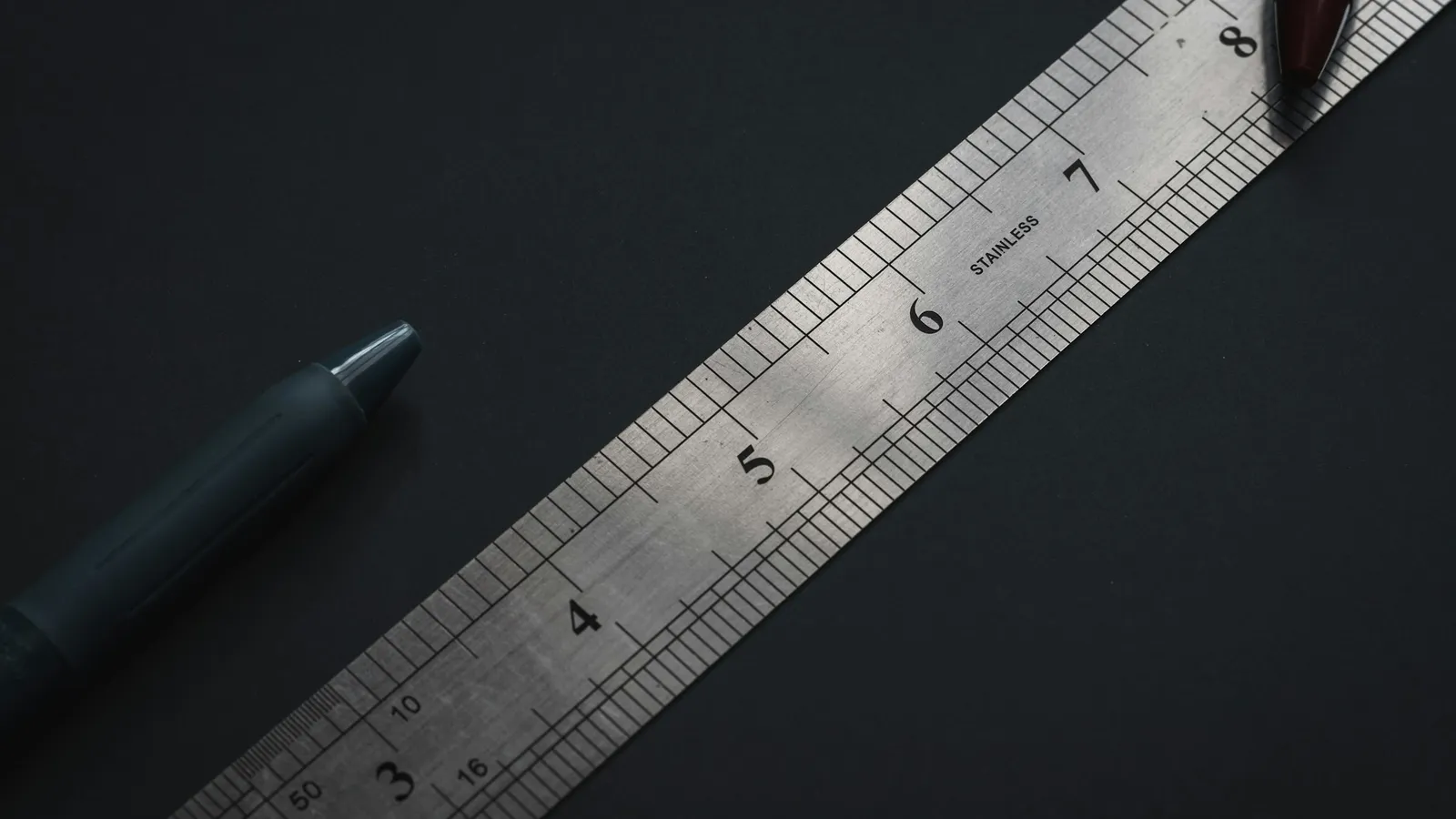
On a 15-cm scale, the smallest division is 1 mm, so 1 mm is the smallest length you can measure with it.
How do you measure length correctly?
Choose the right tool: a 15-cm scale for a pencil, a metre scale or tape for a room, a flexible tape for the girth of a tree.
Place the scale in contact with the object, along its length.
Keep your eye directly above the point you are reading, not to one side.
For a curved line, lay a thread along it, straighten the thread and measure the thread.
If the zero end is broken, start at a clear full mark and subtract.
Worked examples: conversions and a broken scale
Broken scale (from the book). One end of the object is at 1.0 cm and the other at 10.4 cm. Length = 10.4 cm - 1.0 cm = 9.4 cm.
Exercise 5. 1.5 km in metres: 1.5 × 1000 = 1500 m.
Your height. Suppose you are 1.42 m tall. In centimetres: 1.42 × 100 = 142 cm. In millimetres: 142 × 10 = 1420 mm.
Bicycle distance (from "Learning further"). If the outer edge of the wheel measures 1.6 m with a string and the wheel turns 250 times, the distance is 250 × 1.6 m = 400 m, or 0.4 km.
Check each answer by asking whether it should be bigger or smaller. Smaller units always give bigger numbers: 1.42 m becomes 142 cm, not 0.0142 cm.
What does it mean for something to move?
To describe position you need a reference point. On a highway, a stone reading "Delhi 70 km" and later "Delhi 60 km" tells Padma her position from Delhi, her reference point, and shows she has moved 70 - 60 = 10 km closer.
An object is in motion if its position changes with respect to a reference point with time, and at rest if it does not. The choice of reference point matters: passengers sitting in a bus are at rest relative to the bus but in motion relative to a building outside.
The chapter names three types of motion:
Linear: along a straight line, like a box being pushed or students in a march-past.
Circular: along a circular path, like an eraser whirled on a thread or a merry-go-round.
Oscillatory: to and fro about a fixed position, like a swing or a pendulum.
Motion that repeats after a fixed interval is periodic; circular and oscillatory motion are both periodic.
Which mistakes cost marks?
Starting a measurement from a broken or worn zero mark.
Leaving out the unit, or writing "cms".
"1 km = 100 cm". The book uses this as a false statement; 1 km is 100,000 cm.
Reading the scale at an angle.
Saying an object is "moving" without saying relative to what.
Calling a swing's motion circular. It goes to and fro, so it is oscillatory.
A one-week practice routine
Day 1: Measure your table in handspans and with a scale. Compare with a family member.
Day 2: Measure five objects and write each in mm, cm and m.
Day 4: Visit a park, or picture one, and list two examples each of linear, circular and oscillatory motion.
Day 7: Close the book and write all the conversion relations, then check. Self-testing helps; in one study students who recalled a passage remembered more a week later than those who re-read it.
If conversions keep tripping you up, the Fermi Problem Library has a step-by-step solver that explains the reasoning behind each step. In Class 7, the chapter on measurement of time and motion adds speed to these ideas.
Tonight, measure the length of one curved object at home with a thread and a scale, and write the answer in cm and mm.