

On this page
Two of the biggest structures you can name around the Sun carry ideas from one astronomer. Jan Oort showed that the whole Milky Way turns like a giant wheel, with the Sun riding along. Then, more than twenty years later, he explained why comets keep arriving from every direction in the sky. This post walks through both pieces of work, calculates how long the Sun takes to go round the galaxy and how long a distant comet takes to go round the Sun, and draws out what students can learn from his method.
Who was Jan Oort?
The Royal Society's biographical memoir gives his dates as 28 April 1900 to 5 November 1992, and notes that his "life and work spanned most of the 20th century". Both papers discussed here were published as communications from the Observatory at Leiden in the Netherlands, where he worked.
How did Oort show the galaxy rotates?
By 1927 astronomers knew from Harlow Shapley's work that the Sun is far from the centre of the Milky Way. The astronomer Lindblad had suggested that the galaxy rotates. Oort set out to test it in his paper Observational evidence confirming Lindblad's hypothesis of a rotation of the galactic system, published in the Bulletin of the Astronomical Institutes of the Netherlands.
His insight was that a galaxy need not rotate like a solid wheel. If most of the mass is near the centre, stars closer in go round faster, like planets near the Sun. Then, seen from the Sun, nearby stars should show a pattern. In the paper, the extra speed towards or away from us of stars at distance r is rA sin 2(l − l₀), where l is the direction on the sky, l₀ the direction of the centre, and A a constant. Stars in some directions drift towards us, in others away, in a repeating four-part pattern around the sky.
Oort found this pattern in real star motions. He also derived how A and a second constant, B, relate to the rotation, with B = A − V/R, where V is the circular speed near the Sun and R the Sun's distance from the centre. His first estimate put the centre 5,900 parsecs away, corrected in a note added in proof to 5,100.
Worked example 1: how long is the Sun's galactic year?
Modern data make this possible with two numbers. Radio astronomers Reid and Brunthaler (2020) measured that Sagittarius A*, the black hole at the centre, appears to move across our sky at 6.411 milliarcseconds per year along the galactic plane, almost entirely because of the Sun's own orbit. The GRAVITY collaboration (2019) measured the distance to it as 8,178 parsecs.
Period from the angle. A full circle is 360 × 3600 × 1000 = 1.296 × 10⁹ milliarcseconds. Time = 1.296 × 10⁹ / 6.411 = 2.02 × 10⁸ years.
Speed. Moving 1 AU per year is 1.496 × 10⁸ km in 3.156 × 10⁷ s, or 4.74 km/s. An angular speed μ (arcseconds per year) at distance d (parsecs) means a speed 4.74μd km/s. Here 4.74 × 6.411 × 8.178 = 249 km/s.
So the Sun goes round the galaxy at roughly 250 km/s and takes about 200 million years per orbit. This simple picture assumes a circular orbit and a stationary black hole.
Where do long-period comets come from?
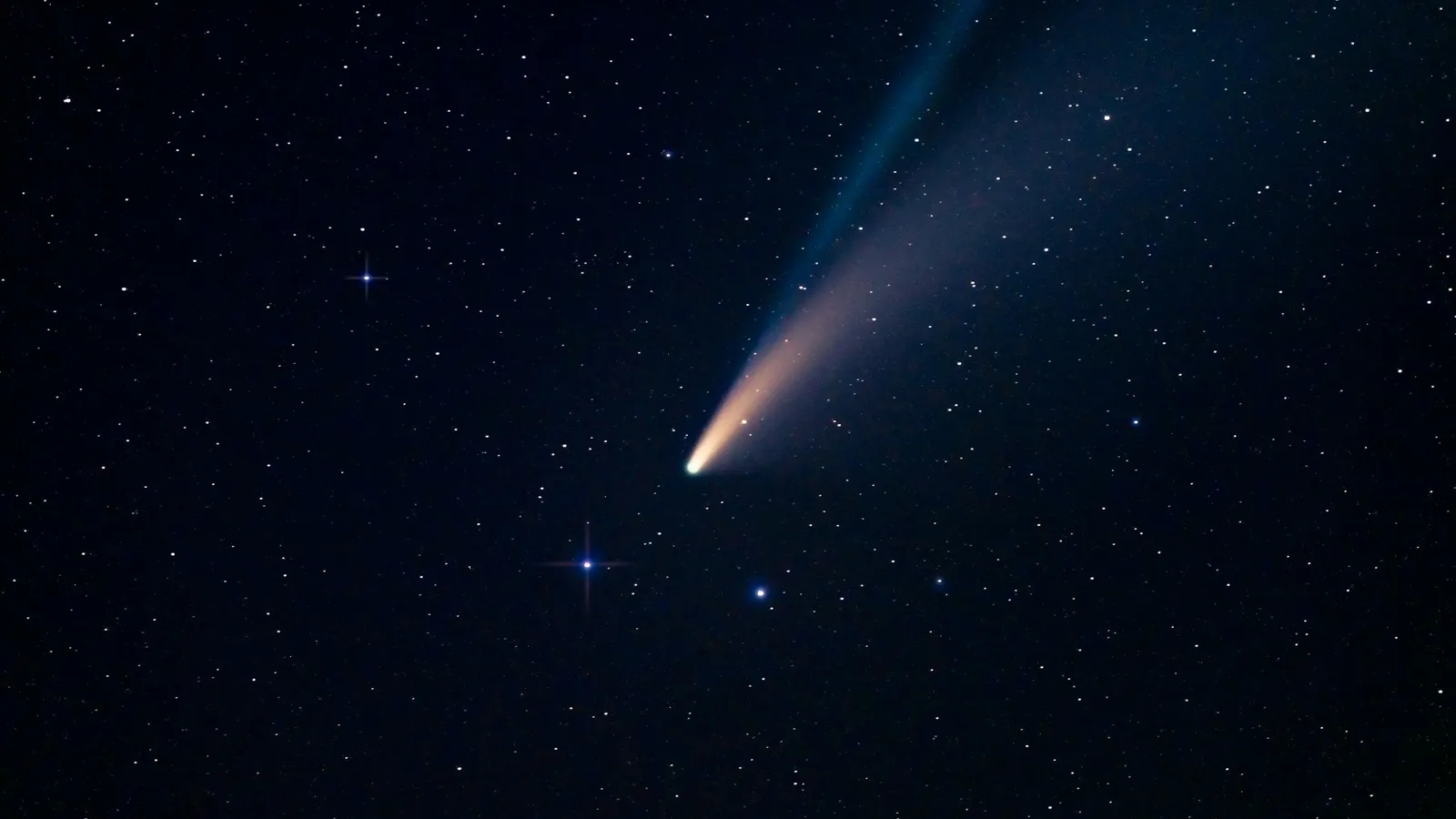
Some comets return every few years. Others arrive once, on orbits so stretched that they take millions of years. In 1950 Oort studied "a score of well-observed original orbits" in The structure of the cloud of comets surrounding the Solar System. His summary says the "new" long-period comets "generally come from regions between about 50000 and 150000 A.U. distance". He concluded that the Sun must be surrounded by a general cloud of comets, "containing about 10¹¹ comets of observable size", with a total mass of about 1/10 to 1/100 of the Earth's. Passing stars nudge some of them inward.
The cloud also explained why these comets come from random directions, unlike the planets, which all lie near one plane. NASA now describes the Oort Cloud as a giant spherical shell whose inner edge may be 2,000 to 5,000 AU from the Sun and outer edge 10,000 to 100,000 AU, and says Voyager 1 will not reach it for about 300 years.
Worked example 2: a comet's period
Oort found the average 1/a for the newest comets was 0.000018 per AU, where a is the semi-major axis.
Semi-major axis. a = 1 / 0.000018 = 55,600 AU. The comet's far point is about 2a, or 111,000 AU, because its near point is tiny by comparison.
Kepler's third law in solar units: T² = a³, with T in years and a in AU. T = 55,600^1.5 = 1.31 × 10⁷ years.
So one orbit takes about 13 million years. Our post on Kepler's laws explains why T² ∝ a³.
Which mistakes does this help you avoid?
Using the far point in Kepler's law. Use a, not the aphelion.
Forgetting T² = a³ works only in years and AU for bodies orbiting the Sun.
Assuming a galaxy rotates like a solid disc. Oort's whole point was that inner parts go faster.
The JEE (Main) 2026 syllabus includes Kepler's laws and orbital motion under gravitation. Check the syllabus for your exam year.
When an orbit problem stalls at the set-up stage, the Fermi Problem Library has worked problems with a step-by-step solver that explains the reasoning rather than printing an answer.
What can a student take from Oort's way of working?
Look for a pattern, not a single number. A sin 2(l − l₀) shape across the whole sky was stronger evidence than any one star.
Small samples, careful reasoning. About twenty comet orbits led him to a cloud of a hundred billion.
Test someone else's idea fairly. His 1927 paper set out to confirm Lindblad's hypothesis, and said so in the title.
Next step: use Kepler's third law to find the period of a comet with a = 2,000 AU, the inner edge NASA gives for the Oort Cloud.


