

On this page
Look up from a rooftop in Delhi or Bengaluru on a clear night and you may count a dozen stars. Far from the city, the same sky fills with hundreds. The stars did not change. The sky behind them did.
What is skyglow, and how does scattering cause it?
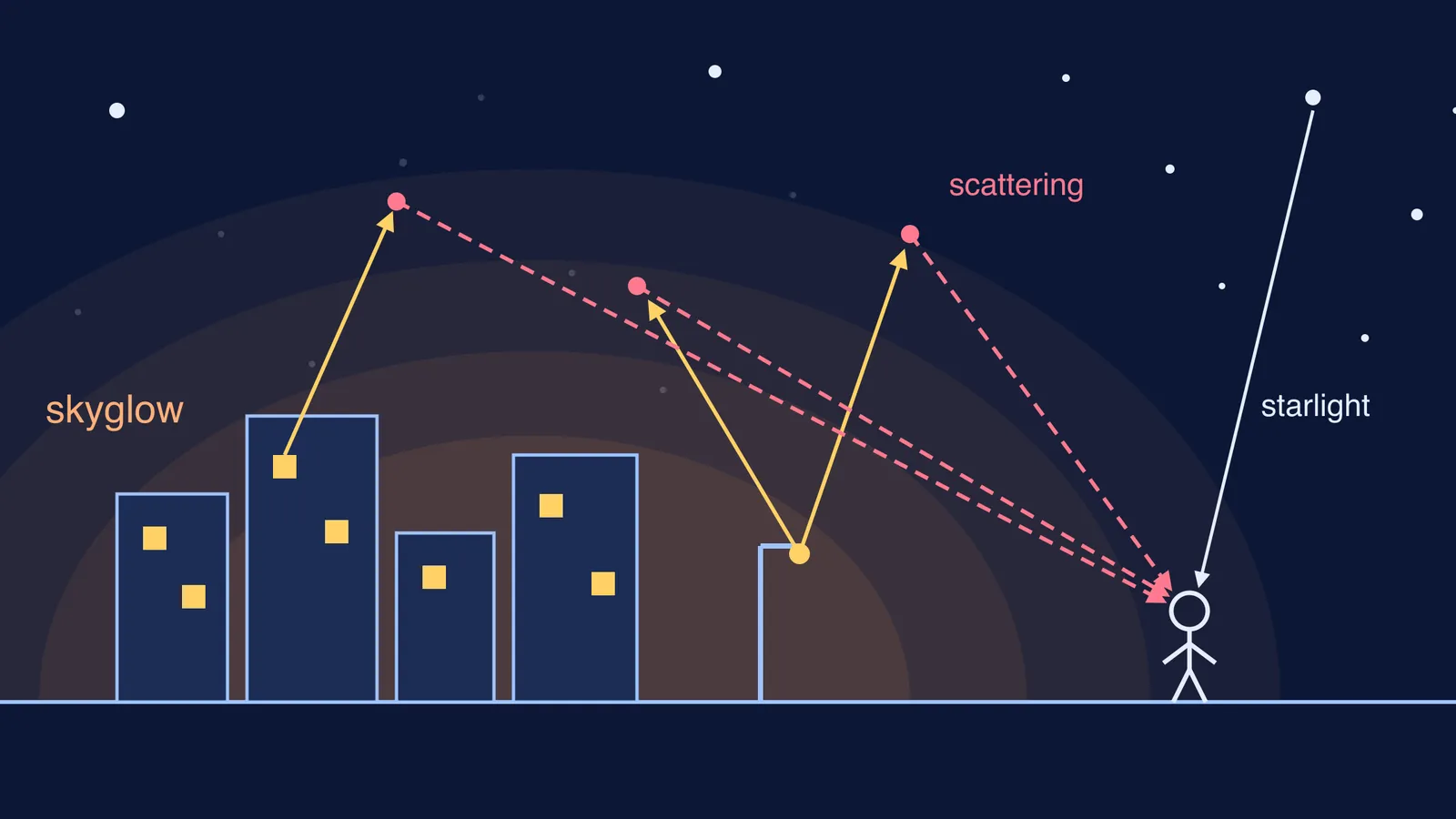
Skyglow is artificial light scattered in the atmosphere that raises the brightness of the night sky; the 2016 world atlas of artificial night sky brightness by Fabio Falchi and colleagues calls it the most visible effect of light pollution.
Here is the chain of events:
A streetlight, a lit billboard or an office window sends some of its light upward or sideways instead of only onto the road.
That light travels up through the air and hits gas molecules, water droplets and dust.
Each hit can send the light off in a new direction, including back down towards you. This is scattering, the same process that makes the daytime sky blue.
Light arriving from millions of these scattering events, from every direction, makes the whole sky glow a dull orange or grey.
If you have read our explainer on Rayleigh's 1/λ⁴ law and why the sky is blue, you know that shorter wavelengths scatter more. A 2023 NOIRLab release on the Globe at Night study notes that shorter wavelengths contribute disproportionately to skyglow, and that white LEDs, now common in outdoor lighting, peak in emission between 400 and 500 nanometres. The same release says light emitted sideways, from illuminated signs and windows, is a significant contributor to skyglow seen from the ground.
Why does a brighter sky hide faint stars?
Your eye detects a star by the difference between the star and the sky around it. A torch is easy to spot at midnight and nearly invisible at noon, though it gives out the same light.
Stars work the same way. A bright star like Sirius still beats the city glow. A faint star sends you a tiny, fixed amount of light, and once the background swamps that difference, the star is gone. The NOIRLab release explains that as the sky brightens, the fainter objects disappear from sight, and it says the unaided eye should be able to see several thousand stars on a clear, dark night.
How bad is light pollution in India and the world?
The Falchi atlas combined satellite data with more than 35,000 ground measurements. Its key findings:
About 83% of the world's population lives under light-polluted skies.
The Milky Way is not visible to more than one-third of humanity.
In India, 93.9% of people live under skies the atlas classes as polluted, meaning artificial light adds more than about 8% to the natural night sky brightness.
How fast is the night sky getting brighter?
Christopher Kyba and colleagues analysed 51,351 naked-eye observations of star visibility sent in by citizen scientists and reported in Science in 2023 that the drop in visible stars from 2011 to 2022 can be explained by a rise in sky brightness of 7 to 10% per year. The NOIRLab release reports Kyba's estimate that, at this rate, a child born where 250 stars were visible would see only about 100 by the time they turned 18.
The same release puts the increase at 9.6% per year over the past decade. Treat it like compound interest.
After one year, sky brightness is 1.096 times what it was.
Doubling time: ln 2 ÷ ln 1.096 = 0.693 ÷ 0.0917, which is about 7.6 years.
After 18 years: 1.096^18 = e^(18 × 0.0917) = e^1.65, which is about 5.2.
So at that rate, the sky would be roughly five times brighter by the time a newborn finishes school, and stars that are only just visible today would steadily drop out of sight.
How can you test this yourself?
You can turn this into a small experiment over two clear evenings:
Pick one easy constellation. From India, Orion is high in the evening sky in winter.
On a clear, moonless night, stand somewhere shaded from direct lamps and give your eyes several minutes to adjust. Count every star you can see inside the constellation's outline.
Repeat from a darker spot, such as a terrace with nearby lights off, or a village on a family trip.
Record the counts, place and time, and submit an observation to Globe at Night, the programme behind the Kyba study.
Explain the difference in two sentences using the words scattering and contrast.
Our four-week plan for family stargazing in India has more ideas for darker sites and what to look for.
Scattering is easier to understand when you can change one thing and watch the result. Try our sunset scattering simulation to see how path length changes colour, and explore more in the Fermi Simulation Lab, which has interactive simulations for ideas that are easier to see than to read.


