

On this page
Plug a room heater into a long, thin extension cord and it runs a little cooler than it would at the wall socket. Nothing is broken. The cord has resistance, and that resistance takes a share of the supply voltage before the heater gets any. It is also a standard current-electricity numerical.
Why does a long extension wire lower the voltage at the appliance?
A cord has two conductors: current goes out along one and comes back along the other. Both are in series with the appliance, so one current flows through the whole loop. For why that must be true, read why current is the same everywhere in a series circuit.
By Ohm's law, each resistance in the loop takes a voltage equal to I times its resistance. The supply voltage is split between the leads and the appliance in proportion to their resistances, exactly like a voltage divider. The leads' share is the voltage drop; the appliance gets what is left.
The resistance of a wire is R = ρL/A, where ρ is the resistivity, L the length and A the cross-sectional area. HyperPhysics lists the resistivity of copper as 1.68 × 10⁻⁸ Ω·m at 20 °C. Long and thin means more resistance, so a bigger drop.
How do you calculate the voltage drop across connecting wires?
Here is a full worked example. India's mains supply is 230 V at 50 Hz, as listed in the mains electricity by country table. Take a heater rated 1000 W at 230 V, on a 30 m copper extension cord with 0.75 mm² conductors. Assume the heater's resistance stays fixed (real elements change a little with temperature).
Heater resistance: R = V²/P = 230² / 1000 = 52.9 Ω.
Lead length: current travels 30 m out and 30 m back, so L = 60 m.
Lead resistance: r = ρL/A = (1.68 × 10⁻⁸ × 60) / (0.75 × 10⁻⁶) = 1.34 Ω.
Current: I = 230 / (52.9 + 1.34) = 4.24 A.
Voltage across the heater: V = I × R = 4.24 × 52.9 ≈ 224.3 V.
Voltage drop in the leads: 230 − 224.3 = 5.7 V, about 2.5% of the supply.
A one-line shortcut gives step 5 directly: V(appliance) = V(supply) × R / (R + r).
How much power is lost in the leads?
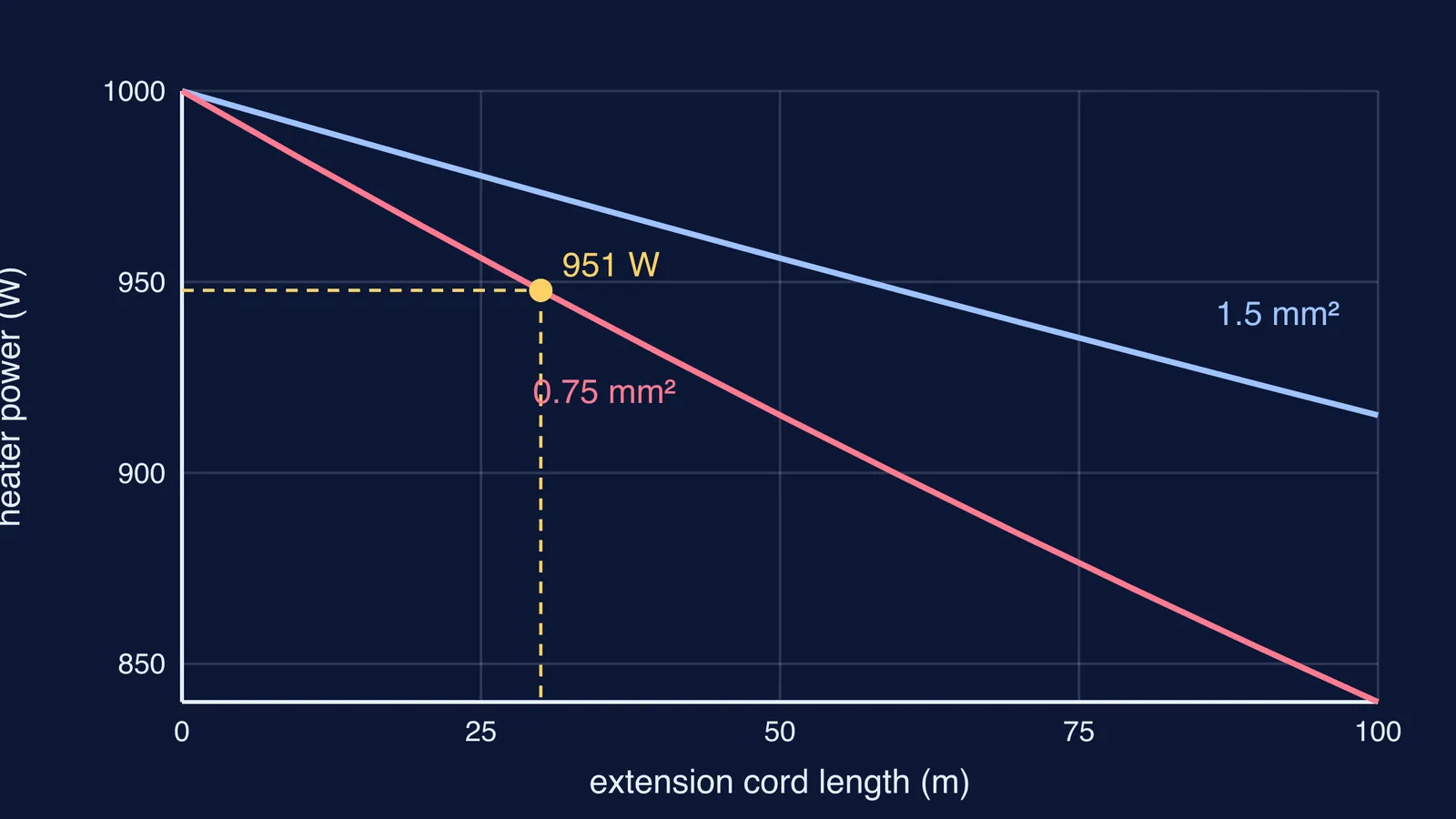
The same current heats the leads, whose 1.34 Ω came from the HyperPhysics copper resistivity. Power lost in the leads is I²r = 4.24² × 1.34 ≈ 24 W. The heater now delivers I²R = 4.24² × 52.9 ≈ 951 W, not its rated 1000 W. The supply provides 230 × 4.24 ≈ 975 W in total, and 951 + 24 = 975, so the books balance.
Notice the heater's voltage fell by only 2.5% but its power fell by about 4.9%. That is because P = V²/R: the power drops by roughly twice the fraction the voltage does, when the drop is small. A neat way to write it is P(actual) = P(rated) × (R / (R + r))², which gives 1000 × (52.9 / 54.24)² ≈ 951 W.
The 24 W warms the copper along the cord's whole length. A bad joint does the same, with the heat squeezed into one spot; see why a loose wire connection gets hot.
What changes with a thicker or shorter wire?
Resistance scales as L/A, so doubling the area halves r. Rerun the same steps with 1.5 mm² conductors and the same copper resistivity:
Lead resistance: r = 0.67 Ω.
Current: 230 / 53.57 ≈ 4.29 A.
Heater voltage: about 227.1 V.
Heater power: about 975 W.
Power lost in the leads: about 12 W.
Halving the cord length has the same effect as doubling the area. The idea is the same one behind a battery's internal resistance, where the cell's own resistance takes part of its emf; compare it with finding internal resistance from two voltmeter readings.
How do you check your answer in an exam?
Run four checks:
Did you double the cord length for the return wire?
Did you find the appliance resistance from its rating, not assume it draws rated current?
Do the lead drop and appliance voltage add up to the supply voltage?
Do the lead loss and appliance power add up to V × I from the supply?
If the second check trips you up, the Fermi Concept Library gives every physics concept its own lesson, so you can revisit resistance and electrical power. For more series-circuit numericals, the Fermi Problem Library has worked problems with a step-by-step solver that explains the reasoning rather than printing an answer.
Try it yourself: a 2000 W, 230 V heater on the same 30 m, 0.75 mm² cord. Expect a bigger drop, because twice the current flows through the same leads.


