

On this page
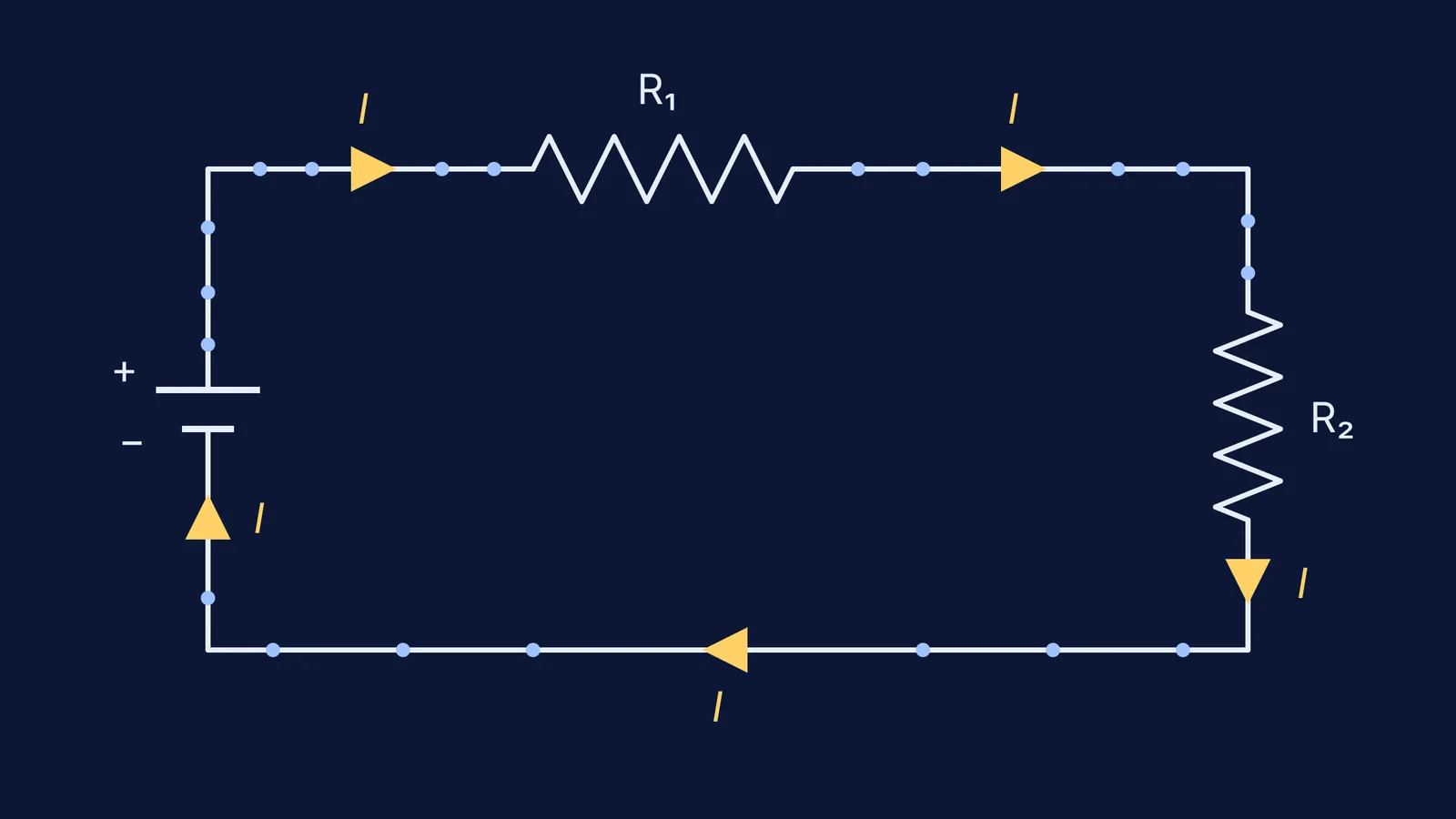
Picture a battery, a 2 Ω resistor and a 4 Ω resistor in one loop. Many students expect less current after each resistor, as if the resistors "eat" some of it. They don't. An ammeter reads the same wherever you put it in the loop. The reason fits in one sentence: charge cannot pile up anywhere in a steady circuit.
Why is current the same at all points in a series circuit?
Electric current is the rate at which charge passes a point, measured in coulombs per second (amperes). A series circuit gives the charge only one path. If 2 coulombs cross the wire before the first resistor each second, then 2 coulombs must cross the wire after it each second too. Otherwise the charge has to be going somewhere.
The OpenStax textbook University Physics Volume 2 says: "Since there is only one path for the charges to flow through, the current is the same through each resistor."
The same idea sits behind Kirchhoff's junction rule. In the words of the same textbook's chapter on Kirchhoff's rules, "Current is the flow of charge, and charge is conserved; thus, whatever charge flows into the junction must flow out." Apply that reasoning to any point on a series wire, with one wire in and one out, and current in equals current out.
What would happen if charge piled up?
Try the opposite. Suppose 2 A flowed into the 4 Ω resistor but only 1.5 A flowed out. Then 0.5 coulomb of extra charge would collect inside it every second, and the pile would keep growing.
Charge that collects in one place makes its own electric field. That field pushes back on charge arriving and pushes harder on charge leaving, so any imbalance cancels itself. The loop quickly settles into the state where inflow equals outflow at every point. That settled state is the "steady current" that school and JEE circuit questions assume.
Worked example: what changes, and what stays the same?
A 12 V battery with negligible internal resistance drives current through R1 = 2 Ω and R2 = 4 Ω in series.
Equivalent resistance: series resistances add, so R = 2 + 4 = 6 Ω, the rule given in OpenStax's series and parallel section.
Current: I = V/R = 12/6 = 2 A. That is the current everywhere: before R1, between R1 and R2, after R2, and inside the battery.
Voltage across R1: 2 A × 2 Ω = 4 V. Across R2: 2 A × 4 Ω = 8 V. The drops add to 12 V.
Power: R1 turns 2 × 4 = 8 W into heat, R2 turns 2 × 8 = 16 W. Total 24 W, equal to the battery's 12 V × 2 A.
What is used up is energy, not charge. Each coulomb leaves the battery carrying 12 joules, gives 4 J to R1 and 8 J to R2, and goes round again at the same rate. For the voltage side in more detail, see our guide on finding the potential difference between two points in a circuit.
Why do so many students think current gets used up?
The idea is persistent. A 2026 study in Physical Review Physics Education Research by Steinmetz and colleagues tested 1,274 high school students after initial instruction and 423 students in physics-related degree programmes before their university lectures began. It found that "current consumption" reasoning was significantly more common among the university starters than among the school students.
The authors suggest that everyday experience and language may reinforce such ideas over time. Phrases like "the bulb uses electricity" are true about energy and misleading about current. You can test the idea yourself with two ammeters, as in our post on whether current is used up by bulbs in a series circuit.
How do you check a series circuit answer in an exam?
Run this check before you move on:
Is the current the same through every component in the loop? If your working gives two values, you've made an error.
Do the voltage drops add up to the battery's EMF (minus any internal-resistance drop)?
Does the total power in the resistors equal the battery's output power, EI minus I²r?
Is the brighter bulb the one with the larger resistance? In series, P = I²R, so with equal current the bigger R gets more power.
To see why charges in a wire drift at a steady rate in the first place, read the derivation of drift velocity and Ohm's law.
When a problem goes wrong at a particular step, the Fermi Problem Library has worked problems with a step-by-step solver that explains the reasoning rather than printing an answer. If charge flowing round a loop still feels abstract, the Fermi Simulation Lab has interactive simulations for ideas that are easier to see than to read.


