

On this page
When you connect a bulb to a battery and it lights up, it feels obvious that something is being consumed. We are used to fuels running out in everyday life: a car burns petrol, and a candle burns wax until nothing is left. This instinct leads to one of the most common and stubborn mistakes in physics.
Research shows that between 20% and 40% of students believe in the "attenuation model" of electric circuits. They think that current leaves the battery, enters the first bulb, gets partially "used up" to make light, and then a weaker current continues to the next bulb. Because the battery eventually goes flat, it is easy to assume it has simply run out of current.
But current is not used up. So what exactly is the bulb consuming to produce all that light, and how can we prove it with an experiment?
Current vs energy: what is actually used up?
To fix this mistake, we have to separate two ideas that are often confused: current and energy.
Current is the flow of charge. Think of it like water flowing in a closed ring of pipes. The water does not disappear when it goes through a turbine; the exact same amount of water comes out the other side and continues through the pipe. In a circuit, the battery does not "supply" or create electrons. The charge carriers are already there, sitting inside the copper wire.
What the battery supplies is energy. It acts like a powerful pump, pushing the existing electrons around the loop. As these electrons squeeze through the tight tungsten filament of a bulb, they encounter electrical resistance. The electrons lose some of their energy, which is transformed into heat and light by the bulb.
Energy is what gets used up. The current—which is simply the rate of electrons passing a point every second—remains exactly the same before and after the bulb.
How do you test the series circuit rule?
The best way to break a physics misconception is to make a prediction and test it.
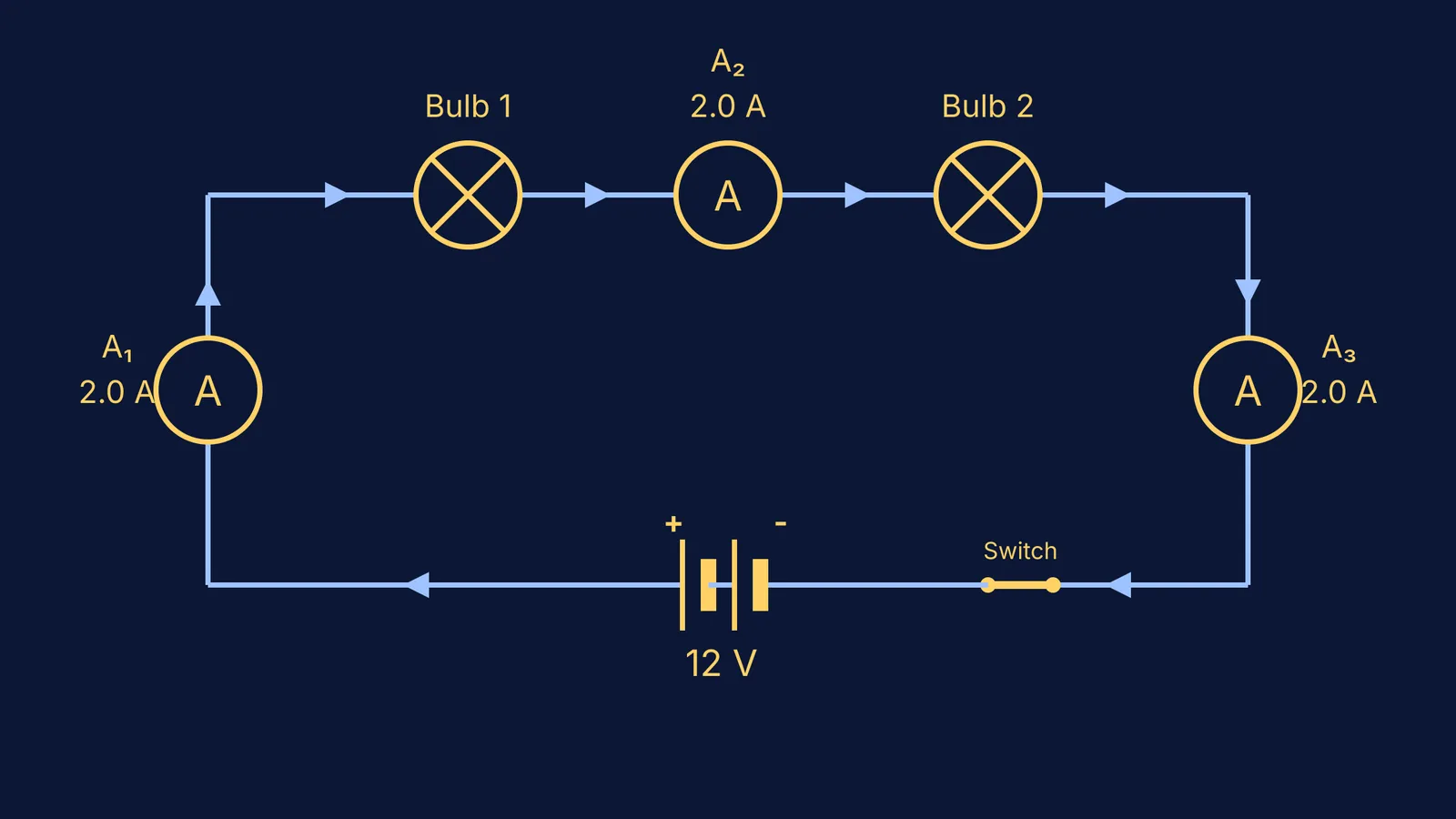
Imagine a simple loop with one battery and two identical bulbs wired in series. Where is the current highest? If the attenuation model were true, the current would be strongest right out of the battery, slightly weaker after the first bulb, and weakest after the second bulb.
You can test this yourself in a lab, or build it in the Fermi Simulation Lab if you want to experiment quickly without burning out real bulbs. Here is the plan:
Connect the battery and the two bulbs in a single series loop.
Place Ammeter 1 between the battery's positive terminal and the first bulb.
Place Ammeter 2 directly between the two bulbs.
Place Ammeter 3 between the second bulb and the negative terminal.
When you close the switch and let the simulation run, what do you see? All three ammeters give the exact same reading—for example, 2.0 A.
This proves the scientific rule: in a simple series circuit, the current is constant at every point. The flow of charge does not weaken, no matter how many components it passes through.
A checklist for circuit problems
When you sit down to solve a problem—or if you get stuck and need step-by-step problem solving guidance from your tutor—use this three-point checklist to keep your facts straight:
Are there any junctions? Trace the wire with your finger. If it never splits into different paths, it is a series circuit. The current has nowhere else to go, so it must be identical everywhere.
What is dropping? Remember that voltage (potential difference) drops across the bulb because energy is being transformed into light. The current never drops.
What happens if I cut the wire? If you break a series circuit, all the bulbs go out instantly. This proves that charge moves as a continuous, linked chain, rather than a free-flowing stream that can pool up inside a component.
By checking these facts before you write down an equation, you can avoid the traps of everyday language. If you want to take this further and see how current and voltage change when a capacitor is added to the mix, try predicting the curve in an RC circuit simulation.


