

On this page
A capacitor and a resistor in series with a battery make the simplest circuit where something changes with time. On paper it is a pair of exponential formulas. In a simulation you can watch the voltage climb, see the current fade, and test your predictions before the graph appears. Below are predictions to make and the numbers to check them against.
What is the time constant of an RC circuit?
The time constant of an RC circuit is the product of resistance and capacitance, τ = RC, as defined in OpenStax University Physics Volume 2, section 10.5. With R in ohms and C in farads, τ comes out in seconds.
While charging, the capacitor's charge follows q(t) = Cε(1 − e^(−t/RC)), and the current follows I(t) = I₀e^(−t/RC), with I₀ = ε/R (OpenStax). The voltage across the capacitor is q/C, so it follows the same curve as the charge.
Why is the capacitor 63% charged after one time constant?
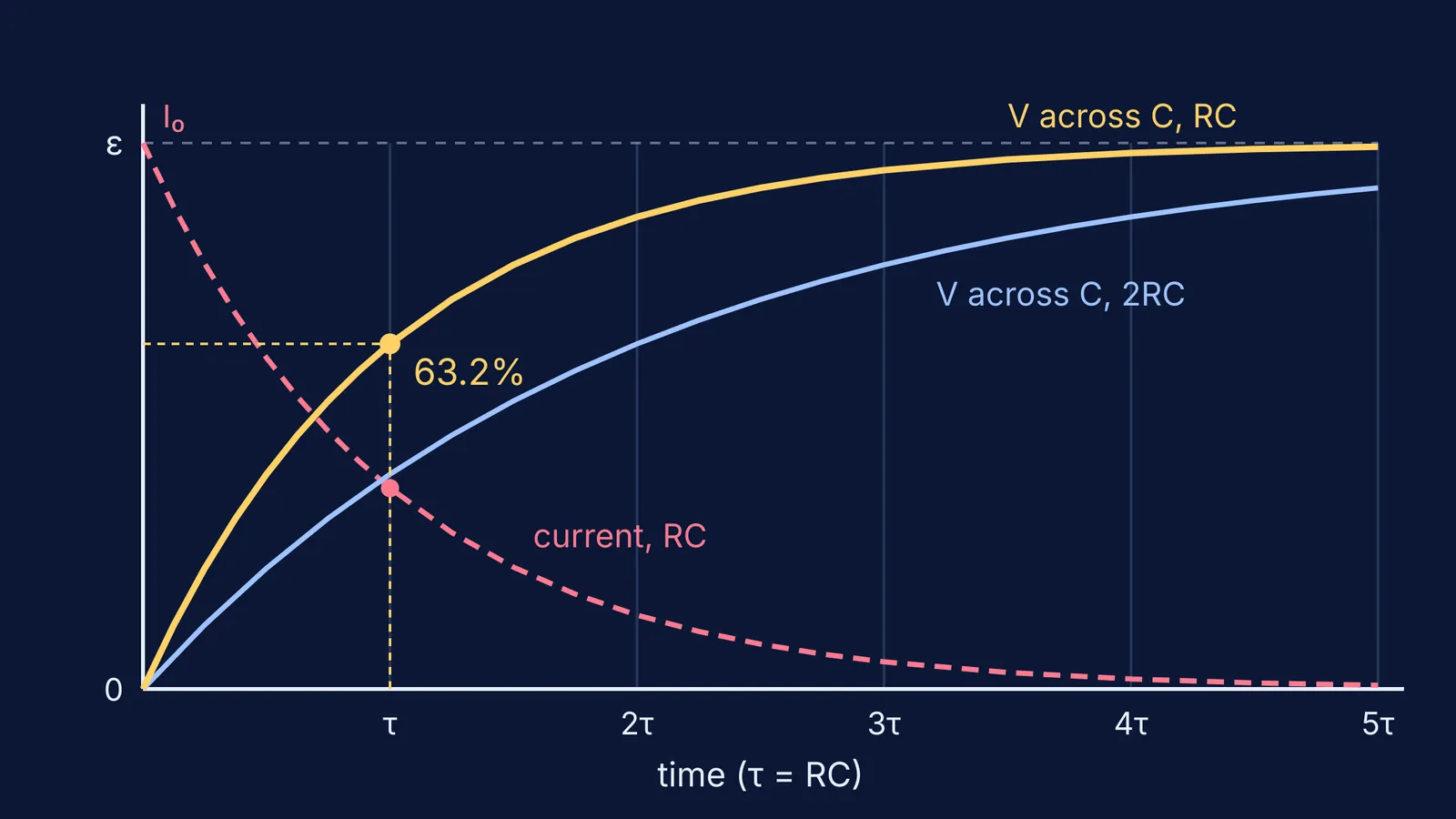
Put t = RC into the charging formula and the bracket becomes 1 − e⁻¹. OpenStax works this out: 1 − 0.368 = 0.632, so at t = τ the charge is 63.2% of its maximum Q = Cε (OpenStax, section 10.5). The number has nothing to do with the particular R, C or battery. It comes from e alone, which is why the same 63% mark shows up in every RC problem.
Each further time constant closes 63.2% of the gap that is left. Using the same formula, the capacitor reaches about 86.5% at 2τ, 95.0% at 3τ and 99.3% at 5τ. In theory it never reaches 100%, so a simulation's graph flattens out rather than stops.
Why does the current start large and then decay?
At the moment you close the switch the capacitor holds no charge, so there is no voltage across it. The whole battery voltage sits across the resistor, and the current jumps straight to I₀ = ε/R (OpenStax). As charge builds up, the capacitor's voltage pushes back against the battery, the resistor gets less of it, and the current shrinks. As time goes to infinity the current goes to zero.
One time constant in, the current is I₀e⁻¹ = 0.368I₀, according to the same OpenStax section. The two curves mirror each other: when the capacitor's voltage is 63.2% of the way up, the current has fallen to 36.8% of its starting value.
How do R and C change the charging curve?
τ = RC, so doubling either R or C doubles the time constant and stretches the curve along the time axis. OpenStax gives a car's intermittent wipers as an example: increasing the resistance increases the RC time constant and lengthens the time between wipes (OpenStax, section 10.5). The final voltage does not change, because that is set by the battery alone.
R and C differ in one way a simulation shows clearly. A bigger R also lowers the starting current ε/R. A bigger C leaves the starting current alone but keeps it flowing for longer, because there is more charge to store.
A worked example to test in a simulation
Take ε = 9 V, R = 10 kΩ and C = 100 µF. The numbers below are computed from the OpenStax charging formulas.
Time constant: τ = (10,000 Ω)(100 × 10⁻⁶ F) = 1 s.
Starting current: I₀ = 9 V ÷ 10,000 Ω = 0.9 mA.
At t = 1 s: the capacitor is at 0.632 × 9 ≈ 5.7 V and the current is 0.368 × 0.9 ≈ 0.33 mA.
At t = 3 s: the capacitor is at about 8.55 V (95%).
Change R to 20 kΩ: τ becomes 2 s and the starting current halves to 0.45 mA. At t = 1 s the capacitor reaches only 1 − e^(−0.5) ≈ 39%, about 3.5 V.
Now discharge it. Remove the battery and connect the charged capacitor across the resistor. The charge follows q(t) = Qe^(−t/τ) (OpenStax), so after one time constant 36.8% of the charge is left. The current flows the other way and decays on the same timescale.
For a full derivation of the charging and discharging equations, read our guide to RC circuits: charging, discharging and the time constant. To see what a capacitor does once the current has stopped, read capacitors in DC circuits at steady state. For the same predict-then-test approach with resistors and bulbs, try learning DC circuits with a simulation.
When you want to change R and C and watch the curve move, open the Fermi Simulation Lab, which has interactive simulations for ideas that are easier to see than to read. If you get stuck partway through a problem, Fermi's AI tutor can notice where you are stuck and decide whether to explain, ask or show.


