On this page
This two-line numerical comes straight from the end-of-chapter exercises in NCERT Class 10 Science: so many watts, this voltage, this fuse, how many lamps? It takes one formula and one division. Here is the method, a worked NCERT example, and where students lose marks.
How many bulbs can be connected before a fuse blows?
Add up the current that all the bulbs draw together and compare it with the fuse rating. The NCERT Class 10 Science chapter on electricity gives the two facts you need.
Power: electric power is P = VI, so one bulb of power P on a supply of voltage V draws a current I = P/V (NCERT, Eq. 11.22 and Example 11.10).
Parallel circuits: in a parallel combination, the total current is the sum of the currents through each branch, I = I1 + I2 + I3 (NCERT, Eq. 11.15).
Fuses: NCERT says a fuse melts and breaks the circuit when a current larger than its specified value flows, and lists domestic fuse ratings of 1 A, 2 A, 3 A, 5 A and 10 A (NCERT, section 11.7.1).
Put together: each of n identical bulbs sits across the same voltage and draws P/V, so the total is I = nP/V. The fuse survives while nP/V stays within its rating. So the maximum number of bulbs is (fuse rating × V) ÷ P, rounded down to a whole number.
If the parallel rule feels shaky, read why household appliances are connected in parallel first.
Worked example: the NCERT 10 W lamp question
Exercise 12 at the end of the NCERT electricity chapter asks: several bulbs rated 10 W are designed for a 220 V line; how many can be connected in parallel if the maximum allowable current is 5 A?
Current through one bulb: I = P/V = 10 ÷ 220 = 1/22 A, about 0.045 A.
Total current for n bulbs: n ÷ 22 amperes.
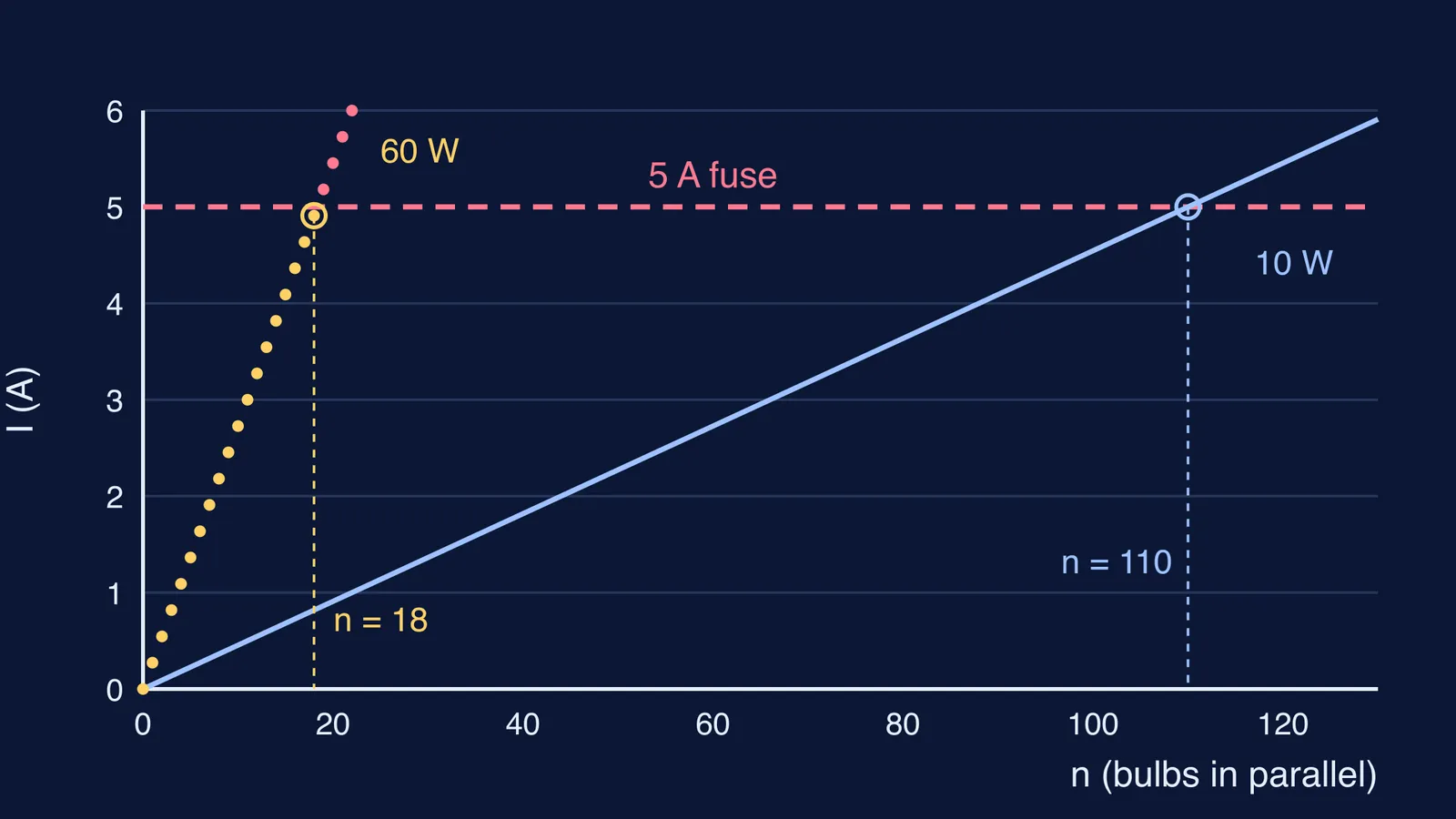
Set it equal to the limit: n ÷ 22 = 5, so n = 110.
Check with power: 110 × 10 W = 1100 W, and 1100 W ÷ 220 V = 5 A. It matches.
The answer is 110 lamps. A faster route compares powers: the line can deliver 5 A × 220 V = 1100 W, and 1100 ÷ 10 = 110. It is the same equation, so use whichever you slip on less. For the single-appliance version, see how much current a 1000 W heater draws.
What if the answer is not a whole number?
Switch to 60 W bulbs on the same 220 V line and 5 A fuse, using the same NCERT relation I = P/V. Now n = 5 × 220 ÷ 60 = 18.33. Is the answer 18 or 19?
With 18 bulbs: 18 × 60 ÷ 220 = 4.91 A, below 5 A. Safe.
With 19 bulbs: 19 × 60 ÷ 220 = 5.18 A, above 5 A. The fuse blows.
So the answer is 18. Rounding up always puts you over the limit.
What if another appliance is already on the circuit?
Suppose a 1 kW iron is already running on the same 220 V line. NCERT works out that it draws 4.54 A on its own (NCERT, section 11.7.1). A 5 A fuse allows 1100 W in total, so 100 W is left: room for one 60 W bulb. Two would make 1120 W, about 5.09 A.
Mistakes to check before you write the answer
Series thinking: in parallel, each bulb gets the full V. Do not split it between bulbs.
Rounding up: take the whole-number part, never the next integer.
Units: convert kW to W before dividing.
Forgotten loads: subtract anything already on the circuit first.
The voltage: use the value the question gives; the mains problems in the NCERT chapter use 220 V.
Switch-on surge: the textbook model assumes hot, steady bulbs. A bulb's resistance is lower when cold, so real filament lamps draw extra current for a moment at switch-on. The textbook calculation ignores this.
How to practise this so it sticks
Solve three versions without looking: one that comes out exact (10 W), one that needs rounding down (60 W), and one with an extra appliance on the line. Exercise 10 in the same NCERT chapter, how many 176 Ω resistors in parallel carry 5 A on a 220 V line, is the same reasoning written with resistance.
If your number keeps differing from the answer key, the Fermi Problem Library has worked problems with a step-by-step solver that explains the reasoning, so you can see which step went wrong. If the gap is the idea of parallel circuits itself, the Fermi Concept Library gives each physics concept its own lesson and its place in the map, so you can go back one step to Ohm's law and power.
Try the 60 W version with a 3 A fuse next. You should get 11 bulbs.