On this page
Questions like "how many reflexive relations are there on a set with 4 elements?" come up whenever you practise Class 12 relations. You do not need to memorise the formulas: with a small grid you can rebuild both and check them.
What is a relation on a set, in counting terms?
The NCERT Class 12 textbook, in Chapter 1, Relations and Functions, says a relation in a set A is a subset of A × A. If A has n elements, A × A has n × n = n² ordered pairs (the Cartesian product of sets explains why).
Picture those n² pairs as an n-by-n grid: row a, column b is the pair (a, b). Building a relation means deciding, for each cell, "in" or "out". Two choices per cell, n² cells, so there are 2^(n²) relations in total. The OEIS entry A002416 lists these values as 1, 2, 16, 512, 65536 for n = 0 to 4.
Every count in this post is the same move: find how many cells you are still free to choose, call it k, and the answer is 2^k.
How many reflexive relations are there on a set with n elements?
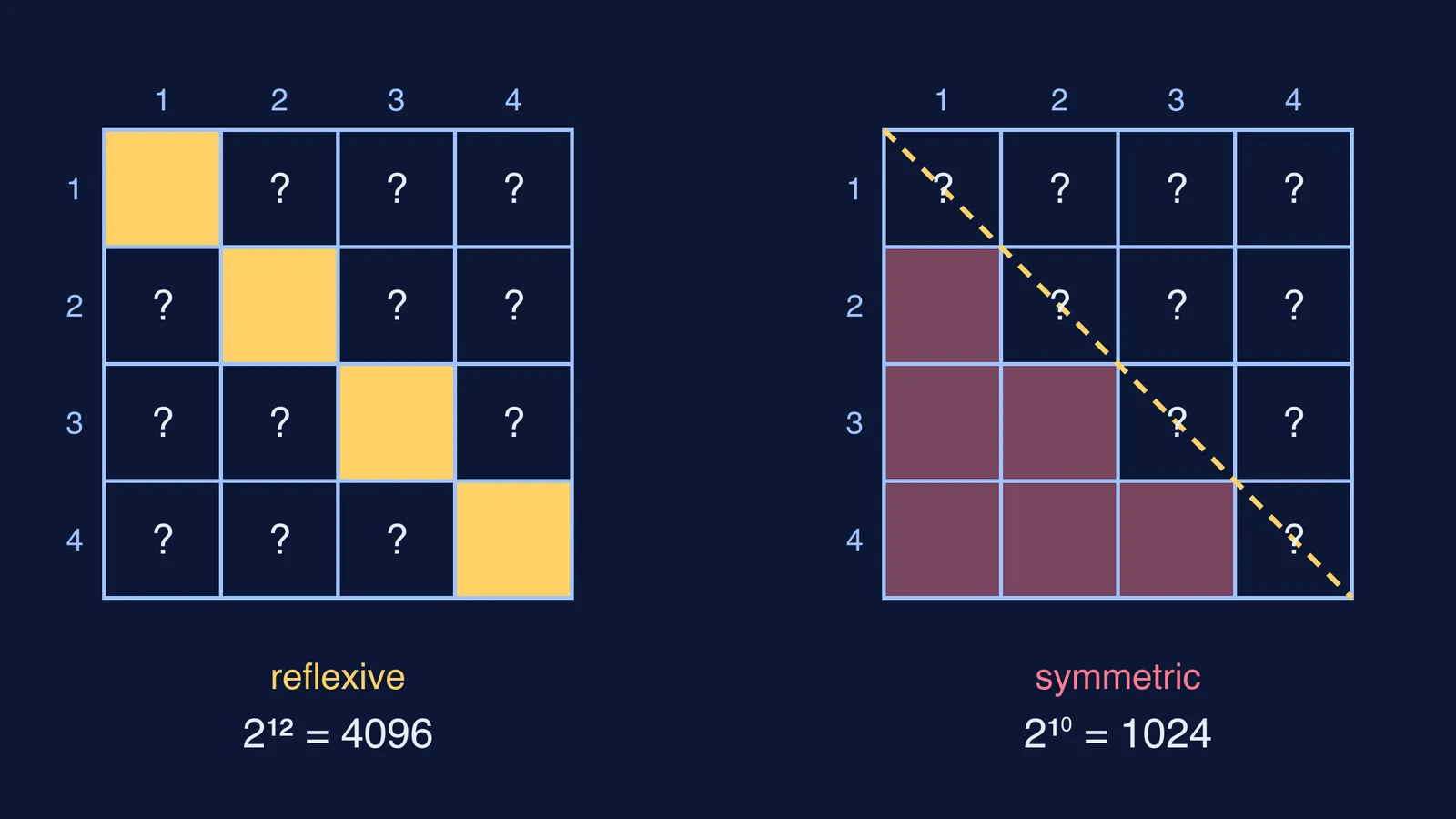
NCERT's definition: R is reflexive if (a, a) ∈ R for every a in A (NCERT, Chapter 1, Definition 3). In the grid, those pairs are the n cells on the main diagonal, and they are forced "in". You have no choice there.
The other n² − n cells stay free, each in or out. So:
The number of reflexive relations on a set with n elements is 2^(n² − n). The OEIS entry A053763 gives 2^(n² − n) as "the number of reflexive binary relations on an n-element set", with values 1, 4, 64, 4096 for n = 1 to 4.
Worked example, A = {1, 2, 3}: the grid has 9 cells, 3 are fixed on the diagonal, 6 are free, so 2^6 = 64 reflexive relations.
How many symmetric relations are there on a set with n elements?
R is symmetric if (a, b) ∈ R always brings (b, a) ∈ R with it (NCERT, Chapter 1). In the grid, the cell (a, b) and its mirror cell (b, a) across the diagonal must agree. They are one decision, not two.
So count decisions, not cells:
The n diagonal cells are mirrors of themselves, so each is a free choice: n decisions.
The n² − n off-diagonal cells pair up across the diagonal: (n² − n)/2 decisions.
Add them: n + (n² − n)/2 = n(n + 1)/2 decisions.
The number of symmetric relations on a set with n elements is 2^(n(n + 1)/2). The OEIS entry A006125 lists 2^(n(n − 1)/2) and notes that its term number n + 1 counts symmetric binary relations on an n-element set, which is the same 2^(n(n + 1)/2): 2, 8, 64, 1024 for n = 1 to 4.
What about relations that are both reflexive and symmetric?
Combine the two rules. The diagonal is forced "in" (reflexive), and the off-diagonal cells come in mirror pairs (symmetric). Only the (n² − n)/2 mirror pairs are left to choose, so the count is 2^(n(n − 1)/2). The OEIS entry A006125 describes its term n as "the number of binary relations that are both reflexive and symmetric on an n-element set".
Here are all four counts side by side, each checked against the OEIS entries above:
n = 1: 2 relations, 1 reflexive, 2 symmetric, 1 both
n = 2: 16 relations, 4 reflexive, 8 symmetric, 2 both
n = 3: 512 relations, 64 reflexive, 64 symmetric, 8 both
n = 4: 65536 relations, 4096 reflexive, 1024 symmetric, 64 both
Adding transitivity to reflexive and symmetric gives an equivalence relation, which needs a different counting method. Our post on equivalence relations in Class 12 covers how to test all three properties.
How do you check your answer in an exam?
Use this three-step routine instead of memorising:
Draw the n-by-n grid in the margin and mark the diagonal.
Ask what the property forces: reflexive fixes the diagonal; symmetric ties each cell to its mirror; both does both.
Count the free decisions k, write 2^k, then test n = 1 or n = 2 by listing the relations by hand.
For n = 2, A = {1, 2}, the symmetric relations are easy to list: choose (1, 1) or not, (2, 2) or not, and the pair {(1, 2), (2, 1)} together or not. That is 2 × 2 × 2 = 8, matching 2^(2 × 3 / 2) and the value in OEIS A006125.
Our guide to counting relations and functions between finite sets uses the same idea for functions. To practise, the Fermi Problem Library has worked problems with a step-by-step solver that explains the reasoning, so you can compare your grid count with each step.