On this page
Write out the squares 1, 4, 9, 16, 25 and the gaps grow: 3, 5, 7, 9. There is a clean rule for how many numbers fit in each gap: between n² and (n + 1)² there are exactly 2n whole numbers, and none is a perfect square. Here is why, in one line of algebra and one picture, with a check for n = 4.
How many non-square numbers lie between n² and (n + 1)²?
The answer is 2n. The NCERT Class 8 Mathematics textbook states it directly in its chapter on squares and square roots: "there are 2n non perfect square numbers between the squares of the numbers n and (n + 1)" (NCERT Class 8 Mathematics, Squares and Square Roots, p. 55). The same page lists the first few cases: 2 and 3 between 1 and 4; 5, 6, 7 and 8 between 4 and 9; and 10 to 15 between 9 and 16. The count grows 2, 4, 6, 8 as n goes 1, 2, 3, 4.
Why is the gap between consecutive squares 2n + 1?
Expand the bigger square and subtract the smaller one:
(n + 1)² − n² = (n² + 2n + 1) − n² = 2n + 1
But the difference is not the count. If you walk from 16 to 25 one step at a time, you take 9 steps and land on 9 numbers: 17, 18 and so on up to 25. The last one, 25, is the next square itself. Drop it, and 2n + 1 − 1 = 2n numbers are left strictly between. The textbook puts it as the count being "1 less than the difference of two squares".
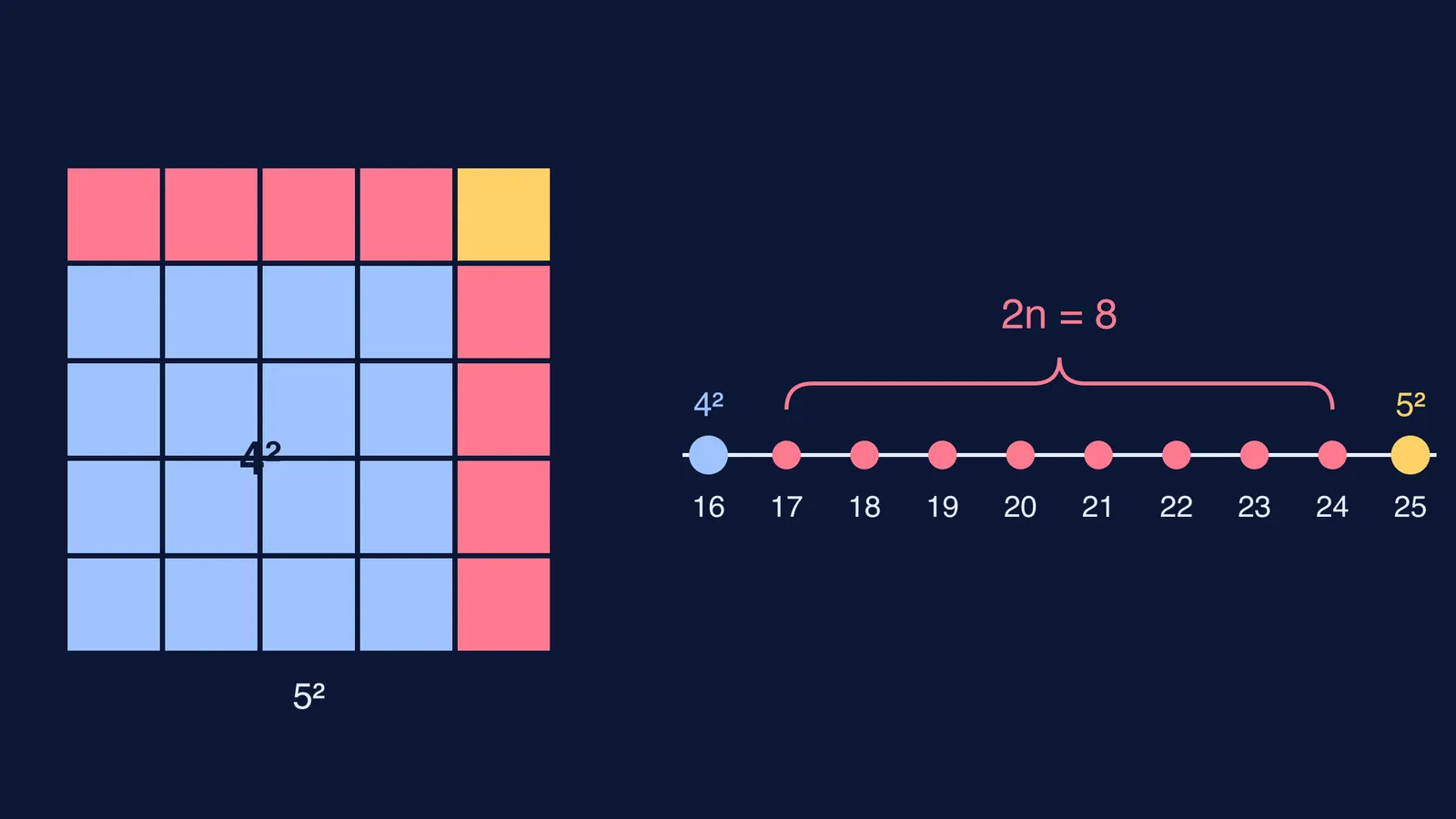
There is also a picture. To grow an n × n square of tiles into an (n + 1) × (n + 1) square, add a strip of n tiles down one side, n tiles along the top, and one corner tile: 2n + 1 tiles in an L. The two strips are the 2n numbers in between; the corner completes the next square. The diagram above shows it for n = 4.
Stacking these L-shapes from one tile is also the picture behind why the sum of the first n odd numbers is n².
Quick check: what lies between 16 and 25?
Take n = 4, so n² = 16 and (n + 1)² = 25.
Difference: 25 − 16 = 9, which matches 2n + 1 = 2 × 4 + 1 = 9.
Numbers strictly between: 17, 18, 19, 20, 21, 22, 23, 24.
Count them: 8, which matches 2n = 2 × 4 = 8.
Any squares among them? No: 4² = 16 and 5² = 25, and there is no whole number between 4 and 5.
Try one more yourself before reading on: between 6² = 36 and 7² = 49 you should find 2 × 6 = 12 numbers, 37 to 48.
Why can none of the numbers in between be a perfect square?
A number between n² and (n + 1)² would need a square root between n and n + 1. There is no whole number there, so it cannot be the square of a whole number. NCERT uses exactly this argument to show that 32 is not a square: 5² = 25 and 6² = 36, and no natural number lies between 5 and 6 (NCERT Class 8 Mathematics, p. 51).
The same bracketing is the first step of a square-root estimate: 20 sits between 16 and 25, so √20 is between 4 and 5. Our guide to estimating square roots without a calculator picks up from there.
How do exam questions use this rule?
Questions rarely ask for the proof; they ask you to use the rule quickly. Here are three to try, with answers; the first two follow the textbook's Try These box (NCERT Class 8 Mathematics, p. 56).
How many natural numbers lie between 9² and 10²? Here n = 9, so 18.
How many non-square numbers lie between 1000² and 1001²? Here n = 1000, so 2000.
How many non-square numbers are there from 1 to 100? Add 2n for n = 1 to 9: 2 × (1 + 2 + ... + 9) = 2 × 45 = 90. Cross-check: 100 numbers minus the 10 squares 1, 4, 9 ... 100 also gives 90.
Before you write the answer, run this checklist:
Take n from the smaller square, not the larger one.
Read whether the question says "between" (2n) or includes both squares (2n + 2).
For any other range, count the squares inside it and subtract.
If counting questions still trip you up, the Fermi Problem Library has worked problems with a step-by-step solver that explains the reasoning rather than printing an answer. For the wider chapter, start with our post on squares and square roots in Class 8, or open the topic in the Fermi Concept Library, where each concept has its own lesson and its place in the map.