

On this page
It is one of the most satisfying patterns in mathematics: if you add up odd numbers starting from 1, the total is always a perfect square. The sum of the first n odd numbers is calculated using the formula Sn = n².
For example, the first three odd numbers are 1, 3 and 5. Adding them up gives 9, which is 3². Add the next odd number (7), and you get 16, which is 4². As the sequence grows, the pattern holds perfectly.
Whether you are studying for a school board exam or preparing for competitive engineering tests like JEE, understanding where this result comes from is much more useful than simply memorising it. It gives you an intuitive grasp of how numbers behave when grouped together.
Why does the sum of the first n odd numbers equal n squared?
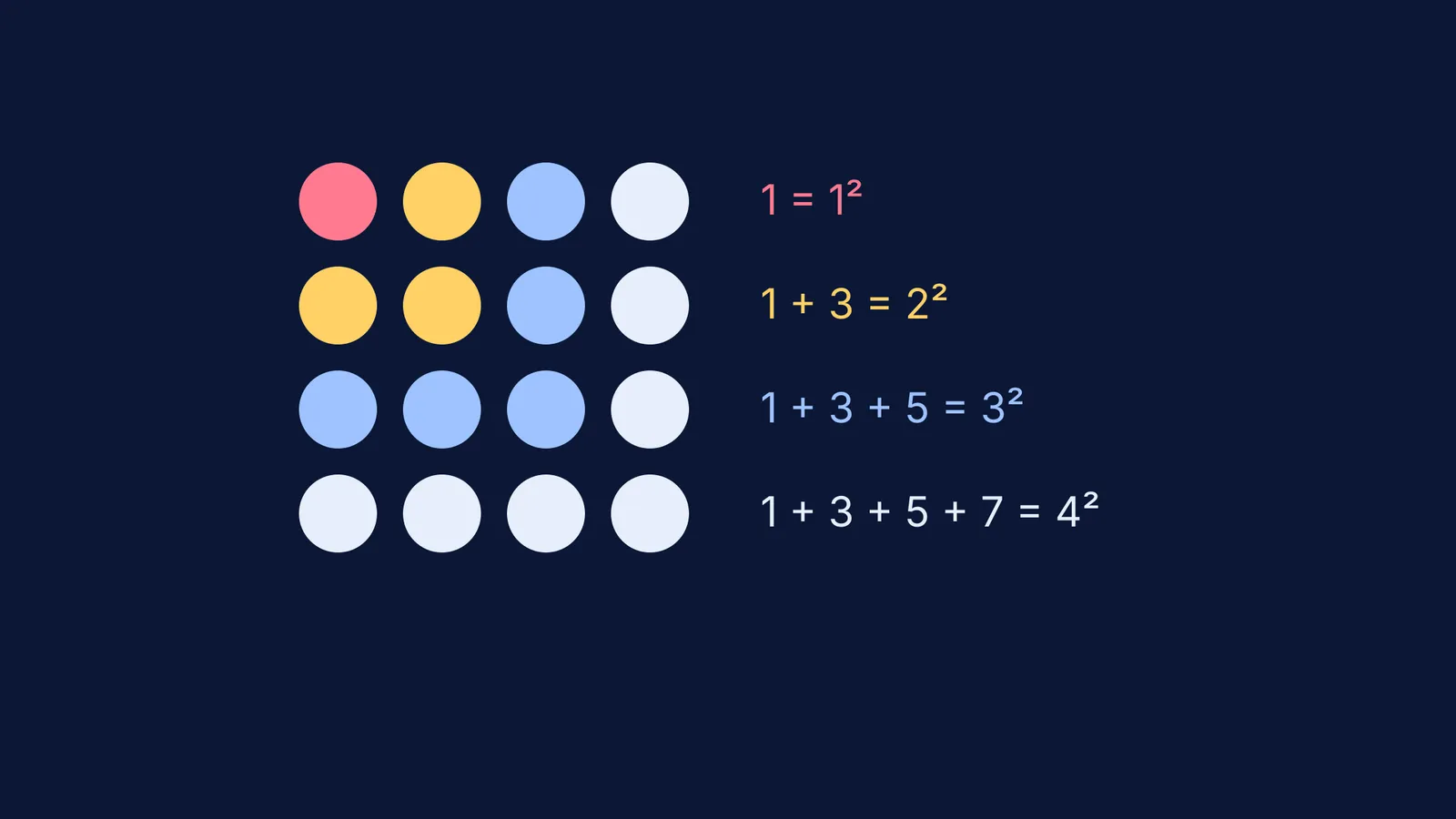
The clearest way to see this mathematical truth is by drawing it. Imagine you want to build a square grid out of dots, step by step, adding new layers as you go.
You start with 1 dot. This forms a small 1 × 1 square. Its total area is 1² = 1.
To build a 2 × 2 square, you need to add an L-shaped border around your first dot. This new border takes exactly 3 dots (one to the right, one below, and one diagonally adjacent). Your total is now 1 + 3 = 4 dots, which forms a 2² square.
To build a 3 × 3 square, you add another L-shaped border. This one takes 5 dots. Your total is now 1 + 3 + 5 = 9 dots, which forms a 3² square.
Every time you expand an n × n square to an (n + 1) × (n + 1) square, you add an L-shaped layer. The number of dots in that layer is always exactly the next odd number, (2n + 1). Because each odd number perfectly completes the next square, the sum of the first n odd numbers must be exactly the area of an n × n square: n².
How do you prove it using arithmetic progressions?
If you prefer algebra, you can derive the exact same result using the standard formula for an arithmetic progression (AP).
For an in-depth review of AP terms and sums, you can read our guide to Arithmetic progressions in Class 10: nth term and sum problems.
The sequence of odd numbers is 1, 3, 5, 7, ...
The first term (a) is 1.
The common difference (d) is 2.
We want the sum of the first n terms.
The mathematical sum of an AP is given by the formula: Sn = (n / 2) × [2a + (n − 1)d]
Substitute our values of a = 1 and d = 2 into the equation: Sn = (n / 2) × [2(1) + (n − 1)2] Sn = (n / 2) × [2 + 2n − 2] Sn = (n / 2) × [2n] Sn = n²
This simple algebraic derivation is exactly the kind of fundamental maths skill you will find in the Fermi Concept Library, which maps every concept in mathematics, each with its own lesson.
What is the formula for the sum of the first n even numbers?
If the odd numbers sum to a perfect square, what happens when we add the even numbers? The sum of the first n even numbers is n(n + 1).
The sequence of even numbers is 2, 4, 6, 8, ...
We can easily find their sum by factoring out a 2 from the entire sequence: 2 + 4 + 6 + ... + 2n = 2 × (1 + 2 + 3 + ... + n)
The part inside the brackets is just the sum of the first n natural numbers, which is given by the formula n(n + 1) / 2. Multiplying this by 2 cancels out the denominator, leaving you perfectly with n(n + 1).
Visually, n(n + 1) represents the area of a rectangle that is exactly one unit longer than it is wide. So while adding odd numbers builds perfect squares, adding even numbers builds rectangles.
As we often emphasise in our post on Sequences and series for JEE: derive the sums, don't memorise them, knowing how to break a complex sequence down into a simpler one (like pulling a 2 out of the even numbers) saves you from trying to memorise endless lists of formulas.


