

On this page
You're in the middle of a high-pressure exam like JEE or NEET, and you need to calculate √50 to finish a physics problem. Calculators aren't allowed, and you don't have time to do long division. What do you do?
What is linear interpolation?
To estimate a square root without a calculator, you can use a method called linear interpolation. This involves finding the two perfect squares that bracket your number, and assuming the square root grows at a steady, fractional rate between them.
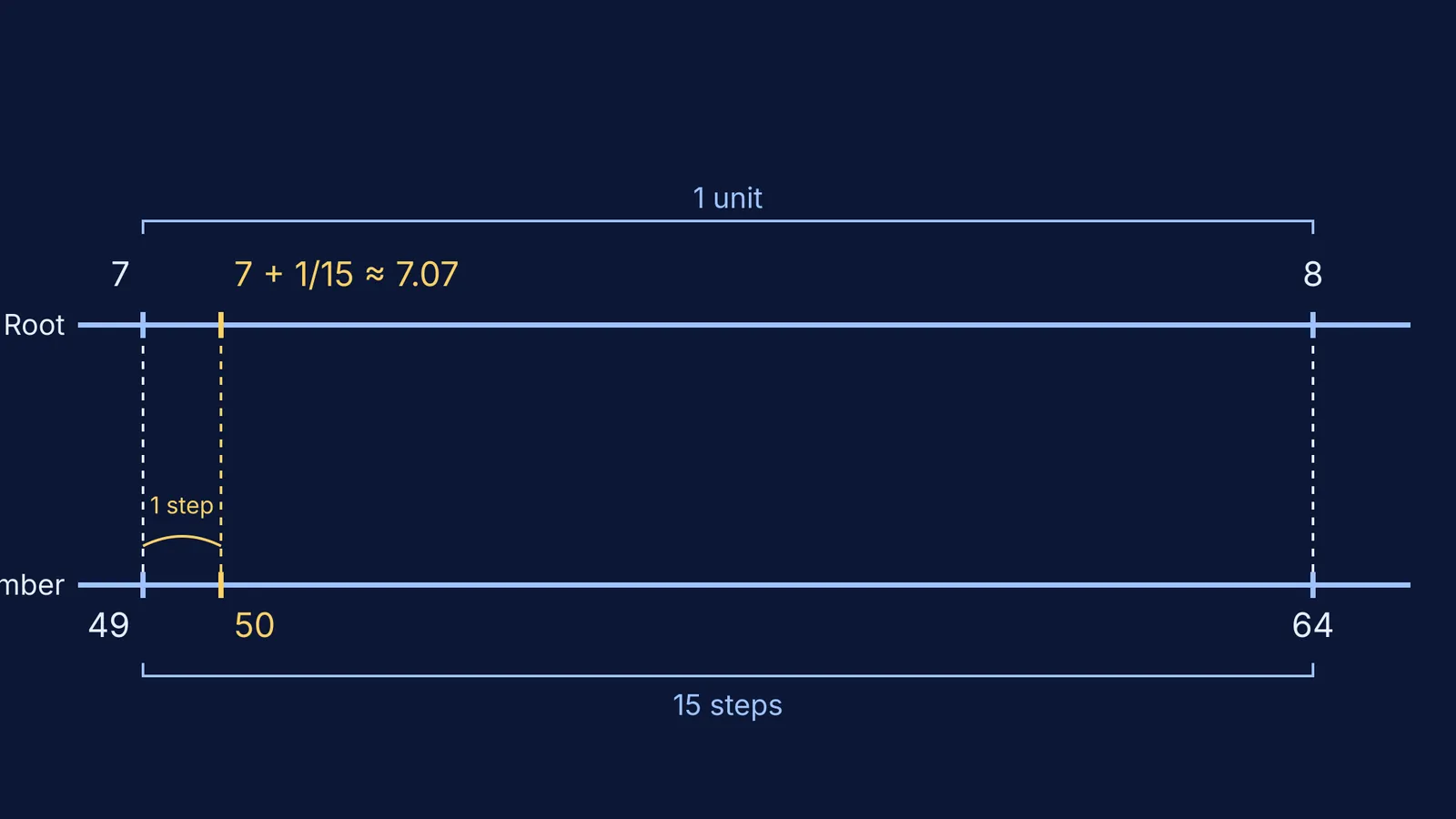
For example, √49 is 7, and √64 is 8. The number 50 sits between 49 and 64, so its square root must sit somewhere between 7 and 8. The mathematical trick is figuring out exactly where it sits in that gap. You can read more about Squares and square roots in Class 8: patterns and methods to brush up on the foundations of perfect squares.
How to estimate square roots without a calculator?
Let's walk through estimating √50 step by step using this method. Linear interpolation provides about three significant digits of accuracy.
Find the nearest perfect squares: 50 is just above 49 (7²) and below 64 (8²).
Find the total distance between the squares: 64 − 49 = 15 steps.
Find how far your number is from the lower square: 50 − 49 = 1 step.
Make a fraction: You have moved 1 step out of the 15-step gap, so your fraction is 1/15.
Add it to the lower root: Your estimate is 7 + 1/15.
Since 1/15 is roughly 0.067, we can say √50 ≈ 7.07. This is very close to the exact value of 7.071. If you find yourself frequently stuck on these calculation steps, Fermi's AI tutor works out what you already know and builds a plan for the session, keeping you moving forward instead of stalling on the math.
Estimating the square root of a larger number
The same logic applies to three-digit numbers, provided you know your larger perfect squares. Let's try to estimate √150.
Find the nearest perfect squares: 150 sits between 144 (12²) and 169 (13²).
Find the total distance between the squares: 169 − 144 = 25 steps.
Find how far your number is from the lower square: 150 − 144 = 6 steps.
Make a fraction: You have moved 6 steps out of the 25-step gap, so your fraction is 6/25.
Add it to the lower root: Your estimate is 12 + 6/25.
To convert 6/25 to a decimal easily, multiply the top and bottom by 4 to get 24/100, which is 0.24. So, √150 ≈ 12.24.
When we check this by squaring (12.24 × 12.24), we get 149.8176, which is very close to 150.
Why does this method work?
Linear interpolation works by treating a small section of the square root curve as a straight line. If you were to draw a graph of y = √x, the curve would smoothly connect the points (49, 7) and (64, 8). Linear interpolation simply draws a straight secant line between those two points.
Because the square root graph is "concave down" (it bows outward like a hill), a straight line drawn between any two points on it will always run slightly underneath the true curve. This means linear interpolation will always slightly underestimate the exact square root. However, for quick physics or chemistry calculations, this small difference rarely matters.
When to use this trick in exams
During competitive exams, you will rarely be asked to just find a square root. Instead, messy roots appear as the final step of a longer physics or chemistry problem.
Physics: In kinematics or mechanics, finding the final velocity of an object often involves taking the square root of a messy sum (like v = √(u² + 2as)). If your calculation leaves you with v = √85, you know it is between 81 (9²) and 100 (10²), specifically 9 + 4/19 ≈ 9.21.
Chemistry: When calculating the solubility product or equilibrium constants, you frequently need to take square roots of concentrations. Linear interpolation lets you keep moving without getting stuck.
Multiple-choice questions: If the answers are spread far apart, you don't even need the exact fraction. Knowing that 85 is much closer to 81 than to 100 tells you the answer is on the lower end of the 9-to-10 gap.
Checking your estimate by squaring
Always verify your estimate to make sure you haven't made a careless error. You can do this by squaring your answer.
Let's test our estimate of 7.07: 7.07 × 7.07 = 49.9849
Since 49.98 is very close to 50, you know your estimate is solid. Whether you are learning the Square root of a complex number: the method and JEE uses or dealing with messy physics formulas, a quick check by squaring saves valuable marks.
For a deeper dive into the mathematical ideas behind functions and curves, you can explore every concept in physics, chemistry, biology, mathematics and computing in the Concept Library.


