

On this page
Most household electrical problems simply come down to matching the right appliance with the right plug and wiring. If you plug a heavy load into a weak socket, it overheats and could start a fire. A classic physics problem for JEE and board exams is calculating exactly how much current a 1000 W heater draws. Let's work through the numbers.
How much current does a 1000 W heater draw?
The relationship between electrical power (P), voltage (V) and current (I) is one of the most useful rules in physics: P = V × I. Rearranging this to find current gives I = P / V.
To solve this properly, we need to know the supply voltage. The standard household single-phase voltage in India is 230 V, according to the Bureau of Indian Standards document IS 12360:1988. Many older physics textbooks still use 220 V or 240 V in their examples, but 230 V has been the official nominal voltage for many years, harmonising India's grid with international IEC standards.
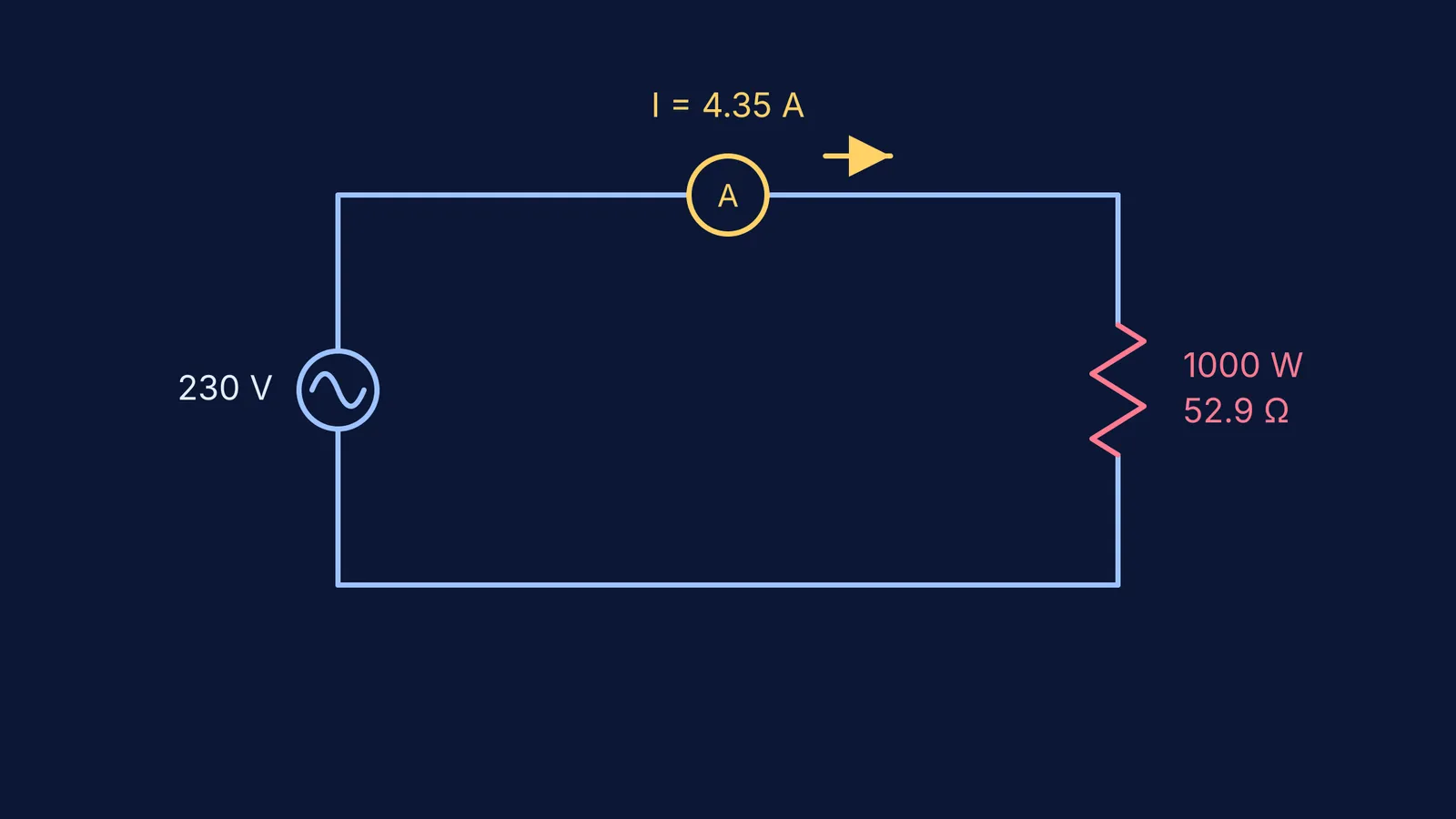
For a 1000 W heater operating at a steady 230 V:
P = 1000 W
V = 230 V
I = 1000 / 230 = 4.3478... A
So, a 1000 W heater draws approximately 4.35 A of current when the voltage is exactly 230 V. If the grid voltage fluctuates and drops to 210 V or spikes to 250 V, the current drawn will also change, which is why real-world electrical measurements often vary slightly from textbook calculations.
If you want to practice more circuit problems and master these calculations, explore the Fermi Problem Library.
Which plug and socket should you choose?
Once you calculate the current, the next practical question is whether you can safely plug this heater into a normal wall socket. In India, standard household sockets are rated for either 6 A or 16 A, governed by the IS 1293:2019 standard.
Since our 1000 W heater draws only 4.35 A, it safely fits into a standard 6 A socket. This is the smaller socket type commonly used for televisions, fans, and phone chargers. The internal wiring for a 6 A socket is thick enough to handle the 4.35 A load continuously without overheating.
However, if you upgrade to a 1500 W or 2000 W room heater, the current demand rises significantly to 6.5 A or 8.7 A. These currents will overload a standard 6 A plug and socket. Over time, the excess current will cause the metal contacts to heat up, potentially melting the plastic casing and starting a fire. For these larger appliances, you must use a larger 16 A socket (often called a "power socket"), which features wider pins and heavier internal copper wiring. If a socket or plug ever gets hot to the touch while an appliance is running, it is a clear warning sign that it is pulling too much current for its rating.
What is the resistance of the heating element?
An electric heater works on the principle of Joule heating. It forces current through a high-resistance wire (typically made of an alloy like nichrome), converting electrical energy directly into thermal energy. We can calculate this resistance (R) by combining Ohm's law (V = I × R) with the power formula, giving us: P = V² / R.
Rearranging this equation to solve for resistance:
R = V² / P
R = (230)² / 1000
R = 52900 / 1000
R = 52.9 Ω
The heating element has a resistance of precisely 52.9 ohms. This resistance is a physical property of the nichrome wire used inside the heater. Understanding how Stretching a wire: how its resistance changes with length affects this value is another common exam topic. Resistance depends on the wire's length, cross-sectional area, and material. If the manufacturer decided to use a longer or thinner wire, the total resistance would increase. Paradoxically, because P = V² / R, a higher resistance at a constant voltage would actually *decrease* the overall power output and the amount of heat produced!
This fundamental logic applies not just to a single heater, but to large networks of resistors in any electrical system. Once you know the resistance of each individual component, you can use techniques like the Node potential method: solving circuits by assigning voltages to map out the voltage drops and find the exact current flowing through every branch of a complex house wiring diagram.
By mastering these basic relationships between power, voltage, current, and resistance, you build a strong foundation for both advanced physics exams and everyday electrical safety.


