

On this page
Take a 60 W bulb, put a multimeter across its pins and you will read a few tens of ohms. Work out its resistance from the rating with R = V²/P and you get several hundred. Neither the meter nor the formula is wrong. They are measuring the same wire at two very different temperatures.
Why is bulb resistance higher when glowing?
In a metal, the current is carried by free electrons, and what resists them is mostly collisions with the vibrating lattice of atoms. Heat the metal and the atoms vibrate harder, so electrons are scattered more often and resistivity goes up. A 2017 review of tungsten's properties by P. Tolias in Nuclear Materials and Energy notes that, except in very impure samples, collisions between electrons and lattice vibrations (phonons) already dominate from room temperature (open-access version on arXiv).
A bulb filament is tungsten, and it runs extremely hot. A 1919 paper by Benj. E. Shackelford on temperatures of incandescent-lamp filaments reports that most of the more common sizes of tungsten lamps have temperatures ranging from 2500 to 3000 K. That is more than 2,000 kelvin above room temperature.
How much bigger is the hot resistance?
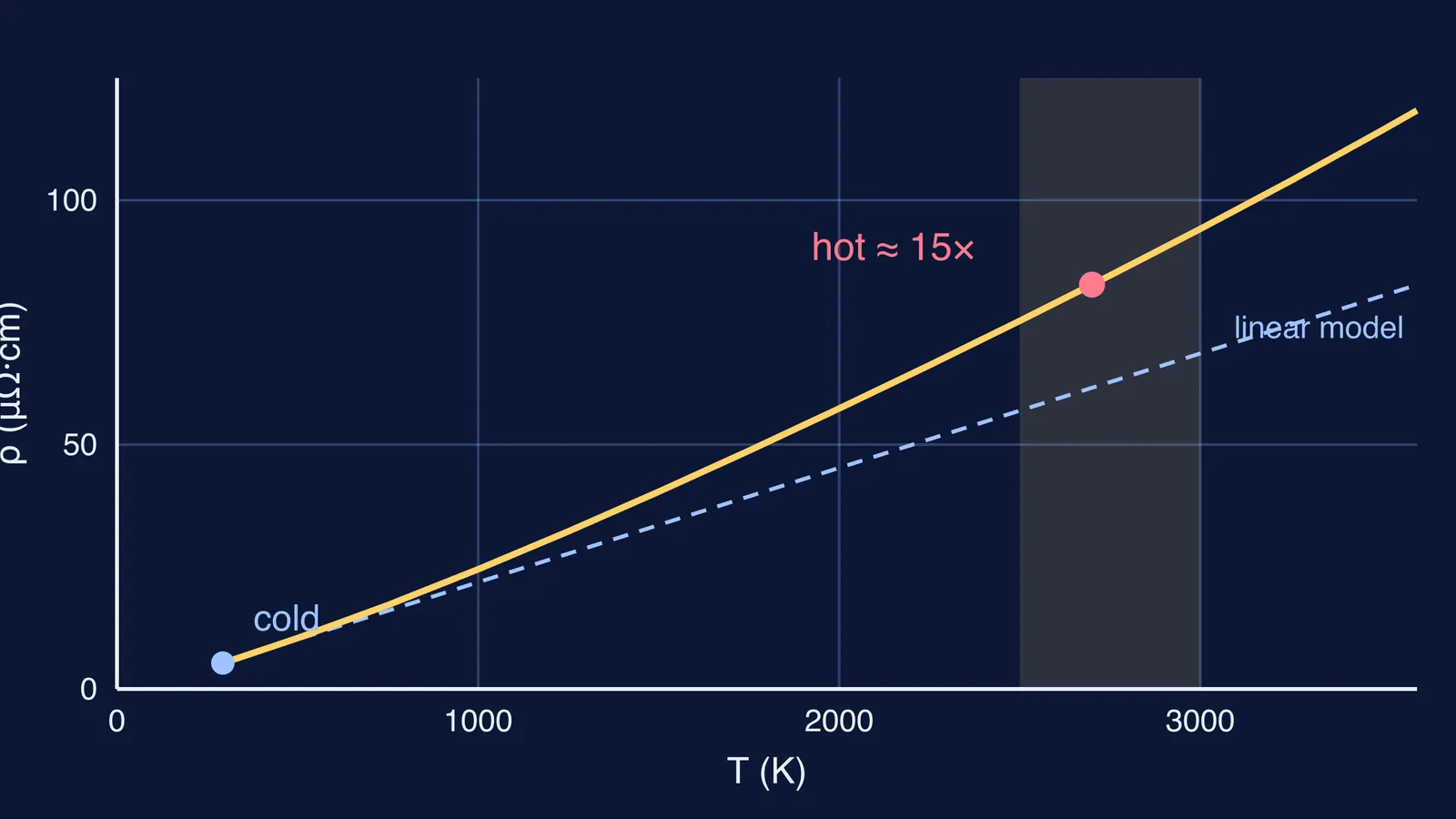
The Tolias review notes that Desai and colleagues analysed all 201 experimental datasets then available for tungsten's resistivity in 1984, and that White and Minges later fitted the recommended values from 100 K to 3,600 K with a 0.2% rms deviation (Tolias 2017, arXiv). Putting temperatures into that published White–Minges formula gives these values (our calculation):
293 K (room temperature): about 5.3 μΩ·cm
2,500 K: about 75 μΩ·cm, roughly 14 times the room value
2,700 K: about 83 μΩ·cm, roughly 15.6 times
3,000 K: about 94 μΩ·cm, roughly 17.7 times
A tungsten filament at 2,700 K has roughly 15 times the resistivity it has at room temperature (Tolias 2017). An independent table on The Physics Factbook gives 5.65 μΩ·cm at 300 K and 92.04 μΩ·cm at 3,000 K, a ratio of about 16, so the two sources agree.
Resistance is R = ρL/A. The wire's length and thickness change very little compared with this huge change in ρ, so the bulb's resistance rises almost exactly as much as the resistivity does.
Why does R = R₀(1 + αΔT) give the wrong answer?
The textbook formula assumes a straight line. The slope of the White–Minges curve at room temperature gives α ≈ 0.0044 per kelvin for tungsten (our calculation from the Tolias review). Using that over a 2,400 K rise predicts 1 + 0.0044 × 2,400 ≈ 11.6 times the cold value. The real figure at 2,700 K is about 15.6 times. The curve bends upward, which the dashed straight line in the diagram above misses.
Worked example: what does a 60 W, 230 V bulb really draw?
Assume the filament runs at 2,700 K, where the resistivity ratio from the White–Minges fit is about 15.6.
Hot resistance from the rating: R = V²/P = 230² ÷ 60 ≈ 882 Ω.
Running current: I = P/V = 60 ÷ 230 ≈ 0.26 A.
Cold resistance: 882 ÷ 15.6 ≈ 57 Ω. That is roughly what a multimeter shows: its tiny test current cannot heat the wire.
Current at the instant of switching on, in this simple model: 230 ÷ 57 ≈ 4 A, about 15 times the running current.
As the filament heats, its resistance rises and the current falls back to 0.26 A.
The same effect makes a bulb's V–I graph curve. If reading resistance off a graph still trips you up, see how to find resistance from the slope of a V–I graph. For why tungsten is chosen at all, read why tungsten is used in bulbs and nichrome in heaters.
How should you handle bulbs in exam questions?
A quick checklist before you start calculating:
If the question gives a rating such as 60 W, 230 V, the resistance you get from V²/P is the hot, working resistance.
If it says to treat resistance as constant, do so, even though a real filament does not behave that way.
If it shows a V–I curve that bends toward the voltage axis, that is a filament heating up as current rises.
For heating wires cut or rejoined, see why a heater coil cut in half doubles its power.
If resistivity and the temperature coefficient still feel shaky, the Fermi Concept Library gives each concept in physics its own lesson and its place in the map. To practise numericals like the one above, the Fermi Problem Library has worked problems with a step-by-step solver that explains the reasoning rather than printing an answer.
Next time you see a bulb rating, try working out its cold resistance first, then check it with a multimeter.


