

On this page
Every electric heater, toaster and filament bulb in your home runs on one idea from Class 10 Science: current flowing through a resistance makes heat. Joule's law of heating gives that heat as H = I²Rt, so heat grows with the square of the current, with the resistance and with the time (NCERT Class 10 Science, Chapter 11: Electricity). What changes is the material, and tungsten, nichrome and copper each solve a different problem.
Why is tungsten used in bulb filaments?
In a filament bulb, the heating effect is used to make light. NCERT says the filament must keep as much of its heat as possible so that it gets very hot and emits light, and it must not melt at that temperature (NCERT Class 10 Science, section 11.7.1).
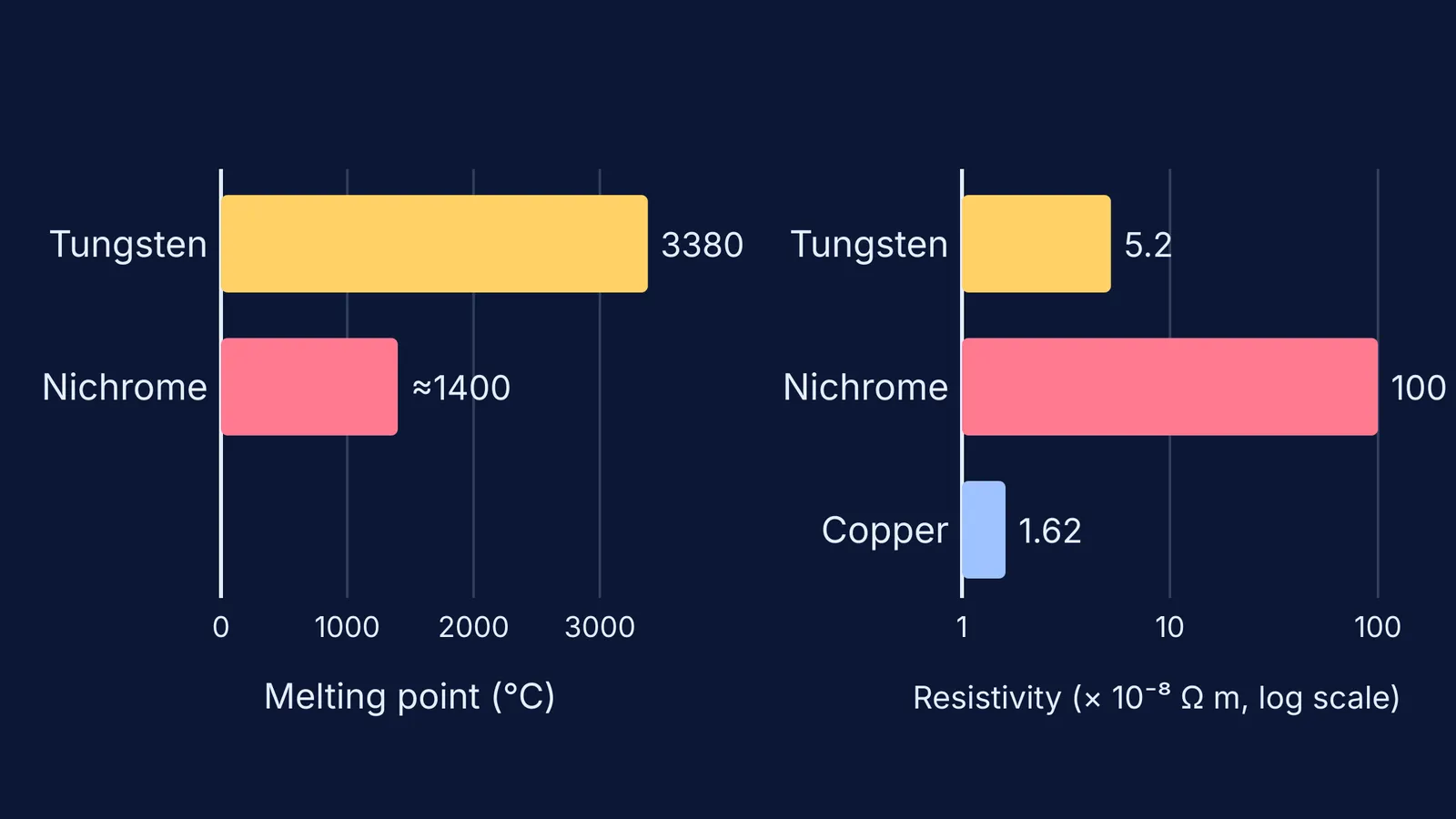
NCERT names tungsten, which melts at 3380 °C, as the strong, high-melting-point metal used for bulb filaments (NCERT, section 11.7.1).
Nichrome of the common Ni80/Cr20 grade (80% nickel, 20% chromium) melts at about 1400 °C (Goodfellow material data for Ni80/Cr20), less than half of tungsten's figure.
The bulb is also filled with chemically inactive nitrogen and argon to make the filament last longer, and NCERT notes that most of the power a filament uses still comes out as heat, with only a small part radiated as light (NCERT, section 11.7.1). See also why bulbs usually fuse at the moment you switch them on.
Why is nichrome used in heaters instead of a pure metal?
A heater must make a lot of heat, in open air, for years. Two properties matter.
High resistivity. Nichrome's resistivity is about 100 × 10⁻⁸ Ω m at 20 °C, roughly 60 times copper's 1.68 × 10⁻⁸ Ω m (HyperPhysics resistivity table).
It does not burn away. NCERT says the resistivity of an alloy is generally higher than that of its constituent metals, and that alloys do not oxidise (burn) readily at high temperatures, which is why they are used in electric irons and toasters (NCERT, section 11.5). On Ni80/Cr20 nichrome, a protective chromium oxide (Cr2O3) layer forms on the surface and stops further oxidation, and the wire can run continuously at up to about 1100 °C (Goodfellow).
A heater coil works in open air, with no sealed glass or inert gas around it, so resistance to oxidation matters as much as resistivity. For a heater that works in water instead, see how an immersion rod heats a bucket of water.
Why is copper used for electrical wires?
Wires are the opposite case: you want almost no heat. NCERT's Table 11.2 lists copper's resistivity as 1.62 × 10⁻⁸ Ω m, lower than every conductor in the table except silver, and says copper and aluminium are generally used for electrical transmission lines (NCERT, section 11.5). Low resistance means little I²R heat, so energy reaches the appliance instead of warming the cord. A fuse is the deliberate exception: see why a fuse wire's rating depends on its radius.
Why does the heater coil glow while the cord stays cool?
NCERT asks this as an in-text question. In its Example 11.3, a heater coil of 100 Ω on a 220 V supply draws 2.2 A (NCERT, Example 11.3). Now assume a copper cord 2 m long in total with a cross-section of 1 mm² (our assumed values).
Cord resistance: R = ρl/A = (1.62 × 10⁻⁸ × 2) ÷ (1 × 10⁻⁶) = 0.0324 Ω.
The coil and cord are in series, so the same 2.2 A flows through both.
Heat per second in the coil: I²R = 2.2² × 100 = 484 W.
Heat per second in the cord: 2.2² × 0.0324 ≈ 0.16 W.
Compare: the coil makes about 3,000 times more heat than the cord.
With the current the same, heat is proportional to resistance.
The same formula shows why heater coils are compact. For a 100 Ω element of wire with a cross-section of 0.1 mm², l = RA/ρ gives about 10 m of nichrome (using the HyperPhysics value, 1.0 × 10⁻⁶ Ω m) but about 617 m of copper. Coiled, 10 m fits in a heater.
How do you answer this in a board exam?
For any "why is this material used" question:
State the device's job: make light, make heat, or carry current.
State the property that job needs: high melting point, high resistivity, resistance to oxidation, or low resistivity.
Name the material and link it to H = I²Rt.
Add a supporting detail: inert gas in bulbs, alloys not oxidising in heaters.
One caution on numericals: the NCERT table prints nichrome as 100 × 10⁻⁶ Ω m, while the HyperPhysics table gives 100 × 10⁻⁸ Ω m and Goodfellow gives 1.08 to 1.12 μΩ m. In an exam, always use the value the question gives you.
If rearranging R = ρl/A is where you lose marks, the Fermi Problem Library has worked problems with a step-by-step solver that explains the reasoning rather than printing an answer. If the gap is the idea itself, resistivity and Joule heating each have a lesson in the Fermi Concept Library.


