

On this page
When you flip the switch on an old incandescent lamp, it is overwhelmingly at that exact moment that the bulb chooses to pop, flash brilliantly for a fraction of a second, and go dark forever. It rarely happens after the bulb has been glowing steadily for an hour.
This sudden failure is a classic physics problem. It comes down to the relationship between temperature and electrical resistance, the concept of inrush current, and what happens to a tungsten wire as it ages over hundreds of hours of use.
Why do bulbs usually fuse when switched on?
The short answer is a massive, instantaneous surge of electricity.
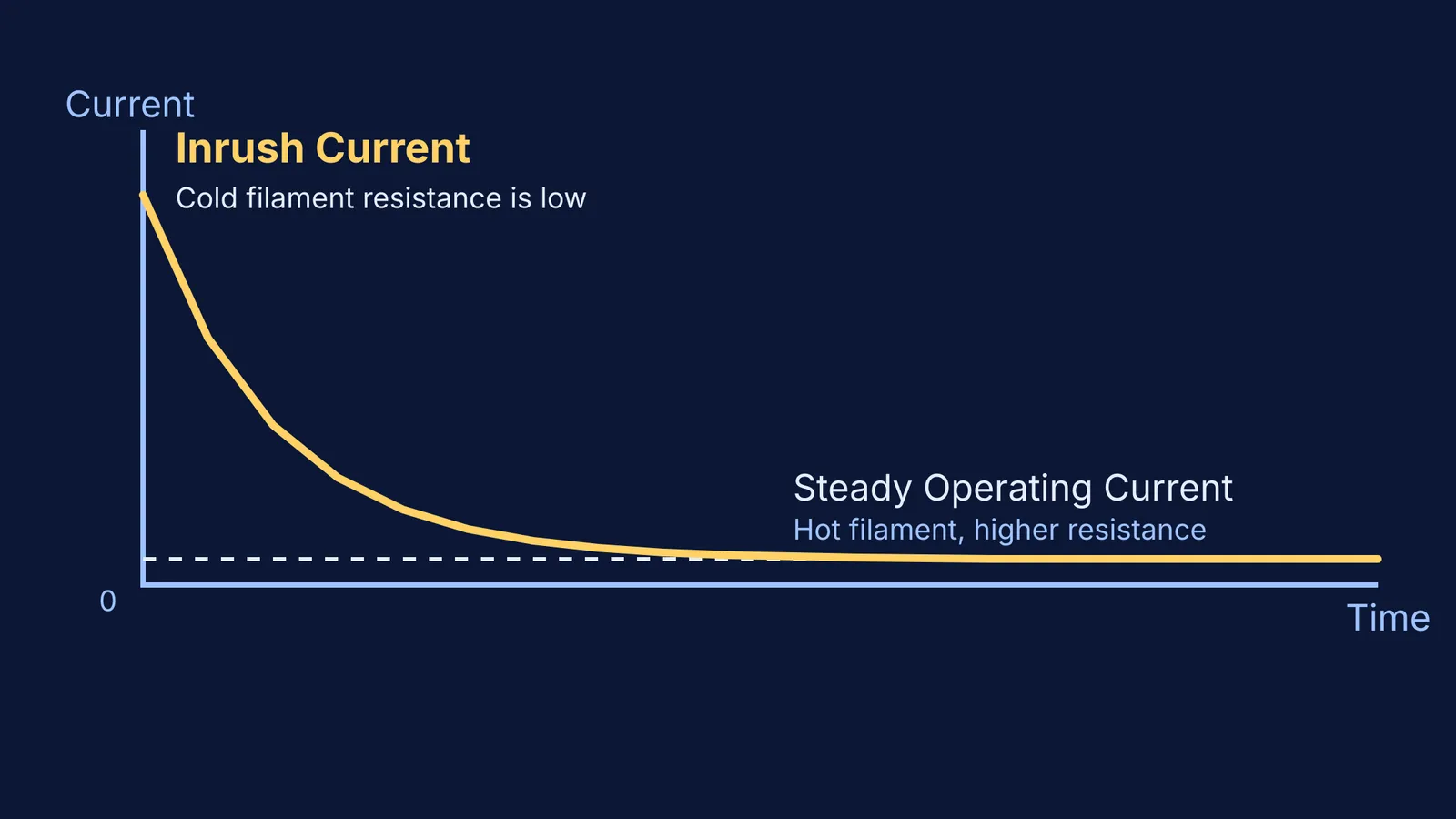
A standard light bulb uses a thin coiled tungsten filament. Like most metals, tungsten has a positive temperature coefficient of resistance. This means its resistance goes up significantly as it gets hotter. When a bulb has been sitting off in a room, its filament is at ambient temperature, and its electrical resistance is at its absolute lowest.
Because the resistance is so low when cold, turning the switch on allows a huge current to flow instantly. According to data on incandescent bulbs from Wikipedia, a filament's hot resistance is 10 to 15 times greater than its cold resistance. Therefore, the initial current that surges through the cold wire is 10 to 15 times greater than the steady operating current. This violent electrical surge forces the wire to heat up to its operating temperature of 2,000 to 3,300 K in just a few milliseconds.
If the filament were perfectly uniform, it would survive this repeated thermal shock indefinitely. But bulbs age. Over time, the extreme heat causes the solid tungsten atoms to sublimate—turning directly into a gas and depositing on the inside of the glass (which is why old bulbs often look black and sooty). To slow down this sublimation process, modern incandescent bulbs are filled with an inert gas like argon or nitrogen, rather than a pure vacuum. The gas atoms bounce the evaporating tungsten atoms back towards the filament, extending the bulb's life. However, even with this protection, uneven evaporation is inevitable.
It creates microscopic "hot spots" where the wire has become slightly thinner than the rest. These thin spots have a smaller cross-sectional area, giving them a higher local resistance than the thicker parts of the filament.
When the switch-on surge hits the wire, I²R heating dictates that heat generation is proportional to resistance. The thin spots heat up much faster and reach far higher temperatures than the rest of the filament. The concentrated, intense heat combined with the rapid, uneven mechanical expansion acts like a microscopic hammer blow. This immense localized stress causes the filament to melt, vaporise, and snap violently at its weakest point.
How does temperature change resistance?
The physical formula that governs how metals respond to heat is:
R = R₀ [1 + α(T - T₀)]
Here, R₀ is the cold resistance at a reference temperature T₀, α is the temperature coefficient of resistance, and T is the final temperature. Because tungsten's α is positive, the resistance climbs steeply as the temperature increases by thousands of degrees.
Once the bulb reaches its glowing white-hot state, that high resistance acts as a natural brake. It chokes the flow of electricity down to a steady, safe trickle that maintains the temperature without destroying the wire. If you are studying for your board exams or JEE, you will often need to calculate this exact change. You can read our guide on the Temperature coefficient of resistance for worked examples showing how to use the formula.
How do you approach bulb problems in exams?
In physics problems, examiners love to test your intuition about the heating effect of current, power dissipation, and the behaviour of non-ohmic components like bulbs. Here is a practical checklist for solving them without getting tricked:
Never assume resistance is constant: If a problem compares a cold bulb to a glowing bulb, or asks about the current at the exact moment a switch is closed, you must account for the temperature coefficient. The cold resistance is merely a fraction of the operating resistance.
Power ratings are for operating temperature: When a bulb is stamped with a rating like "100 W, 220 V", the resistance you calculate using R = V² / P is the *hot* resistance. If you connect this bulb to a 10 V battery, its resistance will be substantially lower than that calculated value.
Series vs parallel brightness: This is a classic trap. In a series circuit, current is constant, so power dissipated is P = I²R. The bulb with the *higher* resistance (which corresponds to a lower power rating) will glow brighter. In a parallel circuit, voltage is constant, so power is P = V² / R. The bulb with the *lower* resistance (the higher power rating) glows brighter.
Fuses and inrush current: When calculating the required fuse rating for a lighting circuit, you must remember that the initial current is much higher than the steady state. However, because this surge only lasts a few milliseconds, a standard household fuse or circuit breaker is usually designed with a slight delay so it does not trip every time you turn the lights on.
If the relationship between current, resistance and temperature is hard to picture, you can explore it in the Fermi Simulation Lab. It provides interactive simulations for the ideas that are easier to see than to read, allowing you to observe how changing a material's properties affects the flow of electricity in real time.


