On this page
Questions on the heating effect of current look easy until two formulas give opposite answers. Does a bigger resistance make more heat or less? Why does a 60 W bulb sometimes glow brighter than a 100 W bulb? This post works through the physics, the energy units on an electricity bill, and fuse ratings, with the mistakes that cost marks.
What is the heating effect of current, and which exams test it?
When charges move through a resistor, collisions with the atoms turn electrical energy into heat. The NCERT Class 10 chapter on Electricity calls this Joule's law of heating: the heat produced is H = I²Rt. The Class 12 chapter on Current Electricity writes the power as P = I²R = V²/R.
The topic sits in CBSE Class 10 and 12, in the JEE (Main) 2026 syllabus under "electrical energy and power", and in the JEE (Advanced) 2026 syllabus as "Heating effect of current". Check the syllabus for your own exam year.
Which power formula should you use?
All three forms, P = VI, P = I²R and P = V²/R, are the same law. The skill is choosing the one that holds the fixed quantity.
Parallel circuits and household wiring: every appliance gets the same voltage, so use P = V²/R. A smaller resistance means more power.
Series circuits: every element carries the same current, so use P = I²R. A larger resistance means more power.
A rating such as "100 W, 220 V" tells you the resistance, since R = V²/P. It does not promise 100 W in every circuit.
Worked example: two bulbs in series
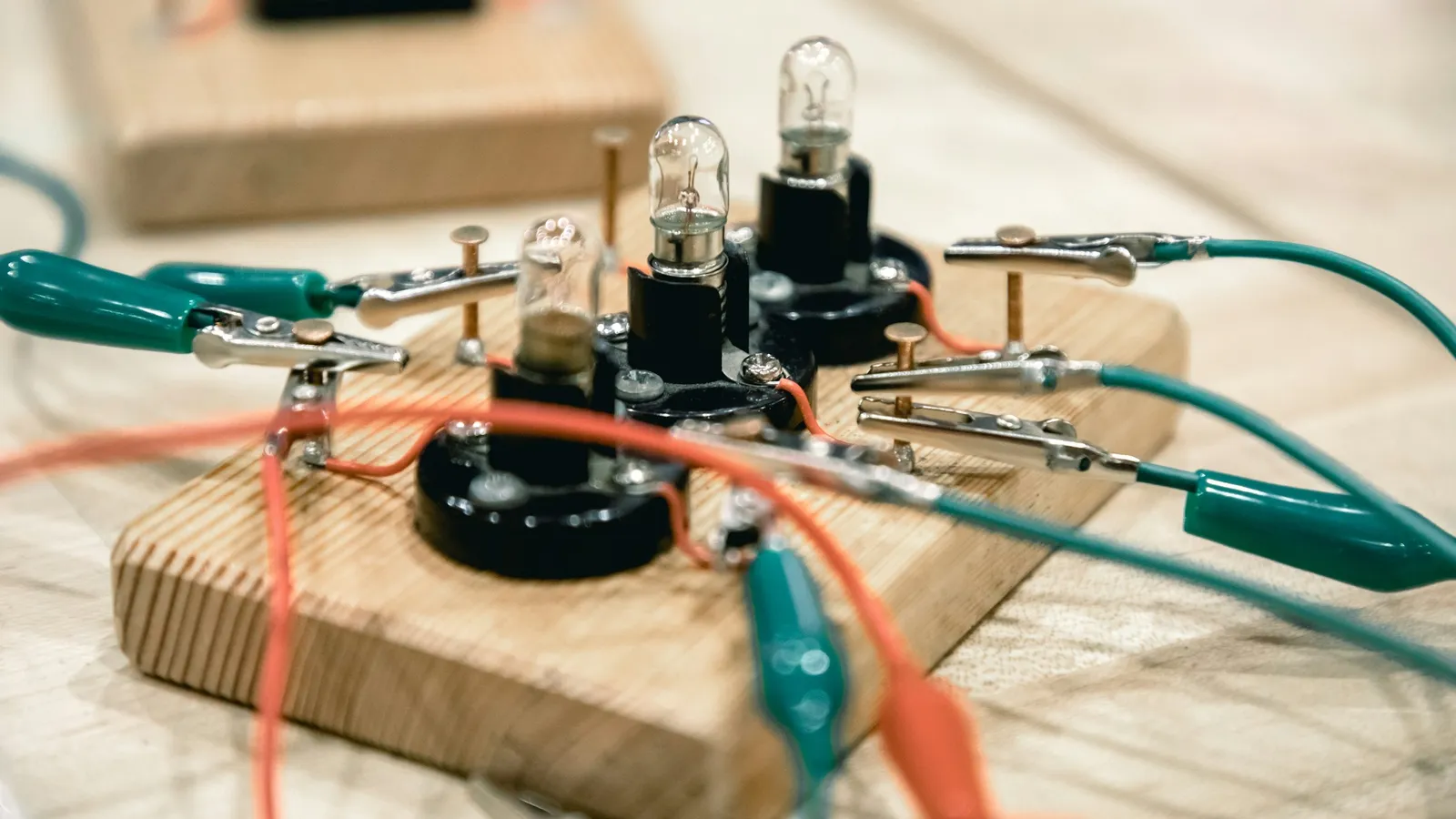
A 60 W bulb and a 100 W bulb, both rated for 220 V, are connected in series across 220 V. Which glows brighter?
Resistances: R₆₀ = 220²/60 = 806.7 Ω and R₁₀₀ = 220²/100 = 484 Ω.
Current: I = 220 / (806.7 + 484) = 220 / 1290.7 = 0.170 A.
Power in each: P₆₀ = I²R₆₀ = 0.0291 × 806.7 = 23.4 W, and P₁₀₀ = 0.0291 × 484 = 14.1 W.
The 60 W bulb glows brighter, because in series the larger resistance takes the larger share of the power. Together they use only 37.5 W, less than either bulb would use alone. Connected in parallel across 220 V, each bulb gets its rated voltage and the 100 W bulb is brighter.
How is an electricity bill calculated?
The bill counts energy, not power. NCERT's Electricity chapter defines the commercial unit as the kilowatt hour, "commonly known as 'unit'", with 1 kW h = 3.6 × 10⁶ J. It also makes a point students often miss: we pay for energy, not for electrons, which are not used up.
Example. A 2000 W room heater runs on 220 V for 2 hours a day for 30 days.
Current: I = P/V = 2000/220 = 9.09 A. Resistance: R = V²/P = 220²/2000 = 24.2 Ω.
Energy: 2 kW × 2 h × 30 = 120 kW h, which is 120 units.
Cost: at an assumed tariff of ₹7 per unit, 120 × 7 = ₹840. Real tariffs vary by state and by slab, so read your own bill.
In joules, 120 kW h = 120 × 3.6 × 10⁶ = 4.32 × 10⁸ J. Board questions often ask for both.
How does a fuse protect a circuit?
A fuse is a short wire with a low melting point placed in series with the appliance. NCERT explains that if a current larger than the rated value flows, the wire heats, melts and breaks the circuit. Its example: an iron that uses 1 kW at 220 V draws 1000/220 = 4.5 A, so a 5 A fuse is used. Choose the smallest standard rating above the normal current. A fuse rated far above it will not melt in time to protect the appliance.
What are the common mistakes?
Using the rated power as the actual power. Ratings give R. Recalculate the power in the new circuit.
Mixing W and kW, or seconds and hours. Units on a bill are kW × h. Joules are W × s.
Thinking current is used up. The same current flows into and out of a bulb. Energy is transferred, not charge.
Forgetting that resistance changes with temperature. A filament's resistance when hot is much larger than when cold; NCERT's toaster example in Current Electricity shows the same effect for nichrome.
If series and parallel arrangements still trip you up, our post on combination of resistors problems builds the circuit-reduction step first, and power and efficiency covers power in mechanics.
A practice routine for this topic
Write the fixed quantity (V or I) before choosing a formula.
Solve three series-versus-parallel bulb problems, predicting the brighter bulb before calculating.
Take one month's electricity bill at home, read the units, and check the cost against the tariff printed on it.
For every appliance in one room, read the power rating and pick a fuse rating.
When a problem goes wrong and you cannot see why, the Fermi Problem Library has worked problems with a step-by-step solver that explains the reasoning rather than printing an answer, so you can find the step where your choice of formula slipped.
Tonight, redo the two-bulb example in parallel and check that the 100 W bulb comes out brighter.