

On this page
If you connect a wire to a battery and measure the voltage (V) and current (I), you can plot those numbers on a graph to find the wire's resistance. In 1827, German physicist Georg Ohm published his measurements of applied voltage and current, establishing the relationship we now call Ohm's law (Wikipedia). For an ohmic conductor at a constant temperature, the current is directly proportional to the potential difference.
But when you calculate the slope of the line, does it give you the resistance or something else? And how can you tell which of two wires has higher resistance just by looking at the graph? The answer depends entirely on which variable is on the y-axis.
Is it a V-I graph or an I-V graph?
Most exam mistakes happen when students see a straight line and immediately assume a steeper slope equals higher resistance. You must check the axes first.
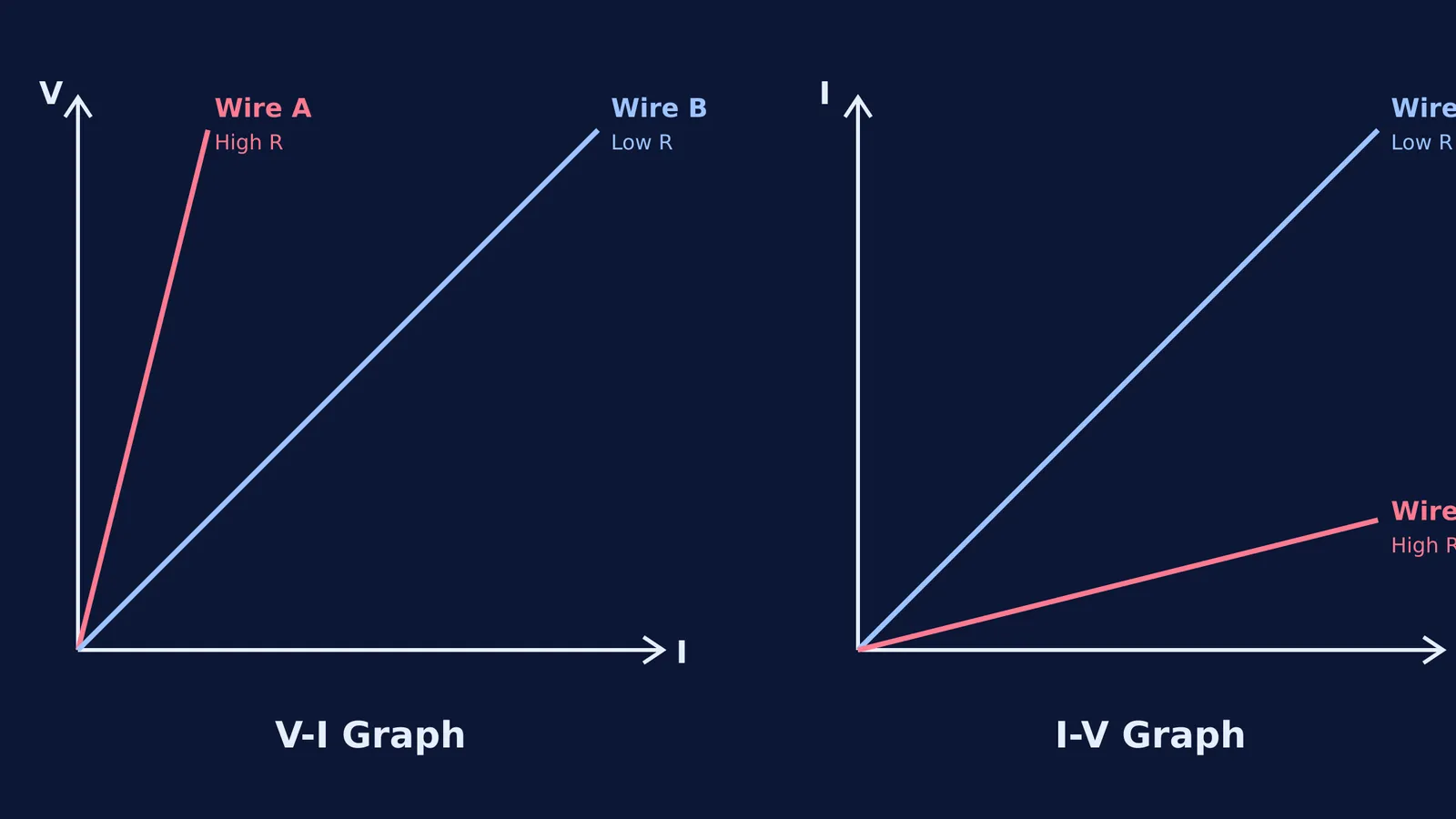
In a V-I graph, the voltage (V) is plotted on the vertical y-axis and the current (I) is on the horizontal x-axis.
The slope formula is Δy / Δx, which here is ΔV / ΔI.
Because resistance is defined as R = V / I, the slope of a V-I graph equals the resistance (R).
A steeper line means a larger change in voltage causes only a small change in current, so the resistance is high.
In an I-V graph, the axes are swapped. Current (I) is on the vertical y-axis and voltage (V) is on the horizontal x-axis.
The slope is now ΔI / ΔV.
This fraction is the reciprocal of resistance (1/R) (Physics Classroom).
A steeper line means a small change in voltage drives a large current, so the resistance is low.
How can you tell which wire has higher resistance?
Imagine two wires, A and B, plotted on the same axes.
If the graph is a V-I graph, the steeper line has a larger slope. Since slope equals R, the steeper line has a higher resistance.
If the graph is an I-V graph, one wire will still be steeper than the other. But because the slope equals 1/R, a larger slope mathematically means a smaller resistance. In an I-V graph, the steeper line has the lowest resistance.
Does every straight line obey Ohm's law?
Not every straight line represents an ohmic conductor. For a component to obey Ohm's law, its resistance must remain constant regardless of the voltage applied.
Graphically, this means the line must be straight and it must pass exactly through the origin (0,0). A straight line with a non-zero y-intercept implies that there is a voltage without any current (or a current without any voltage).
If a graph curves—like the I-V graph of a filament bulb—the resistance is changing. For a bulb, as the current increases, the wire heats up and its resistance increases, causing the slope of the I-V graph to flatten out.
How does Fermi help you see the difference?
Memorising formulas like "slope equals R" works until the examiner swaps the axes. The Fermi Concept Library contains a lesson for every concept in physics. When you study Ohm's law, Fermi's AI tutor teaches through the material by drawing the figure and checking your understanding as it goes, so you see exactly why the axes matter.
If you are stuck on a past paper where you have to rank three wires, bring it to the Fermi Problem Library. The step-by-step solver explains the reasoning rather than printing an answer, guiding you to check the axes and deduce the physical meaning yourself. Read more about how to solve physics problems step by step or why you should learn physics from first principles, not formulas.


