

On this page
A heater coil is a resistor. Plug it into a wall socket and the socket fixes the voltage, not the current. That one fact decides every version of this question.
Why does cutting a heater coil in half double its power?
Start with two results from the NCERT Class 12 chapter on current electricity: the resistance of a wire is R = ρl/A, so it is proportional to length, and the power dissipated in a resistor is P = I²R = V²/R (NCERT Physics Part I, Chapter 3). The same chapter notes that this is the power that heats up the coil of an electric bulb.
Cut the coil in half and keep one piece. Same metal, same thickness, half the length, so R becomes R/2. The voltage is still the mains voltage V. So the new power is V²/(R/2) = 2V²/R, which is twice the original power.
The current doubles too, from V/R to 2V/R. OpenStax states the general rule plainly: at a given voltage, the lower the resistance connected, the greater the power delivered (OpenStax College Physics 2e, section 20.4).
What happens if the coil is folded, stretched or joined in series?
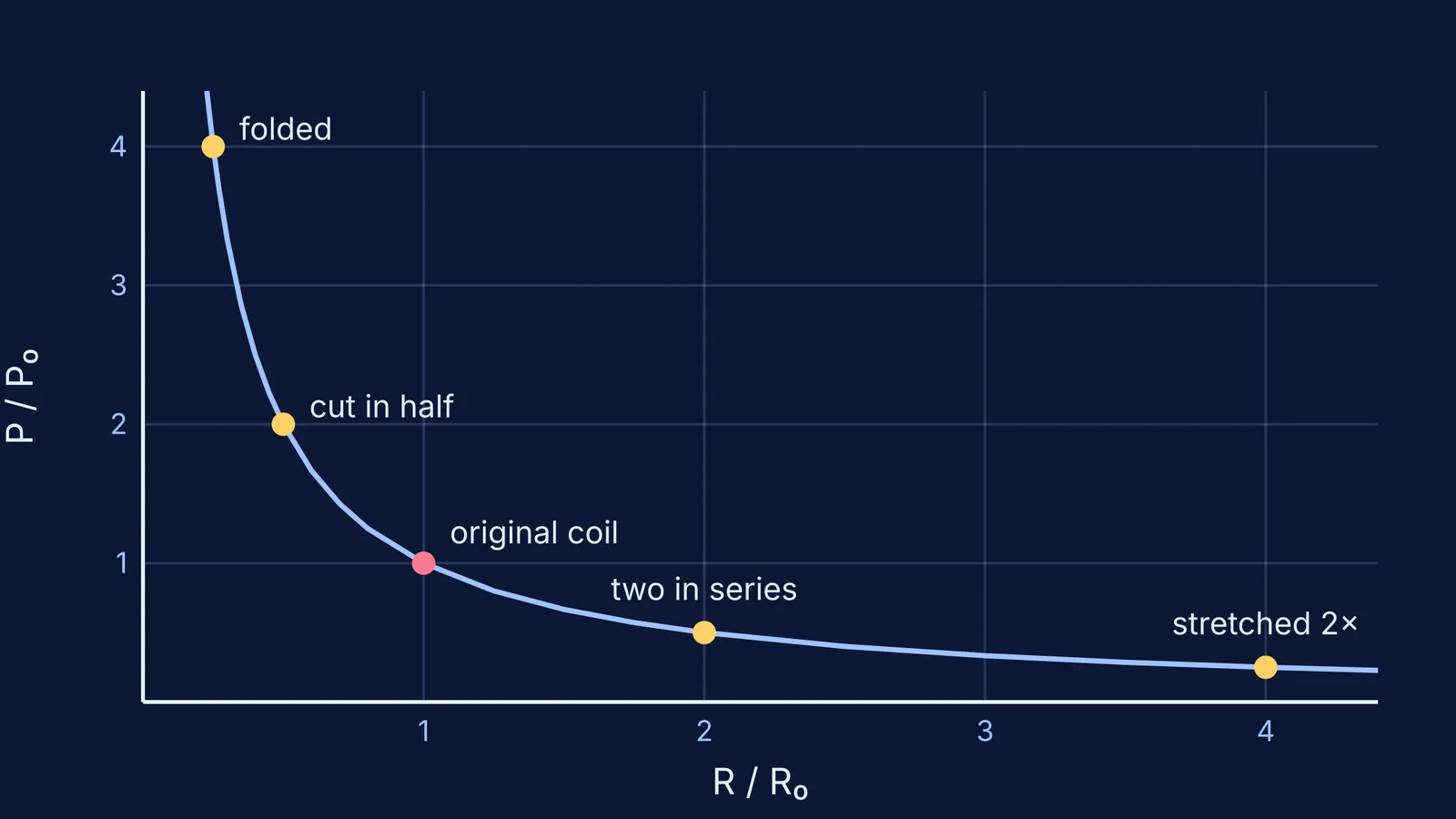
Every variant reduces to one question: what is the new R? Use R = ρl/A from the NCERT chapter, then remember that at fixed voltage P is proportional to 1/R. Here is the full set, with R₀ and P₀ for the original coil.
Cut in half, one piece used: l becomes l/2, so R = R₀/2 and P = 2P₀.
Folded in half (doubled over, ends joined): length l/2 and cross-section 2A, so R = ρ(l/2)/(2A) = R₀/4 and P = 4P₀. This is the same as cutting the coil and connecting the two halves in parallel.
Stretched to twice its length: the volume of metal stays the same, so if l doubles, A halves. R = ρ(2l)/(A/2) = 4R₀ and P = P₀/4.
Two identical coils in series: R = 2R₀, so P = P₀/2 in total.
Two identical coils in parallel: R = R₀/2, so P = 2P₀ in total.
A quarter of the coil cut off: l becomes 3l/4, so R = 3R₀/4 and P = 4P₀/3.
For the stretching case, our post on how a wire's resistance changes when it is stretched works through the constant-volume argument in more detail.
How do you solve heaters of different ratings in series?
A common textbook version: two heaters are rated 1000 W and 500 W at the same voltage V, and they are joined in series across V. What do they draw together? Each rating gives a resistance through P = V²/R (OpenStax, section 20.4).
Find each resistance: R₁ = V²/1000 and R₂ = V²/500, so R₂ = 2R₁.
In series, the total resistance is R₁ + R₂ = 3R₁.
Total power is V²/(3R₁) = 1000/3, about 333 W.
Shortcut for ratings at the same voltage: in series, 1/P = 1/P₁ + 1/P₂; in parallel, P = P₁ + P₂.
The series pair draws less than either heater alone. Which one gets hotter? The same current flows through both, so P = I²R says the higher-resistance heater, the 500 W one, dissipates twice as much as the other. The same logic decides which bulb glows brighter; see bulbs in series and parallel and which glows brighter.
Does a real heater behave exactly like this?
Not quite. Resistivity depends on temperature (HyperPhysics, resistance and resistivity), and a heater coil runs red hot, so its working resistance differs from its cold resistance. Exam questions assume R stays constant unless they say otherwise. If a question gives you a coefficient, our post on the temperature coefficient of resistance shows how to handle it.
There is also a safety point. A shortened coil draws more current than the heater, its wiring and its fuse were designed for. Never cut or rejoin a real heater element at home; leave repairs to a qualified electrician.
A 30-second checklist for any coil question
What is held fixed: voltage (mains, or an ideal battery) or current?
What changed: length, area, or both? If the wire was stretched or folded, the volume of metal is unchanged.
Write the new R as a multiple of R₀ before touching power.
Fixed V: P is proportional to 1/R. Fixed I: P is proportional to R.
Sense check: does your answer agree with the one-line rule above?
If you keep reaching for the wrong formula, the Fermi Problem Library has worked problems with a step-by-step solver that explains the reasoning rather than printing an answer, so you can see exactly where V or I was held fixed. To go back to resistivity itself, the Fermi Concept Library gives each concept in physics its own lesson.


