On this page
You twist, you pull, the ring rides up to the knuckle and stops. Before it is anything else, this is a physics problem, and the physics tells you which household fixes work and which one quietly makes things worse.
Why does a tight ring get stuck in the first place?
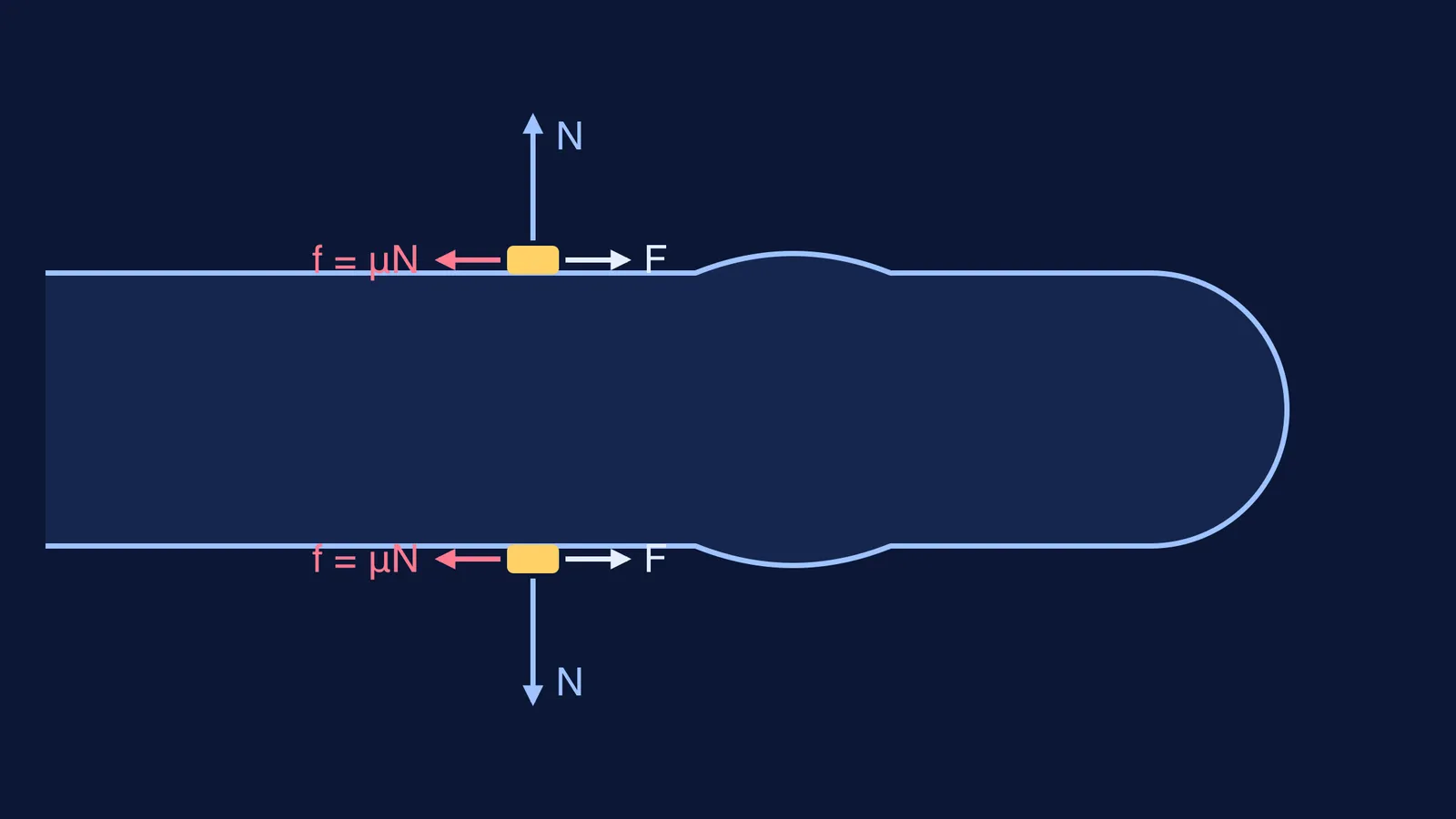
A ring stays put because of friction. The band presses inward on the skin all the way round, and the skin pushes back with a normal force, N. Friction opposes sliding, and the most it can supply is roughly f = μN, where μ, the coefficient of friction, depends on the two surfaces in contact.
That gives you two ways to free a ring: make μ smaller, or make N smaller. Soap does the first. Cold and a raised hand do the second.
The knuckle is what turns a snug ring into a stuck one. It is wider than the base of the finger, so the ring has to squeeze past it, and any swelling there raises N right where you need the ring to slide.
Why does soap help remove a tight ring?
Soap molecules (surfactants) cling to surfaces and leave a slippery layer, so skin and metal no longer grip each other directly. Kao, a cosmetics maker, describes the same idea for a hair-care lubricant: a water film one or two molecules thick between adsorbed lubricant layers gives ultra-low friction.
Here is the surprising part: plain water on skin is not a lubricant. A review of skin-friction measurements by S. Derler and L.-C. Gerhardt in Tribology Letters (2012) found that dry skin typically has a friction coefficient of about 0.5. The same review found that moist or wet skin typically has a friction coefficient above 1, set largely by how easily wet skin shears. That is why holding a stuck ring under the tap, with no soap, may do little.
Doctors start the same way. The MSD Manual's professional guide to ring removal says to first lubricate the finger thoroughly with soap or a water-soluble lubricant, then twist the ring off with a circular motion. If that fails, it suggests ice water for several minutes and then lubricant again.
The opposite trick shows the same physics: weightlifters chalk their hands to raise μ, while a banana peel underfoot lowers it.
How do cold water and raising your hand help?
They cut N. A swollen finger holds extra fluid in its tissues, and that fluid presses the skin harder against the band. The Kaiser Permanente health guide advises elevating the hand, then applying ice, which may reduce swelling enough for the ring to come off. If ice doesn't work, it suggests soapy water or cooking oil, turning the ring as if unscrewing it.
Does the cold shrink the metal too? Barely, and in the wrong direction. Work it out with ΔL = αLΔT and gold's linear expansion coefficient of 14 × 10⁻⁶ per °C from OpenStax University Physics, which also explains that a hole in metal grows or shrinks exactly as the metal does:
Take a ring with an inner diameter of 17 mm, as an example.
Cool it by 20 °C, roughly from skin temperature to cold tap water.
Change in diameter = 14 × 10⁻⁶ × 17 mm × 20 = about 0.005 mm.
The hole gets about five thousandths of a millimetre smaller, so the ring tightens by a hair. Any help from cold water comes from the finger, not the gold.
What should you try first, step by step?
Stop tugging hard. Forcing the ring irritates the finger and can add swelling.
Raise your hand above your head for about 10 minutes, as Healthline's medically reviewed guide suggests, with the finger in a cup of ice water if you have one.
Coat the finger and ring with soap, cooking oil or a water-soluble lubricant, not plain water.
Twist the ring as if unscrewing it while easing it towards the fingertip.
If it still won't move, stop and get help.
Why twist? One reason is that once the ring is already sliding, friction resists it less than it did at the start, which is the gap between static and kinetic friction you can see in this graph of the force as you pull a block.
Healthline warns that a tight ring can act like a tourniquet. Doctors can use the MSD Manual's string method or a ring cutter.
How can you see friction change for yourself?
f = μN is easier to trust once you have watched it. In the Fermi Simulation Lab you can work with interactive simulations for the ideas that are easier to see than to read. If a friction numerical goes wrong, the Fermi Problem Library has worked problems with a step-by-step solver that explains the reasoning rather than printing an answer.
Next time a ring sticks, reach for the soap, lift your hand, and remember which term in f = μN you are shrinking.