On this page
Watch a weightlifter before a heavy pull or a gymnast before the rings and you will see the same ritual: hands into a bowl of white powder, a quick rub, a clap. It looks like habit. It is physics and chemistry working together, and both are on your syllabus.
What is gym chalk made of?
Gym chalk is magnesium carbonate, formula MgCO3, listed in PubChem with a molar mass of 84.31 g/mol. It is a fine, dry white powder with a lot of surface for its weight.
That surface is the point. Your palms sweat, and athletes use chalk to dry their hands, aiming for a firmer grip.
Why do sweaty hands slip on a bar?
Friction between two surfaces has a ceiling. The largest friction force before slipping is f = μN, where N is how hard the surfaces press together and μ is the coefficient of friction, a number set by the two surfaces. This is the rule Coulomb tested, as our piece on Coulomb's laws of friction explains.
Sweat changes the surfaces. When it builds up into a film between skin and bar, it can act like a lubricant, so μ can drop and the ceiling on friction drops with it. To hold the same bar you then have to squeeze harder, which tires the forearms.
Chalk goes after the water. Two words from chemistry help here:
Adsorption is the adhesion of atoms, ions or molecules to a surface, as defined in this overview of adsorption.
Absorption is when a fluid is dissolved by or permeates a liquid or solid, as the same overview puts it.
A fine powder offers a huge total surface, so moisture can cling to the particles and fill the gaps between them. Both pull water away from the skin. For the textbook side of surfaces holding molecules, read our profile of Herbert Freundlich and the adsorption isotherm.
Does chalk actually increase friction?
Often, but not always. Most of the research comes from rock climbing, where the same powder goes on fingertips.
In a 2012 hang-board study of 11 experienced climbers, chalk raised the finger friction coefficient by 18.7% on limestone and 21.6% on sandstone (Amca and colleagues, Sports Biomechanics).
A 2001 study of 15 participants found the opposite: chalk decreased the friction coefficient, which the authors put down to drier, less compliant skin and a slippery granular layer. They advised removing all chalk particles and drying the fingers by other means (Li, Margetts and Fowler, Journal of Sports Sciences).
A 2024 lab study on four rock types found the effect depended on moisture and surface roughness; chalk on dry fingertips helped friction more than chalk in simulated sweaty conditions, and it made friction more consistent in most conditions (Clarke and colleagues, Journal of Sports Engineering and Technology).
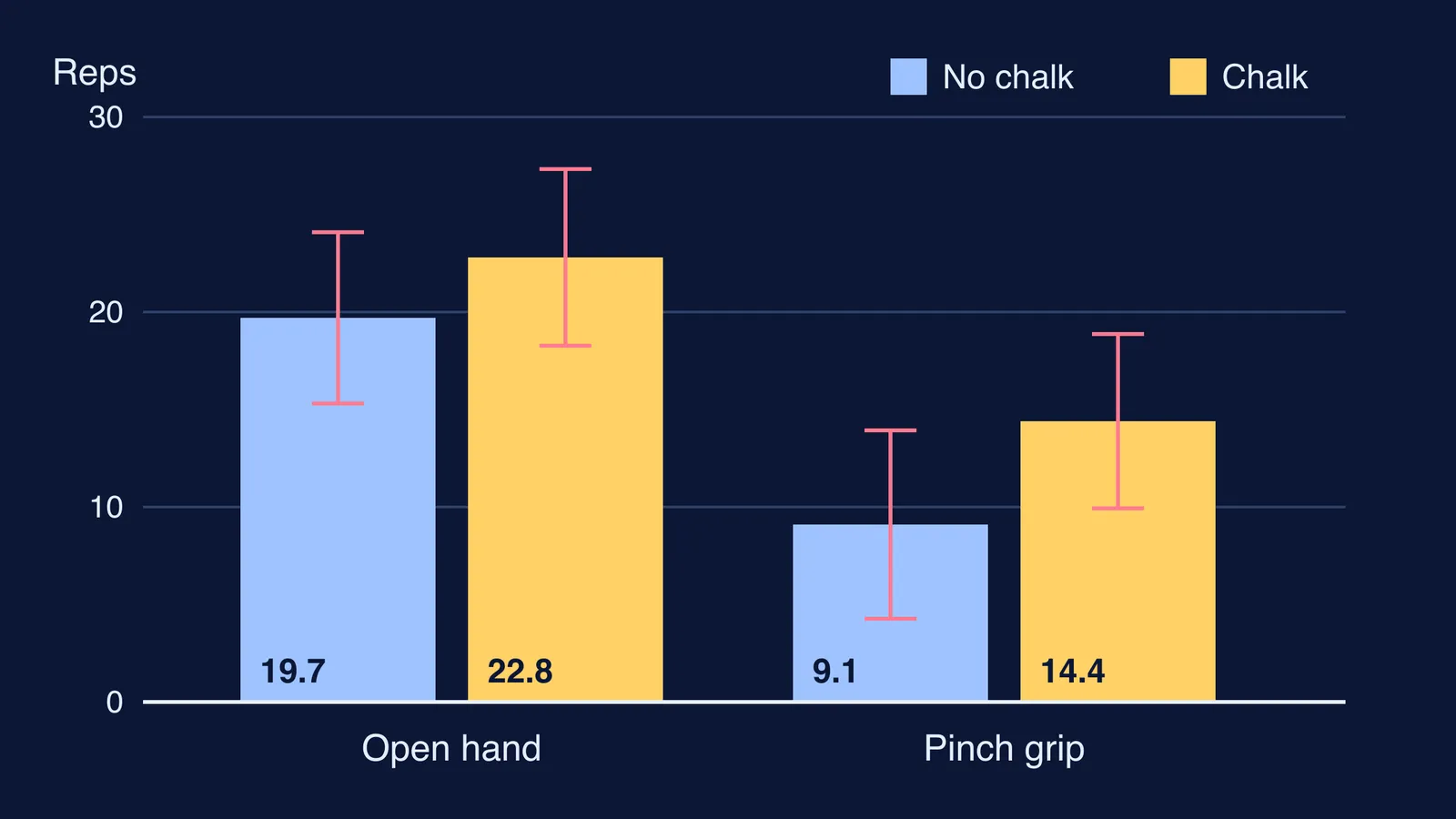
In a 2018 study of 9 recreational climbers, chalk raised weight-assisted pull-ups to failure from 19.7 to 22.8 reps with an open hand, and from 9.1 to 14.4 with a pinch grip (Bacon and colleagues, International Journal of Exercise Science).
Read together, the evidence is mixed rather than simple. Two of these studies found chalk helped, one found it lowered friction, and the newest says it depends on the surface and how wet the skin is. The common thread is that a loose, powdery layer can be slippery, so the goal is dry skin, not a thick white coat.
How much difference could chalk make on a bar?
Take a simplified model: treat your grip as pads pressing on the bar, with friction holding up 300 N of load.
Without chalk, suppose μ = 0.6. The squeeze you need is N = 300 / 0.6 = 500 N.
With chalk, borrow the 18.7% rise measured on limestone in the 2012 study: μ = 0.6 × 1.187 = 0.712.
Now N = 300 / 0.712 = 421 N, about 16% less squeeze for the same load.
The 0.6 is an illustrative number, not a measurement, and a steel bar is not limestone; the point is how a percentage rise in μ turns into a smaller squeeze. Less squeeze per rep may be one reason a grip lasts longer. To see how friction grows with the pull until the block suddenly slips, read our post on the static vs kinetic friction pull graph. The Fermi Simulation Lab has interactive simulations for ideas that are easier to see than to read.
How do you use chalk well?
Wipe sweat off with a towel first; in the 2024 study chalk did more on dry fingertips than on wet ones.
Use a thin layer, rub it in, and clap or brush off the loose excess.
Re-chalk when your hands start to feel damp rather than piling on more.
Brush clumps off the bar, since loose powder can be slippery.
Wash your hands afterwards. If your skin cracks or gets sore, ask a doctor rather than adding more chalk.
If a term here felt shaky, the Fermi Concept Library covers every concept in physics and chemistry, friction and adsorption included.