On this page
In July 1882, a chemist in Göttingen published a five-page paper with a plain title: "Ueber ammon-alkalische Silberlösung als Reagens auf Aldehyd", roughly "On ammonia-alkaline silver solution as a reagent for aldehyde" (Tollens' 1882 paper in Berichte, DOI record). The author was Bernhard Tollens, and Class 12 chemistry students now meet his solution as Tollens' reagent.
Who invented Tollens' reagent?
Bernhard Tollens was born in Hamburg on 30 July 1841 and died in Göttingen on 31 January 1918 (Bernhard Tollens, Wikipedia). He finished a pharmacy apprenticeship in 1862, then studied chemistry at the University of Göttingen in the laboratory of Friedrich Wöhler, the chemist behind Wöhler's famous urea synthesis, and received his doctorate in 1864.
The next few years took him around Europe: to Heidelberg to work with Emil Erlenmeyer, to Paris with Charles-Adolphe Wurtz, and to the University of Coimbra in Portugal, where he ran the chemical laboratory for 11 months. In 1872 he returned to Göttingen and stayed there for the rest of his life (Bernhard Tollens, Wikipedia). Ten years later came the 1882 paper that put his name on a reagent used to tell aldehydes from ketones (Tollens' reagent, Wikipedia).
How does the silver mirror test work?
Tollens' reagent contains the diamminesilver(I) ion, [Ag(NH₃)₂]⁺ (LibreTexts: oxidation of aldehydes and ketones/Aldehydes_and_Ketones/Reactivity_of_Aldehydes_and_Ketones/Oxidation_of_Aldehydes_and_Ketones)). To make it, you add a drop of sodium hydroxide solution to silver nitrate solution, which gives a precipitate of silver oxide, then add just enough dilute ammonia to redissolve it. A few drops of the compound go into the freshly made reagent, and the tube is warmed gently in a hot water bath for a few minutes.
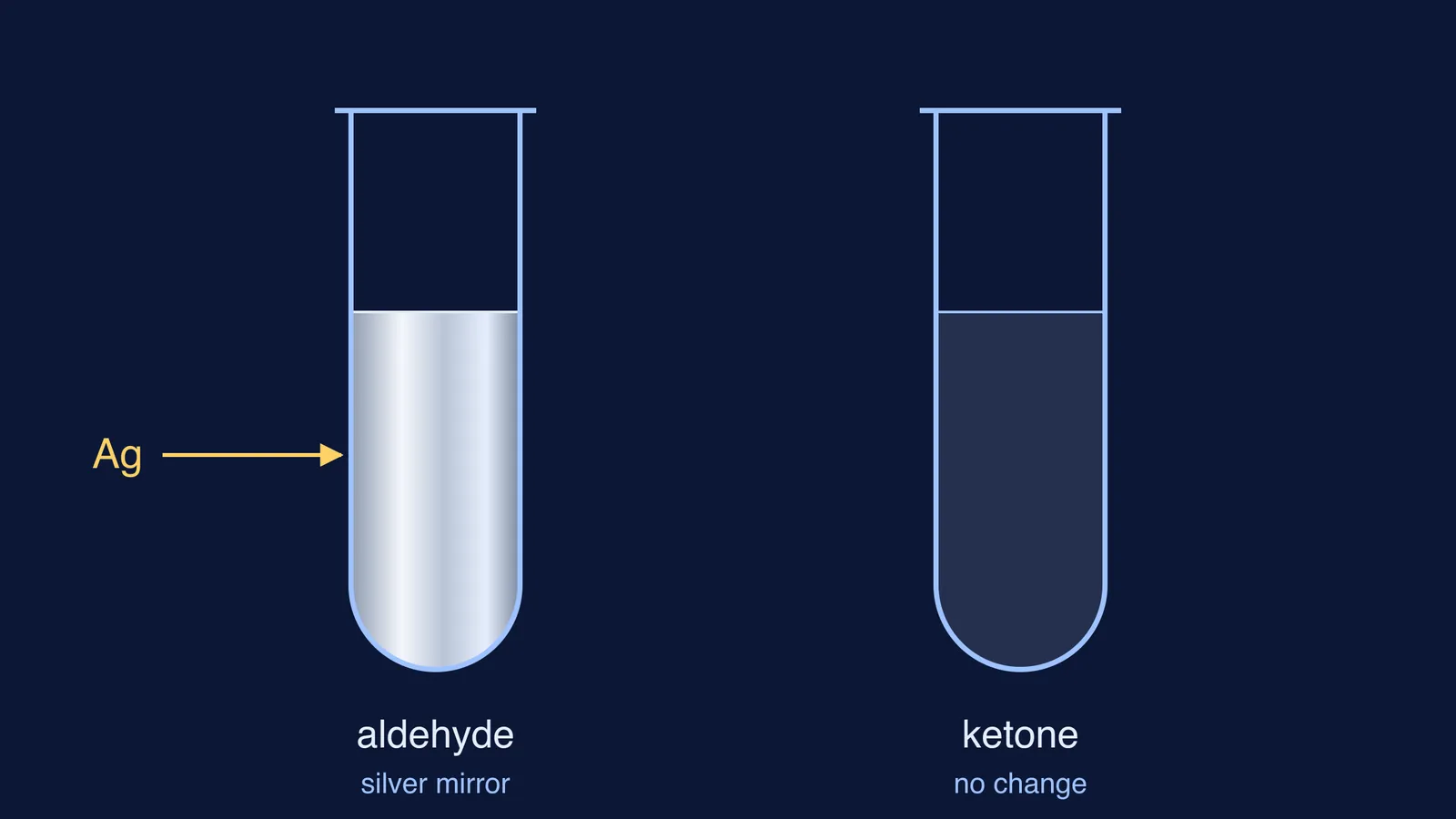
With an aldehyde, the colourless solution gives a grey precipitate of silver or a silver mirror on the glass; with a ketone, nothing changes (LibreTexts, linked above). The two half-equations are:
Reduction: [Ag(NH₃)₂]⁺ + e⁻ → Ag + 2NH₃
Oxidation: RCHO + 3OH⁻ → RCOO⁻ + 2H₂O + 2e⁻
Double the silver half to balance the electrons and you get the full equation: 2[Ag(NH₃)₂]⁺ + RCHO + 3OH⁻ → 2Ag + 4NH₃ + RCOO⁻ + 2H₂O.
The reagent has a short shelf life, so it is not sold ready-made and must be freshly prepared; aged reagent is destroyed with dilute acid to prevent the formation of highly explosive silver nitride (Tollens' reagent, Wikipedia).
Why do aldehydes pass and ketones fail?
The difference is one hydrogen atom. An aldehyde has a hydrogen attached to its carbonyl carbon, and that hydrogen makes aldehydes very easy to oxidise, so they are strong reducing agents (LibreTexts/Aldehydes_and_Ketones/Reactivity_of_Aldehydes_and_Ketones/Oxidation_of_Aldehydes_and_Ketones)). A ketone has no such hydrogen. Very strong oxidants such as potassium permanganate can oxidise ketones, but only destructively, by breaking carbon-carbon bonds. A gentle oxidant like diamminesilver(I) leaves most ketones untouched, so the silver stays in solution.
Fehling's solution uses the same idea with copper(II); our guide to Tollens' and Fehling's tests compares which compounds pass each.
What else did Bernhard Tollens work on?
His later years in Göttingen went into carbohydrate chemistry: that work yielded the structures of several sugars, his reagent and most of his publications (Bernhard Tollens, Wikipedia). He also ran a school of agricultural chemistry at Göttingen; C. A. Browne wrote about Tollens and some of his American students in the Journal of Chemical Education in 1942 (Browne's article, DOI record). The reagent and sugars still meet: glucose, an aldehyde sugar, is the reducing agent used when Tollens' reagent silvers glassware such as vacuum flasks (Tollens' reagent, Wikipedia). Our explainer covers why sucrose fails Tollens' test while glucose passes.
Will this compound give a silver mirror? A three-step check
Exam questions rarely ask you to define the test. They give you a structure and ask what you will see. Run this check, using the exceptions listed in Tollens' reagent, Wikipedia:
Find the carbonyl group. Is there a hydrogen on the carbonyl carbon (–CHO)? If yes, expect a silver mirror.
If it is a ketone, look next door. An alpha-hydroxy ketone or a 1,2-dicarbonyl also gives a positive test; most other ketones do not.
Spot a terminal alkyne (C≡C–H). It gives a white precipitate of silver acetylide, not a mirror.
Worked example. You are asked to tell propanal (CH₃CH₂CHO) from propanone (CH₃COCH₃). Step 1: propanal has an H on its carbonyl carbon, so it reduces the reagent and a mirror forms: 2[Ag(NH₃)₂]⁺ + CH₃CH₂CHO + 3OH⁻ → 2Ag + 4NH₃ + CH₃CH₂COO⁻ + 2H₂O. Propanone has two methyl groups on its carbonyl carbon and no alpha-hydroxy group, so steps 2 and 3 give nothing and the tube stays clear.
If step 1 trips you up because the oxidation itself feels unclear, the Fermi Concept Library gives every concept in chemistry its own lesson. For practice on distinguishing questions, the Fermi Problem Library has worked problems with a step-by-step solver that explains the reasoning rather than printing an answer.
Next time a silver mirror forms in your lab, you are watching the reaction Tollens described in 1882.