On this page
In 1883 Johan Kjeldahl, a Danish chemist at the Carlsberg Laboratory in Copenhagen, gave chemists a dependable way to measure the nitrogen in grain, food and soil. Food and farm labs still use it to work out how much protein a sample holds, and you meet it in Class 11 chemistry.
Who invented the Kjeldahl method?
Johan Kjeldahl was born in Copenhagen on 16 August 1849 and headed the chemistry department of the Carlsberg Laboratory, attached to the Carlsberg Brewery, from 1876 until his death in 1900, according to his Wikipedia biography. His assignment was to measure the protein in the grain used to make malt.
Kjeldahl presented the finished method to the Danish Chemical Society on 7 March 1883, as the EBSCO Research Starters entry on the Kjeldahl method records. The same year he published it in German as "Neue Methode zur Bestimmung des Stickstoffs in organischen Körpern" (a new method for determining nitrogen in organic substances) in Zeitschrift für analytische Chemie, volume 22, pages 366 to 382 (DOI record).
Before him, chemists measured nitrogen with Jean Dumas's combustion-tube method from 1826. The same EBSCO entry says Kjeldahl's approach was more accurate, faster to run and could be operated on a much larger scale.
How does the Kjeldahl method work?
The NCERT Class 11 chemistry textbook, Unit 8, Organic Chemistry: Some Basic Principles and Techniques, describes three stages:
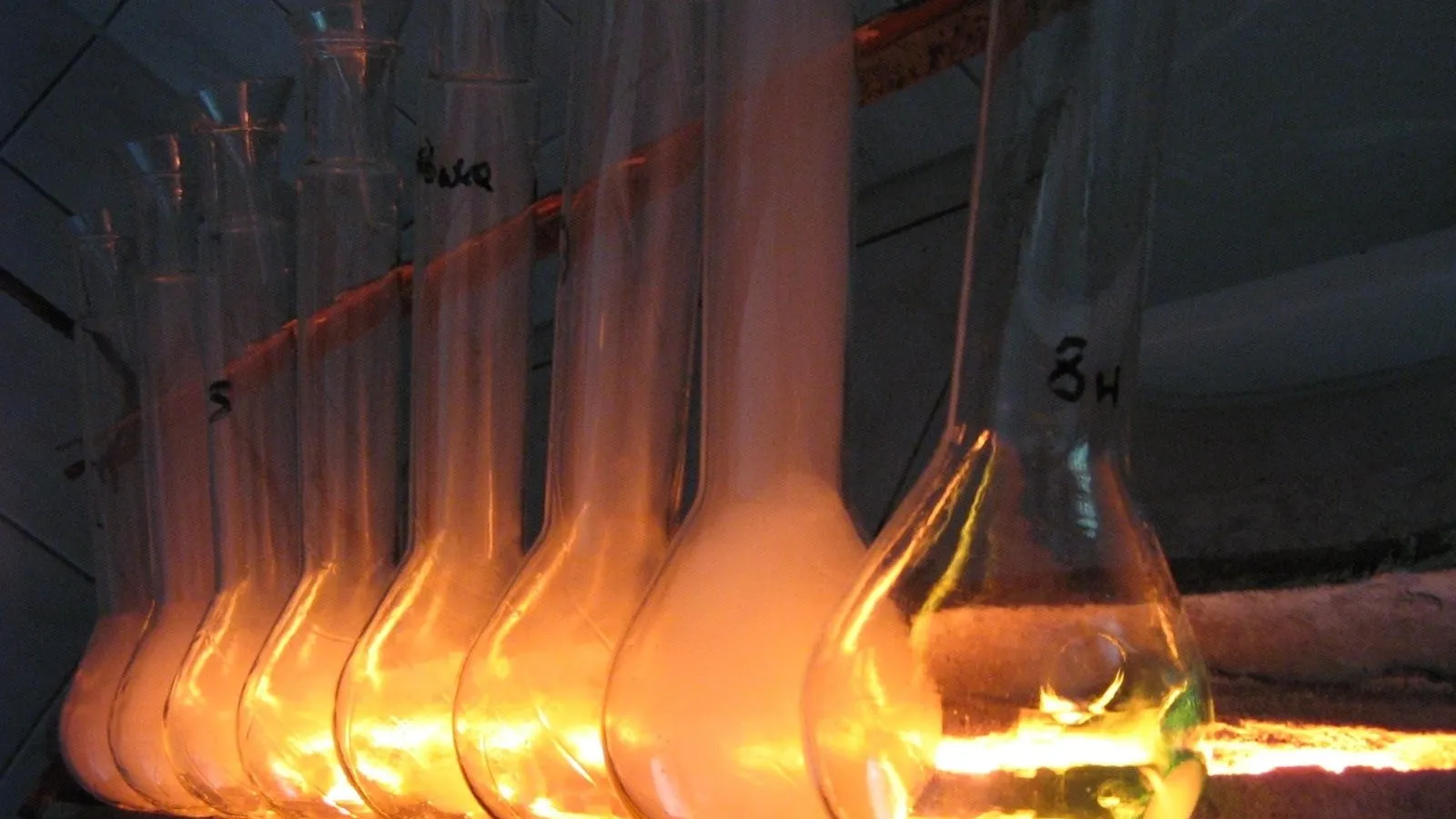
Digestion: heat the compound with concentrated H2SO4 (the textbook figure also adds CuSO4). The nitrogen becomes ammonium sulphate.
Distillation: add excess NaOH. Ammonia gas is driven off and absorbed in a known volume of standard acid.
Titration: titrate the acid left over with standard alkali. The acid that was used up tells you how much ammonia, and so how much nitrogen, the sample held.
Step 3 uses the same logic as back titration calculations: you measure what is left, then subtract from what you started with.
The same NCERT unit notes that the method does not work for nitrogen in nitro and azo groups or in a ring such as pyridine, because that nitrogen does not change to ammonium sulphate under these conditions.
Why multiply nitrogen by 6.25 to get protein?
The FAO report Food energy: methods of analysis and conversion factors, chapter 2 explains that early analyses found proteins average about 16 percent nitrogen, which led to the calculation N x 6.25 (since 100 / 16 = 6.25). It adds that the Kjeldahl or a similar method has been almost universally applied to measure that nitrogen.
The shortcut has limits. Not all nitrogen in food sits in protein; FAO calls the rest non-protein nitrogen. Food-specific Jones factors for the most commonly eaten foods range from 5.18 for nuts and seeds to 6.38 for milk, and using the general 6.25 for individual foods that are major protein sources gives errors from minus 2 to plus 9 percent, according to the same FAO chapter.
Worked example: from titre to protein percentage
The numbers below are made up for practice; the method follows the NCERT unit. A 0.50 g sample of powdered pulse is digested, and its ammonia is absorbed in 25.0 mL of 0.10 M H2SO4. The leftover acid needs 19.0 mL of 0.20 M NaOH.
H2SO4 taken: 25.0 mL x 0.10 M = 2.5 mmol.
NaOH used: 19.0 mL x 0.20 M = 3.8 mmol, which neutralises 1.9 mmol of H2SO4 (2 NaOH per H2SO4).
H2SO4 that reacted with ammonia: 2.5 - 1.9 = 0.6 mmol, so NH3 = 1.2 mmol (2 NH3 per H2SO4).
Nitrogen: 1.2 mmol x 14 g/mol = 16.8 mg = 0.0168 g.
Percentage of nitrogen: 0.0168 / 0.50 x 100 = 3.36 percent.
Protein with the general factor: 3.36 x 6.25 = 21.0 percent. With 5.7, the low end of the 5.7 to 6.25 range FAO gives for cereal and legume proteins, it is about 19.2 percent.
Check yourself on NCERT's Problem 8.22: ammonia from 0.5 g of compound neutralised 10 mL of 1 M H2SO4, and the answer is 56.0 percent nitrogen. To set this method beside the older one, read Dumas and Kjeldahl methods: estimating nitrogen in Class 11.
Three slips cost marks most often:
forgetting that one H2SO4 takes two NH3, or two NaOH;
using 6.25 without asking what the food is;
applying the method to nitro, azo or ring nitrogen.
If one step keeps going wrong, the Fermi Problem Library has worked problems with a step-by-step solver that explains the reasoning rather than printing an answer.
Where is the Kjeldahl method used today?
The EBSCO entry lists nitrogen and protein testing in drinks, meat, feeds, cereals and forages, as well as soil, wastewater, fertilisers and oilseeds, and notes that the work is increasingly done on automated analysers. The chemistry inside those machines is still Kjeldahl's digestion, distillation and titration.
To revise the chemistry around it, from ammonia to acid-base titration, the Fermi Concept Library gives every concept in chemistry its own lesson and its place in the map.