

On this page
The banana-peel slip is a cartoon joke, but also a real friction problem that someone measured. The physics is the friction and lubrication you meet in Class 8.
Why is a banana peel so slippery to step on?
The slipperiness comes from a gel stored inside the peel. Researchers at Kitasato University in Japan, Kiyoshi Mabuchi, Kensei Tanaka, Daichi Uchijima and Rina Sakai, looked at banana skin under a microscope and found bunches of tiny sacs of gel, each a few micrometres across, packed inside it (Mabuchi et al., Tribology Online, 2012).
Thin cellulose walls hold the gel in place, a bit like grease sealed in capsules. When your shoe presses down, the walls burst and the gel merges into a smooth, runny layer the authors call a "homogeneous sol". That layer sits between your sole and the floor, so the two surfaces barely touch. The team named the effect follicular gel lubrication.
Water matters too. The peels they tested were 85% water by weight, and a fully dried peel was far less slippery (full paper, J-STAGE).
How slippery is a banana peel, in numbers?
The coefficient of friction (μ) is the friction force divided by the force pressing two surfaces together, so a lower μ means things slide more easily (Mabuchi et al., 2012).
The team put a force sensor under a linoleum panel and had a person rub a shoe across a banana peel lying on it. They tested 12 peels, 5 times each, which made 60 measurements in all (J-STAGE paper). Here is what they found:
Shoe sole directly on linoleum: μ = 0.412
Fresh peel on linoleum: μ = 0.066, about 0.07
Fresh peel on wood: μ = 0.083
Peel turned the other way up: μ = 0.123
Fully dried peel: μ = 0.329
Apple peel: μ = 0.105 to 0.125; citron skin: 0.198; tangerine skin: 0.225
The peel cuts friction to about one-sixth of what the bare shoe gets (0.066 ÷ 0.412 is roughly 0.16). The authors point out that values below 0.1 belong to well-lubricated surfaces such as a ski on snow or ice on ice. In 2014 the work won the Ig Nobel Prize in Physics (Science News).
What does this have to do with Class 8 friction?
In Class 8 you learn that friction comes from the tiny bumps on two surfaces catching on each other, and that a lubricant such as oil or grease works by putting a thin layer between them. A crushed banana peel is a lubricant you didn't put there on purpose. Our Class 8 friction explainer goes through the chapter's ideas, from rough surfaces to lubricants.
There is one more link. You can only walk because friction from the floor pushes your foot the right way (see which way friction acts when you walk). Take that friction away and your front foot shoots forward.
Will your foot slip? A worked example
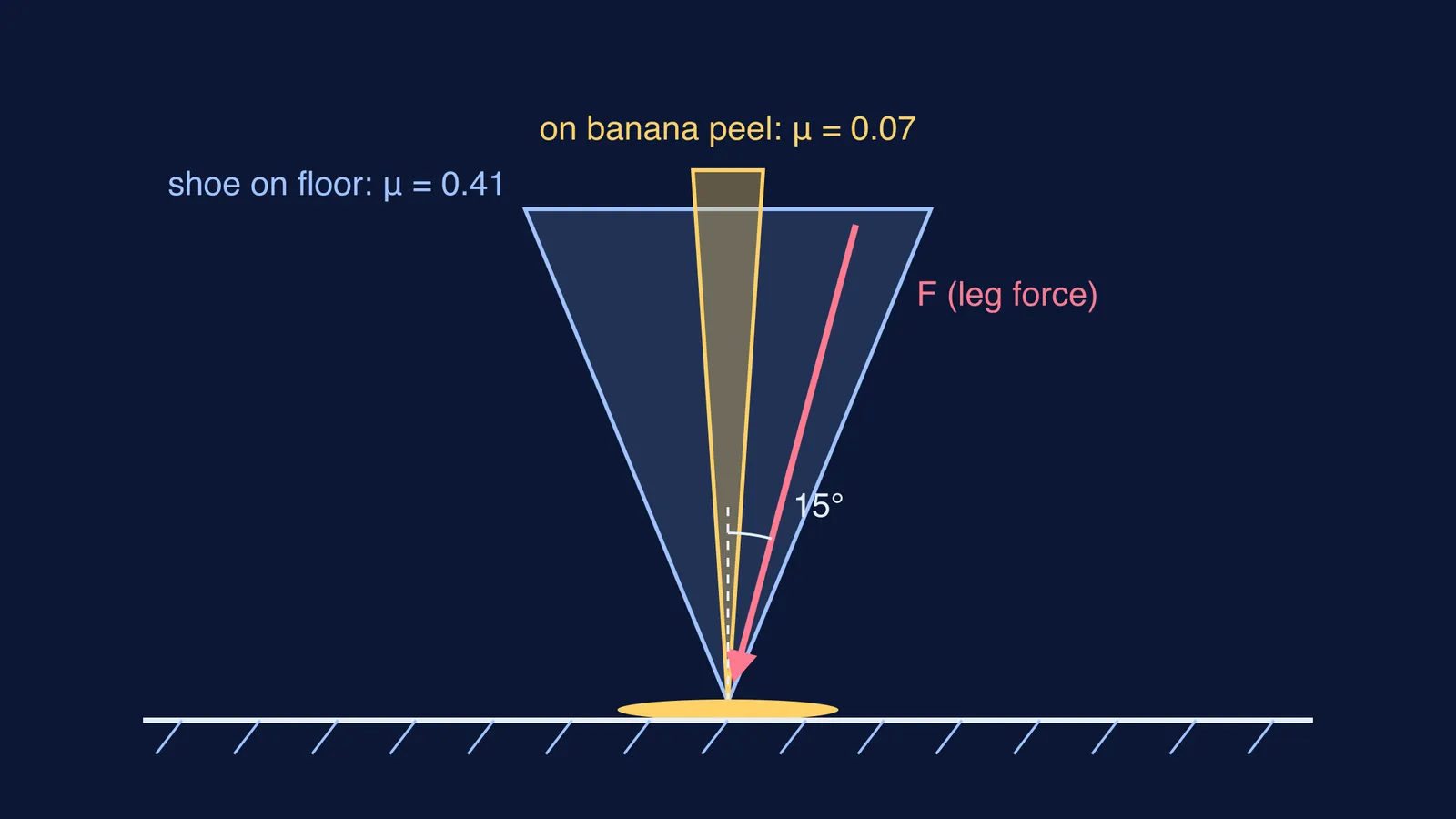
The paper gives a simple rule for a safe step. Your leg pushes on the floor with a force F at an angle θ from the vertical. The floor's grip, μF cos θ, has to beat the sideways push, F sin θ. Cancel F and divide by cos θ to get the condition μ > tan θ (Mabuchi et al., 2012). The authors take a usual step angle of 15°.
Work out tan 15°, which is about 0.27.
Bare shoe on linoleum: 0.412 is more than 0.27, so you are safe.
Shoe on a fresh peel: 0.066 is less than 0.27, so you slip.
The steepest safe angle on the peel is the angle whose tangent is 0.066, about 3.8°. That means stepping almost straight down.
Using the same rule with the paper's other measurements, here is the steepest safe step angle for each (our calculation):
Bare shoe: about 22°
Dried peel: about 18°
Peel the other way up: about 7°
Fresh peel: about 3.8°
This is the same idea as the angle of repose, where a block on a slope slides once tan θ is more than μ; see our post on the angle of repose and friction.
How can you see the friction cone for yourself?
Picture μ > tan θ as a cone: a push inside the cone holds, a push outside it slides. If a picture helps more than an equation, the Fermi Simulation Lab has interactive simulations for ideas that are easier to see than to read.
To practise with different μ values and angles, the Fermi Problem Library has worked problems with a step-by-step solver that explains the reasoning rather than just printing an answer.
Next time you see a peel on the floor, you will know exactly why to step around it.


