

On this page
Most students learn that friction is a force that opposes motion. So when a physics question asks for the direction of friction on your foot while walking, the instinctive answer is "backwards."
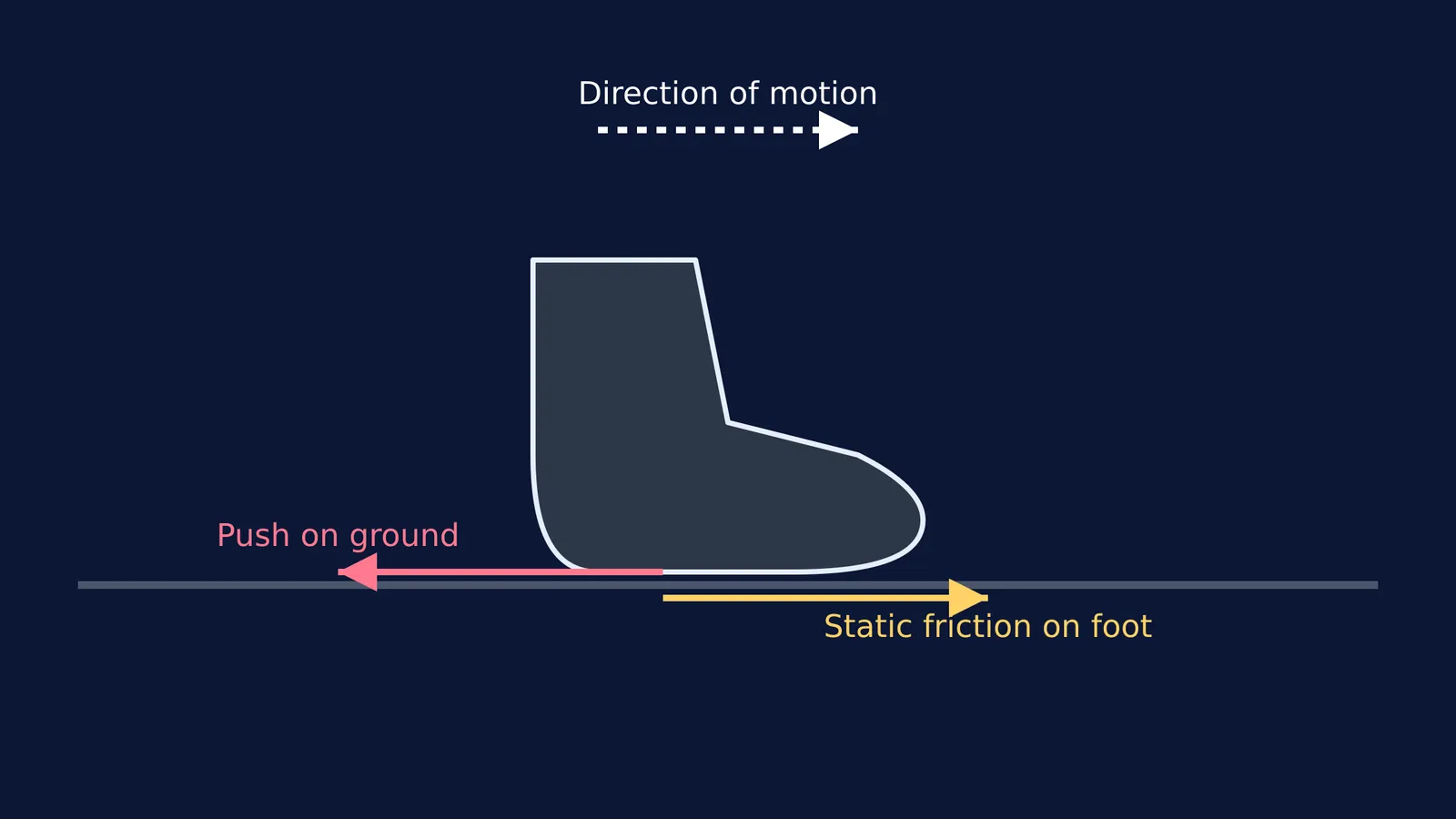
But if you think about it, if friction pushed you backwards, you would never be able to walk forward. The reality is the opposite: when you walk, the static friction on your shoe points in the direction you are going.
Which direction does friction act when we walk?
Walking is a classic example of Newton's third law in action. To move forward, your foot must push backward against the ground. According to OpenStax *University Physics*, the floor exerts a reaction force forward on the person.
This forward reaction force is static friction. Because your foot does not slide across the ground when you take a normal step, the friction is static, not kinetic. Static friction always acts in the direction that opposes the *attempted* relative motion between the surfaces. Since your foot attempts to slide backwards, static friction pushes it forwards, propelling your entire body in the direction of your walk.
If you struggle with applying Newton's laws to everyday movements, the Concept Library maps out every concept in physics, each with its own lesson, to help you visualize these interactions.
Does friction ever point backwards when walking?
Yes, it does, but only during specific parts of your stride. A complete walking cycle consists of two main phases for each foot: the heel strike and the push-off.
During the initial heel strike, your foot lands in front of your body and pushes forward against the ground as it absorbs your weight. To stop your foot from sliding forward out from under you, static friction must point backwards.
As your body moves over your planted foot, you transition into the push-off phase. Your foot now pushes backward against the ground to propel you forward. In response, static friction flips its direction and points forward. Because the forward push is what actually accelerates your body and sustains your walking speed, we generally emphasize that friction acts in the direction of motion when we walk.
Why does static friction do no work on you?
Another counterintuitive fact about walking is that, from a physics perspective, the ground does zero work on you.
Work is defined as a force acting over a displacement. For work to occur, the specific point where the force is applied must move. However, OpenStax notes that the force of static friction does no work in the reference frame between two surfaces because there is never displacement between the surfaces.
When your foot is planted on the floor during a step, it is momentarily stationary relative to the ground. Because that point of contact does not slide while the frictional force is applied, the displacement is zero. Consequently, the work done by static friction on your foot is zero. The energy that moves you forward actually comes from the internal chemical work done by your muscles, not from the ground.
How do you find the direction of static friction?
When facing exam questions about the direction of friction on wheels, feet, or rolling objects, use this simple three-step checklist to avoid common mistakes:
Identify the attempted motion: Ask yourself which way the surface of the object would slide if there were zero friction.
Reverse it: Static friction will point exactly opposite to that attempted slip.
Verify the acceleration: The resulting friction force should align with the object's acceleration if it is the only horizontal force acting on it.
Mastering these force interactions takes practice. If you find yourself guessing on conceptual physics questions, the step-by-step solver in the Fermi Problem Library explains the reasoning behind each force vector rather than just giving you the final answer. You can also explore related mechanics scenarios, such as the angle of repose and angle of friction, or calculate the minimum force to drag a block on a rough floor.


