On this page
You get up from the floor after an hour of revision, and for a second or two the room greys out, sparkles drift across your vision and you reach for the table. Then it passes. That moment is a race between gravity and a fast reflex, and it is one of the clearest everyday demonstrations of the blood circulation you study in school.
What happens to your blood when you stand up quickly?
Your blood vessels are not rigid pipes. Veins stretch, and when you go from sitting or lying to standing, gravity pulls blood down into them. A 2016 study in the journal *Hypertension* states it plainly: on standing, about 500 to 700 mL of blood shifts from the chest to the veins below the diaphragm.
Less blood returns to the heart, so for a few beats the heart pumps out less and blood pressure falls. Standing up actively adds a second effect. A review in *Clinical Science* by Wouter Wieling and colleagues explains that the blood vessels in your working leg muscles widen as you rise, much as they do at the start of exercise, creating a temporary mismatch between how much the heart pumps and how tightly the vessels are squeezed.
Your brain sits at the top of the column, so it feels the drop first. Greying out, tunnel vision and lightheadedness are what a brief fall in blood flow to the brain feels like.
Why does pressure drop at your head and not at your feet?
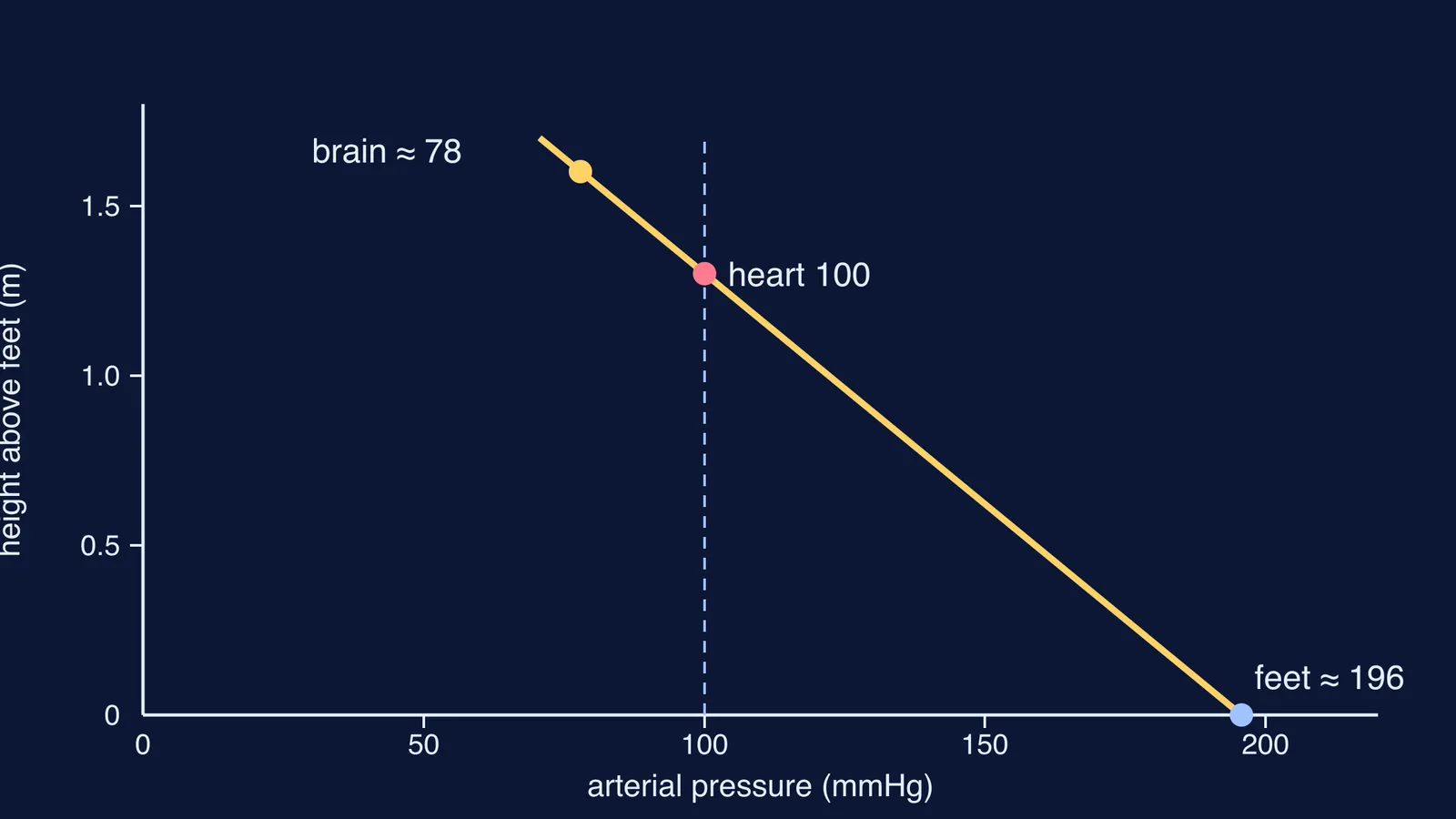
This is the physics part, and it is the same ρgh you use for water tanks and dams: pressure in a fluid column rises with depth. The UBC Physics and Astronomy outreach page on blood pressure works it through: the heart is roughly 1.3 m above the feet, so in a standing person the arterial pressure at the feet is about 96 mmHg higher than the roughly 100 mmHg at the heart.
The same idea works upwards. Here is a worked example, taking blood's density as about that of water (1000 kg/m³, as the UBC page does) and an illustrative 0.3 m from heart to brain:
ΔP = ρgh = 1000 × 9.8 × 0.3 ≈ 2940 Pa.
One mmHg is about 133 Pa, so ΔP ≈ 22 mmHg.
With 100 mmHg at the heart, the brain gets about 78 mmHg.
Standing still, that is fine. The trouble is the first few seconds after rising, when the pressure at the heart itself dips too, so the brain's share falls further. For more practice with the same formula, try these hydrostatics problems on pressure at depth.
If ρgh still feels abstract, the Fermi Simulation Lab has interactive simulations for ideas that are easier to see than read.
How does your body fix it in seconds?
Pressure sensors in the walls of your arteries, called baroreceptors, notice the dip. Your nervous system responds by speeding up the heart and tightening blood vessels, which pushes blood back towards the brain. In a 2007 laboratory study of eight healthy volunteers, heart rate rose from about 62 to 96 beats per minute when they were tilted upright, a clear sign of this reflex at work.
The fix is fast but not instant. In a 2019 study of teenagers in the *Journal of the American College of Cardiology*, blood pressure in the healthy control group recovered about 21 seconds after standing. If the numbers 120/80 still confuse you, read our explainer on systolic and diastolic blood pressure.
Is seeing stars when you stand up normal?
A brief greying out that clears in a few seconds is common. When the dip is large, doctors call it initial orthostatic hypotension, which the Wieling review defines as a temporary fall of more than 40 mmHg in systolic pressure, or more than 20 mmHg in diastolic pressure, within 15 seconds of standing, with symptoms. The same review cites studies finding that standing up is the trigger in 3 to 10% of episodes of losing consciousness, in young and old people alike.
This post is not medical advice. The NHS page on low blood pressure says to see a GP if you keep getting symptoms such as dizziness or fainting. If you actually pass out, tell a parent and get checked.
What can you do to stand up without seeing stars?
The NHS self-care advice is simple, and it fits long study sessions on the floor or a chair:
Get up slowly from sitting to standing.
From bed, move slowly in steps: lying, then sitting, then standing.
Drink more water.
Do not sit or stand for long periods.
Do not bend down or change posture suddenly.
On exam day, when the bell rings after three hours, get up slowly rather than springing to your feet.
To connect this to the rest of the syllabus, the Fermi Concept Library covers every concept in physics, chemistry, biology, mathematics and computing.