On this page
A blood pressure reading like 120/80 looks like a fraction but is not one. It is the highest and lowest pressure in an artery during one heartbeat, and once you see where each comes from, the cuff, the stethoscope and the units all make sense.
What do the systolic and diastolic numbers mean?
The OpenStax Anatomy and Physiology textbook puts it in two sentences you can memorise.
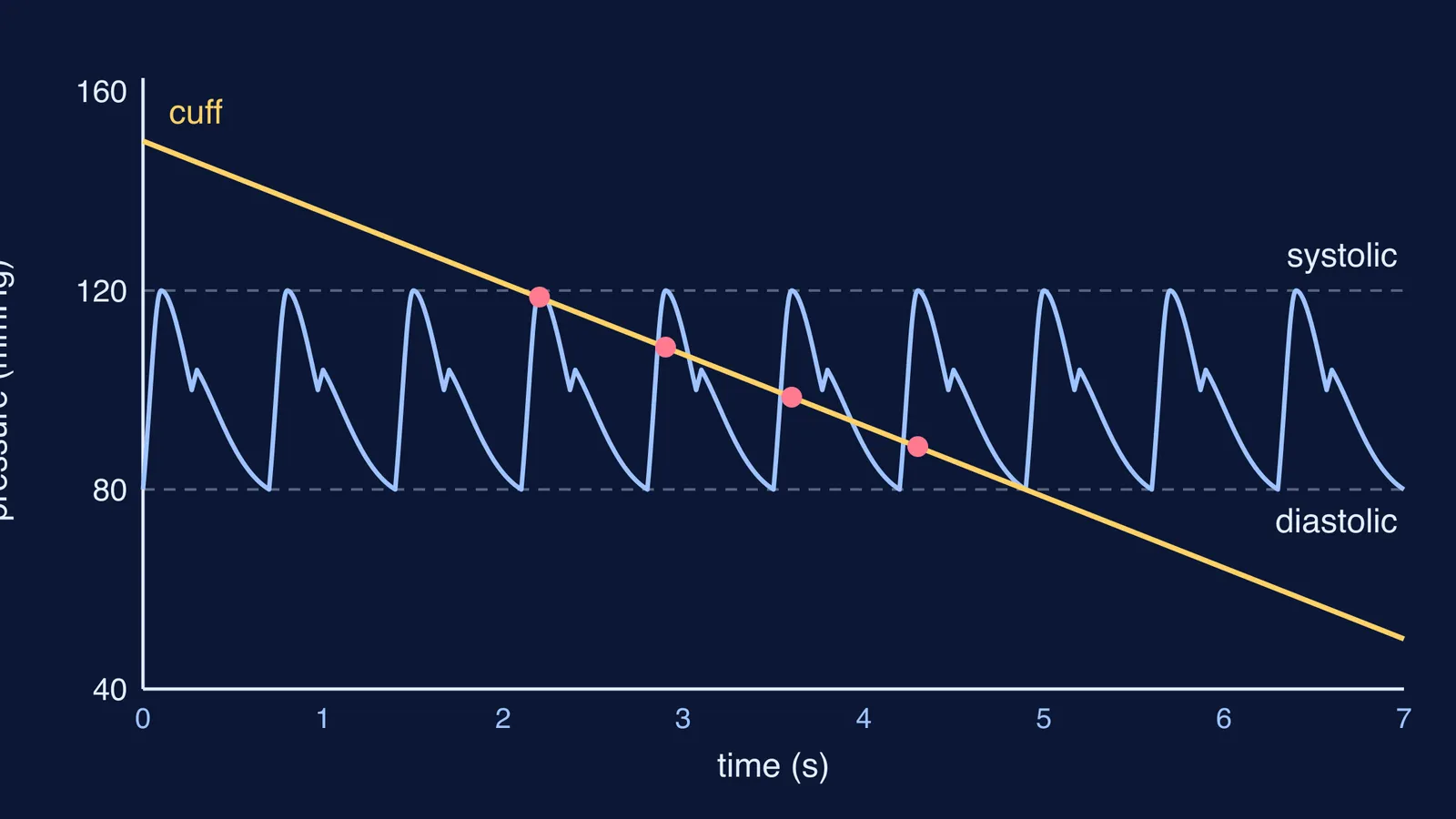
Systolic pressure is the higher value, typically around 120 mm Hg, and reflects the arterial pressure caused by blood being ejected when the ventricles contract (systole).
Diastolic pressure is the lower value, usually about 80 mm Hg, and is the arterial pressure while the ventricles relax (diastole).
The WHO hypertension fact sheet says the same thing in plainer words: systolic is the pressure in blood vessels when the heart beats, diastolic is the pressure when the heart rests between beats.
The unit, mmHg, is millimetres of mercury, the height of a mercury column the pressure could hold up. One mmHg is defined as exactly 133.322387415 pascals (Wikipedia, millimetre of mercury), so 120 mmHg is about 16 kPa and 80 mmHg about 10.7 kPa.
Why doesn't the pressure fall to zero between beats?
The heart pumps only during systole, yet arterial pressure never drops to zero, because arteries are elastic. OpenStax explains that elastic fibres in artery walls stretch to take in each pulse of blood, then recoil, keeping the pressure high. That recoil is what holds the floor at about 80.
The timing matters too. In the OpenStax cardiac cycle chapter, ventricular systole lasts about 270 ms and ventricular diastole about 430 ms, so the arteries spend most of each beat coasting on that recoil. To watch both pressures rise and fall against the valves, try our cardiac cycle pressure graph walkthrough, and for what the valves sound like as they shut, read what causes the lub and dub heart sounds.
How is a blood pressure reading taken with a sphygmomanometer?
A sphygmomanometer is a cuff attached to a pressure gauge. The manual method, as described by OpenStax and MedlinePlus, goes like this.
The cuff is wrapped around the upper arm at about heart level; MedlinePlus puts its lower edge 2.5 cm above the elbow crease.
The cuff is pumped up until it squeezes the brachial artery shut and blood stops flowing into the forearm.
A stethoscope goes over the artery at the inside of the elbow, and the valve is opened so cuff pressure falls slowly.
When cuff pressure drops just below the peak arterial pressure, blood spurts through at each beat. That turbulent flow makes a soft tapping, the Korotkoff sounds. The first one is recorded as systolic.
As the cuff keeps falling, the artery stays open for more of each beat. When cuff pressure drops below the lowest arterial pressure, flow is smooth and the sounds stop. That point is recorded as diastolic.
Why is blood pressure measured in an artery, not a vein?
When people say blood pressure without saying where, they mean systemic arterial pressure, the pressure in the arteries of the body circuit (OpenStax). Three reasons make it the useful place to look.
Arteries carry the heart's push directly, so they show both the systolic peak and the diastolic floor.
Pressure falls as blood moves on through arterioles, capillaries and veins, and vein pressure is relatively low, so it tells you far less about the heart.
The brachial artery in the upper arm can sit at heart height, be squeezed shut by a cuff and be heard with a stethoscope.
For how arterial pressure was first measured, read about Stephen Hales and the first blood pressure measurement.
How do you decode a reading like 128/78?
Here is a worked example you can do with a pencil, using the formulas in OpenStax.
Systolic = 128 mmHg, diastolic = 78 mmHg.
Pulse pressure = systolic minus diastolic = 50 mmHg. OpenStax says it should generally be at least 25% of systolic; 25% of 128 is 32, so 50 passes.
Mean arterial pressure (MAP) = diastolic + pulse pressure / 3 = 78 + 16.7, about 95 mmHg. OpenStax gives a normal MAP range of 70 to 110 mmHg.
Compare with the cut-offs: MedlinePlus calls a reading normal when it is below 120/80, and WHO diagnoses hypertension when systolic is 140 or more and/or diastolic is 90 or more on two different days. So 128/78 is above the MedlinePlus normal range but below the WHO diagnostic threshold.
As with any numerical, write each quantity with its unit before combining them. The Fermi Problem Library has worked problems with a step-by-step solver that explains the reasoning rather than printing an answer, and the Fermi Concept Library has a lesson for each idea in biology and physics, if pressure or the cardiac cycle still feels shaky.