

On this page
In 1733, the English clergyman and scientist Stephen Hales published *Haemastaticks*, giving the world its first quantitative look at the cardiovascular system. Before Hales, scientists knew the heart pumped blood, but they had no way to measure the force behind it. By applying Newtonian physics to biology, he transformed how we understand the human body.
For students studying fluid mechanics or human physiology, Hales's experiment is the perfect bridge between biology and physics: it proves that the rules governing a column of fluid also govern the blood in our veins.
Who first measured blood pressure?
Stephen Hales was the first person to directly measure blood pressure. While earlier anatomists like William Harvey had mapped the circulatory system, they did not measure the pressures involved.
How did Stephen Hales measure blood pressure?
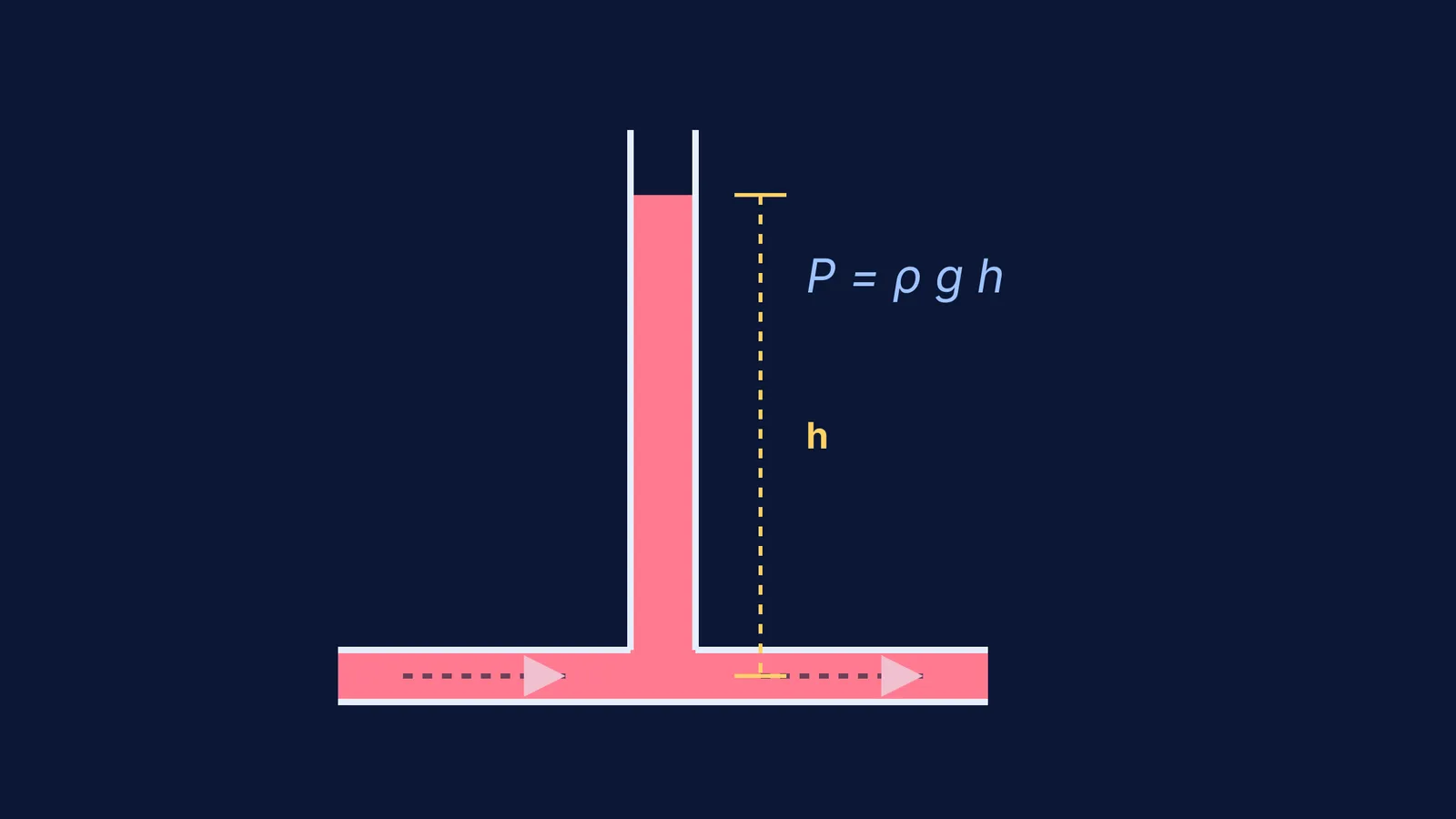
Hales began his work on animal physiology in the early 1700s, though he did not publish the results until his 1733 book *Haemastaticks*, which contained the first direct measurement of blood pressure. According to his biographical accounts, he famously conducted measurements on a mare. He inserted a fine tube into the animal's artery and measured the height to which the column of blood rose.
When he released the ligature on the artery, the blood rushed into the vertical tube and rose to a significant height above the level of the left ventricle. Hales also observed that the blood did not stay at a fixed height; it fluctuated with every heartbeat. This provided the first quantitative evidence of systolic and diastolic variations in pressure.
Hales's apparatus was essentially the world's first manometer. He used a fundamental principle of fluid statics: the pressure exerted by a static fluid column depends entirely on its height and density. The equation is P = ρgh, where P is pressure, ρ is the fluid's density, g is gravity, and h is the column's height.
If you struggle to picture how a fluid column balances pressure, you can explore hydrostatic principles in the Fermi Simulation Lab.
Why was Haemastaticks so important?
Beyond simply recording the height of the blood, *Haemastaticks* introduced concepts that are still taught in biology today. By meticulously recording the volume of blood the heart pumped, Hales made the first calculations of cardiac output.
He also recognised that the force of the blood was determined by two factors: the pumping action of the heart and the resistance provided by the small blood vessels. He noted that cold water made blood vessels constrict, while warm water made them dilate—proving that peripheral resistance is a dynamic, changing variable.
Before this work, physicians often relied on qualitative ideas like "vital spirits" to explain circulation. Hales demonstrated that the body is a measurable machine. His approach shifted physiology from philosophy into a quantitative science.
How do you convert a fluid column to mmHg?
Today, we do not measure blood pressure by the height of a blood column; we use millimetres of mercury (mmHg). We can use physics to translate a fluid column measurement into modern units.
For example, if a column of blood rises to 2.50 metres, we can find the equivalent pressure in mercury. To exert the same pressure, a column of mercury must be much shorter because it is denser. The density of blood is approximately 1060 kg/m³, and the density of mercury is 13546 kg/m³).
Equate the pressures: ρ_blood × g × h_blood = ρ_Hg × g × h_Hg
Cancel gravity and solve for h_Hg: h_Hg = h_blood × (ρ_blood / ρ_Hg)
Calculate: h_Hg = 2.50 m × (1060 / 13546) ≈ 0.196 metres, or 196 mm.
So, a column of blood 2.50 metres high corresponds to a mean arterial pressure of roughly 196 mmHg.
This calculation is a classic fluid mechanics problem. If you need step-by-step help with manometer questions, the Fermi Problem Library breaks down the reasoning rather than just printing the answer.
Hales's invasive method was never used on humans. It took another century for the invention of the mercury sphygmomanometer, and even longer for the non-invasive blood pressure cuffs we use today. Yet every time a doctor reads your blood pressure, they are relying on the fluid mechanics Stephen Hales first demonstrated in 1733.
For more examples of applying physics formulas to real-world scenarios, read our guide on two immiscible liquids in a manometer or see how to calculate work in an irreversible expansion.


