On this page
Two questions about beryllium, the odd one out in group 2, come up again and again: why BeO dissolves in both acid and alkali, and what BeCl2 looks like as a solid and as a vapour. Both answers come from one fact about size. Below is that fact, then a four-step way to draw the structures.
Why is beryllium different from other group 2 elements?
In Shannon's table of effective ionic radii, Be2+ is 45 pm, Mg2+ is 72 pm and Ca2+ is 100 pm (all six-coordinate). Divide the charge by the radius and beryllium comes out at 2/45, or about 0.044, while magnesium is about 0.028. That makes beryllium's charge-to-radius ratio roughly 1.6 times magnesium's, and calcium's is lower still.
Beryllium also holds its electrons tightly. Its first ionisation energy is 9.32 eV in PubChem's element record, against 7.65 eV for magnesium. Its Pauling electronegativity is 1.57, against 1.31 for magnesium (same two records).
This is Fajans' rules at work: a small, highly charged cation distorts the anion's electron cloud, so the bond turns partly covalent. The Wikipedia article on beryllium says beryllium does not form divalent cations; it forms two covalent bonds with a tendency to polymerise, as in solid BeCl2. The same argument explains the diagonal relationship between beryllium and aluminium.
Why is BeO amphoteric when MgO is basic?
An amphoteric oxide reacts with both acids and bases. PubChem's element record lists beryllium's oxide as amphoteric and magnesium's as strongly basic. Its compound record for BeO quotes the Merck Index: slowly soluble in concentrated acids or fixed alkali hydroxides.
The hydroxide shows both sides most clearly. Be(OH)2 dissolves in acid and in alkali:
With acid: Be(OH)2 + H2SO4 → BeSO4 + 2H2O
With alkali: Be(OH)2 + 2NaOH → Na2[Be(OH)4], sodium tetrahydroxoberyllate
Size again: the Be–O bond is partly covalent, so BeO is not a simple source of O2- the way MgO is. It can neutralise an acid, or take in hydroxide to make the tetrahedral [Be(OH)4]2- ion. Notice the four groups around beryllium; that is the key to BeCl2.
What is the structure of BeCl2 in the solid and vapour phase?
A lone BeCl2 molecule leaves beryllium with only four valence electrons, four short of an octet (two empty orbitals), so it borrows lone pairs from neighbouring chlorines.
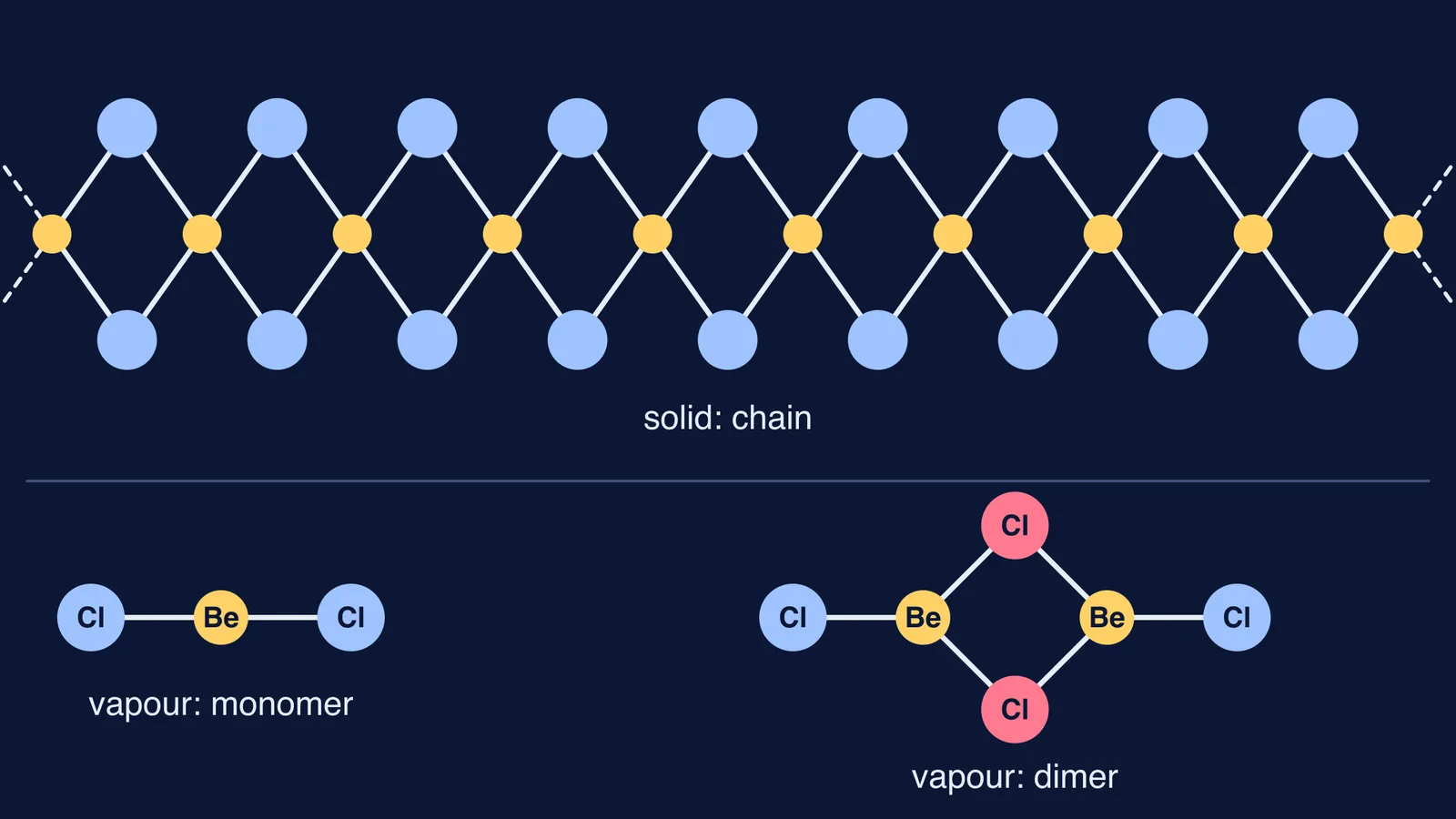
Solid: a polymer. Both known crystal structures of BeCl2 have tetrahedral Be centres linked by doubly bridging chlorides. Each Be has four Cl around it (sp3 in the textbook model) and each bridging Cl is shared by two Be. The form textbooks draw is a chain of edge-sharing tetrahedra; the other form is built from cage-like units.
Vapour: the same source says gaseous BeCl2 exists both as a linear monomer and as a dimer with two bridging chlorines, in which each beryllium is 3-coordinate. The monomer is linear, as VSEPR predicts (sp); each Be in the dimer is trigonal planar (sp2).
Aluminium chloride bridges for the same reason: see why aluminium chloride exists as the dimer Al2Cl6.
How do you draw BeCl2 in an exam?
Count the Cl around one Be first: 2 for the monomer, 3 for the dimer, 4 for the solid. That number fixes the shape (linear, trigonal planar, tetrahedral) and the hybridisation (sp, sp2, sp3).
For the monomer, draw Cl–Be–Cl in a straight line at 180°.
For the dimer, draw a four-membered Be2Cl2 ring as a rhombus, then add one terminal Cl to each Be, pointing outward along the long axis.
For the solid, repeat the rhombus in a row so that each bridging pair of Cl sits between two Be atoms, and leave open bonds at both ends to show the chain continues. Mark the arrows from Cl lone pairs to Be if the question asks about bonding.
Check with the reason: beryllium has an empty orbital, the bridging chlorine has a lone pair, so every bridge is a chlorine sharing a lone pair with a beryllium.
If the s-block feels like a list of exceptions, the Fermi Concept Library gives every chemistry concept its own lesson and its place in the map, so you can see how ionic size links to covalent character. For practice, the Fermi Problem Library has worked problems with a step-by-step solver that explains the reasoning rather than printing an answer.