

On this page
Ask a Class 12 student to sketch equipotentials and you usually get neat circles around a charge or straight lines between two plates. Both are right. The part that usually goes wrong is the spacing, so this guide works through the numbers.
What is an equipotential surface?
An equipotential surface is a surface on which the electric potential has the same value at every point, as defined in OpenStax University Physics, section 7.5. In a two-dimensional drawing, the same idea shows up as equipotential lines.
Two rules from that section do most of the work in exam questions:
Equipotential lines are always perpendicular to electric field lines.
No work is needed to move a charge along an equipotential, because the potential difference along it is zero.
The second rule explains the first: if the field had any component along the surface, moving a charge along it would take work. So the field crosses every equipotential at a right angle.
What shape are equipotential surfaces for a point charge?
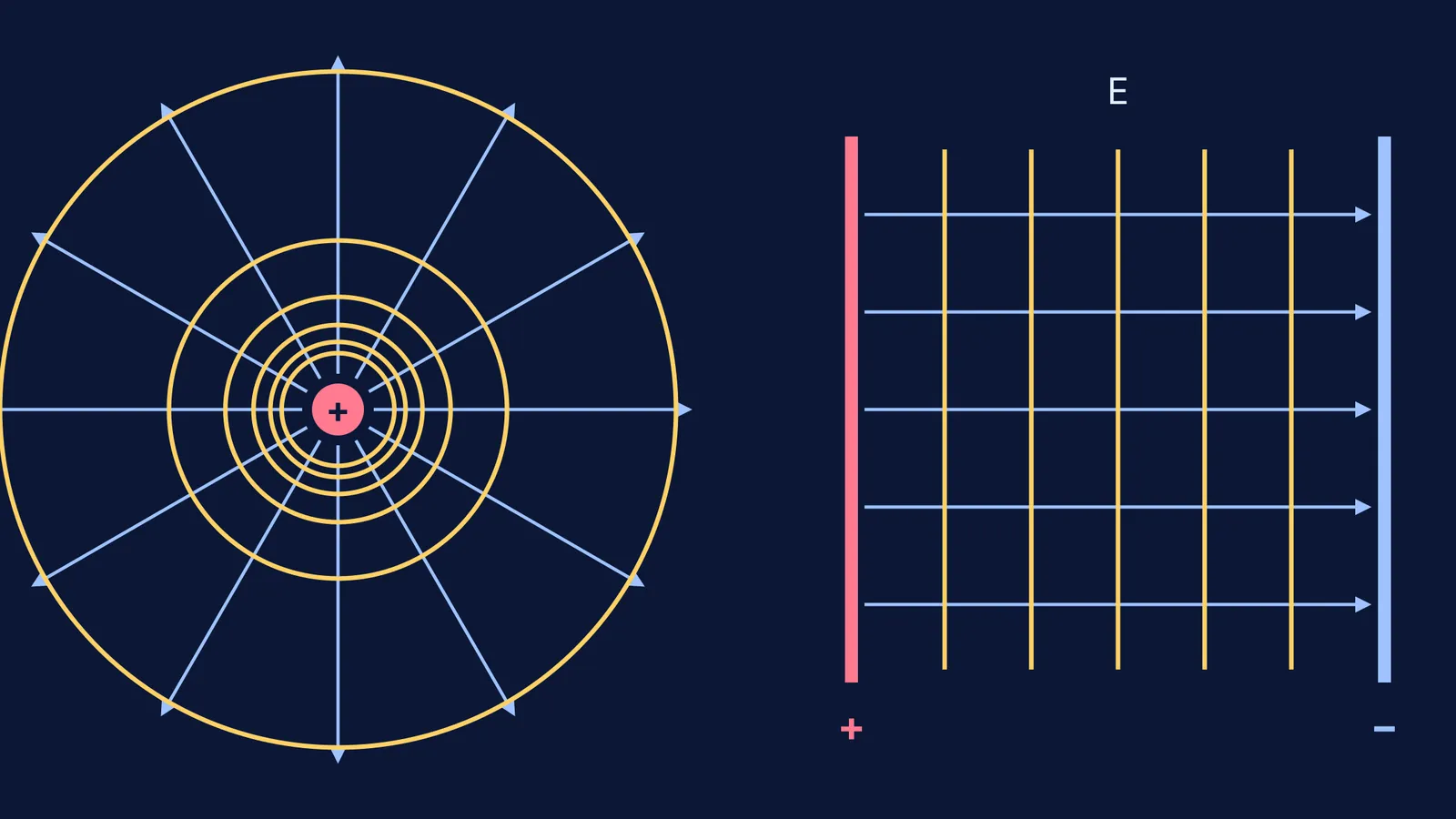
They are concentric spheres centred on the charge. The potential of a point charge is V = kq/r, which depends only on the distance r, so OpenStax puts it simply: the potential is the same anywhere on an imaginary sphere of radius r around the charge. The field lines run outward along radii, and a radius meets a sphere at a right angle, exactly as the rule demands.
Now look at the spacing. The same OpenStax section works out the equipotentials for a +10 nC charge: 100 V at r = 0.90 m, 50 V at 1.8 m, 20 V at 4.5 m and 10 V at 9.0 m. Going from 100 V to 50 V takes 0.9 m. Going from 20 V to 10 V takes 4.5 m. The steps in voltage shrink while the steps in distance grow.
What shape are equipotentials in a uniform electric field?
They are flat planes, parallel to each other and perpendicular to the field. Between two parallel charged plates, OpenStax notes that the equipotentials are evenly spaced and parallel. If you draw the field pointing left to right, the field lines are straight horizontal arrows and the equipotentials are straight vertical lines crossing them.
The spacing is even because the field has the same strength everywhere, so the potential drops by the same amount over every centimetre. Here is a quick worked example. Take a uniform field of 500 V/m and draw an equipotential every 10 V. Each gap is 10 V divided by 500 V/m, which is 0.02 m, or 2 cm, and every gap is the same.
Why are equipotential surfaces closer together where the field is strong?
Because the field is the rate at which potential falls with distance. OpenStax section 7.4 writes this as E = −dV/ds and states that the magnitude of E equals the rate of decrease of V with distance. If you fix the voltage step ΔV between your lines, the gap between them is roughly Δs = ΔV/E. A big E gives a small gap.
You can check this against the point-charge numbers from OpenStax section 7.5. For a point charge, E = kq/r², which is the same as V/r. At the 100 V sphere (0.90 m) the field is about 111 V/m, and at the 10 V sphere (9.0 m) it is about 1.1 V/m. The field is a hundred times weaker far out, which is why the spheres there are so far apart.
A conductor's surface is itself an equipotential, and near a sharp point the equipotentials squeeze together, so the field there is strong. We cover that in why charge collects at sharp points, and how lightning rods work.
How do you sketch equipotentials in an exam?
Use this five-step check on any diagram, whether it is a single charge, a pair of plates or a dipole:
Draw the field lines first, with arrows from positive to negative.
Draw each equipotential so it crosses every field line at a right angle.
Decide your voltage step and keep it fixed for the whole sketch.
Put the lines close together where the field lines are dense, and far apart where they thin out.
Check the special cases: concentric circles for a point charge, evenly spaced straight lines for a uniform field, and the surface of any conductor drawn as one equipotential.
If the field-line half of this still feels shaky, our comparison of electric and magnetic field lines is a good warm-up. And if the idea that only differences in potential matter feels odd, read why the zero of potential energy can go anywhere.
To revise the chain from charge to field to potential, the Fermi Concept Library gives each physics concept its own lesson. For practice, the Fermi Problem Library has worked problems with a step-by-step solver that explains the reasoning rather than printing an answer.


