

On this page
If a ball on a table has potential energy mgh, is h measured from the table, the floor, or sea level? It does not matter, as long as you choose once and stick with it. Here is why, plus a sign rule for gravity and springs, and why the gravitation chapter makes every potential energy negative.
Why can the zero of potential energy be chosen anywhere?
Potential energy is used in two ways: to find a force, and to find a change in energy. Neither cares about the absolute value.
For a conservative force, F = −dU/dx, as OpenStax University Physics, section 8.2 states. The derivative of a constant is zero, so adding 50 J to U everywhere leaves the force unchanged.
Energy conservation uses ΔU, the change between two points. A constant added to both points cancels when you subtract. OpenStax section 8.1 puts it plainly: the numerical values of potential energy depend on the choice of zero, "but the physically meaningful differences of potential energy do not." The same section adds: "whatever choice is made should be stated and kept consistent throughout the given problem."
A worked example: one drop, three choices of zero
A 0.5 kg ball falls from a balcony 10 m above the ground. Take g = 9.8 m/s². How fast is it moving just before it lands?
Zero at the ground: U at the top is 0.5 × 9.8 × 10 = 49 J. U at the ground is 0. ΔU = −49 J.
Zero at the balcony: U at the top is 0. U at the ground is −49 J. ΔU = −49 J.
Zero at a roof 5 m above the balcony: U at the top is −24.5 J. U at the ground is −73.5 J. ΔU = −49 J.
In every case the ball gains 49 J of kinetic energy, so ½ × 0.5 × v² = 49 and v = 14 m/s. Three different numbers for U, one answer. Our guide on when to use energy conservation instead of Newton's laws walks through the method.
How do you choose signs for gravity and springs?
Near Earth's surface, OpenStax section 8.1 writes gravitational potential energy as U(y) = mgy + const, with y measured upward. That gives you a simple checklist:
Point y upward and choose any level as y = 0.
Anything above that level has positive U, anything below has negative U.
Going up always increases U; going down always decreases it, whatever the zero.
For a spring, the same section gives U(x) = ½kx² + const and recommends taking the zero at x = 0, the unstretched length, when the spring force is the only force acting. With that choice, spring potential energy is never negative, because x² is positive whether the spring is stretched or compressed. A spring with k = 200 N/m stretched or compressed by 0.1 m stores 1 J either way.
Why does gravitational potential energy have its zero at infinity?
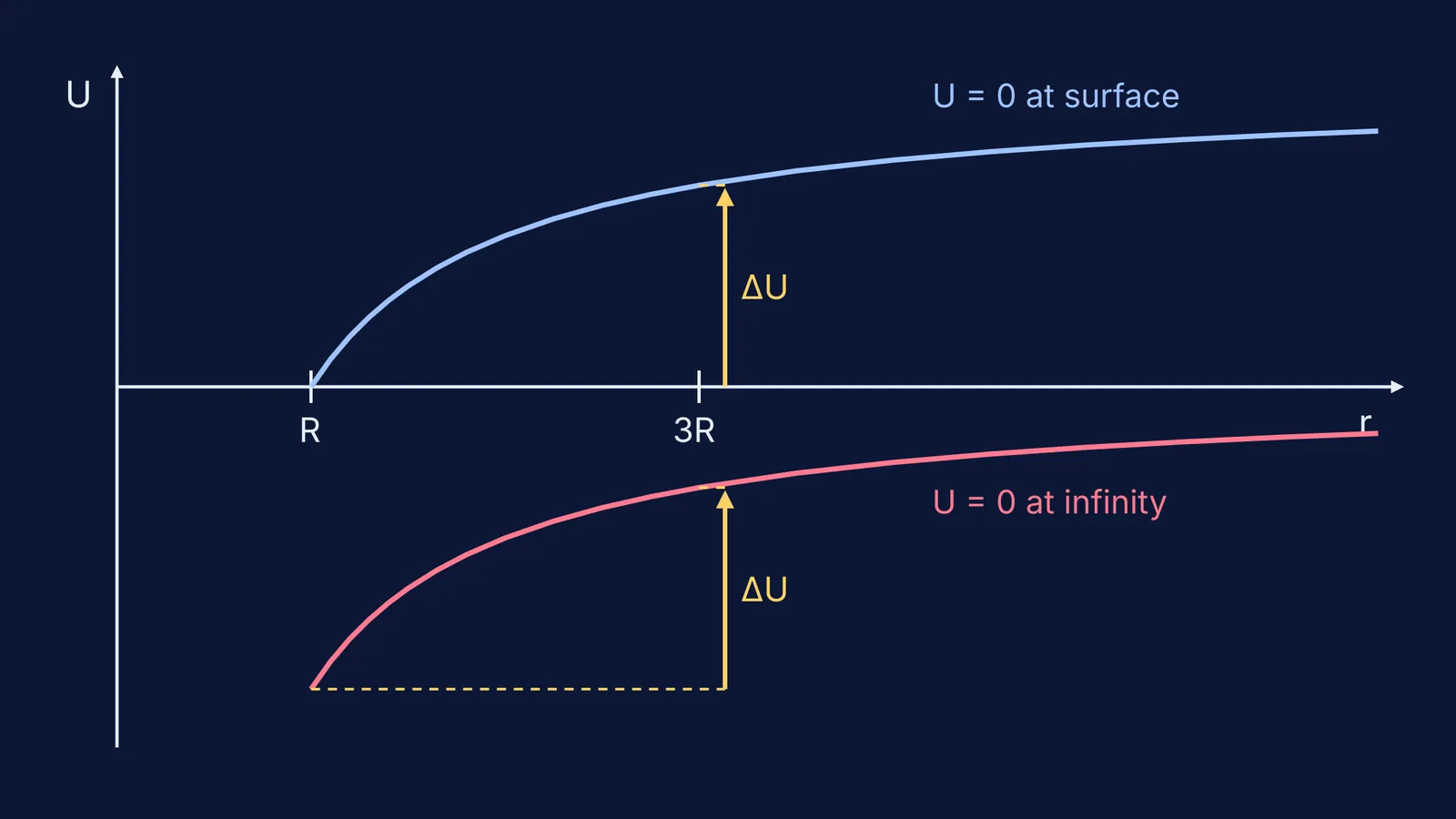
For two masses a distance r apart, OpenStax section 13.3 gives U = −GMm/r. This U goes to zero as r goes to infinity, and the book notes that choosing U = 0 at infinity "is merely one of convenience."
It is a good convenience. At infinity two masses no longer affect each other, so the same zero works for every pair of masses and every problem, with no extra constant to track.
The price is the minus sign: every finite distance has U below zero. OpenStax explains that pulling the masses apart needs positive work against gravity, so U rises towards zero. Negative just means "less than at infinity."
The two formulas also agree where they should. The change from the surface (radius R) to a height h is GMm(1/R − 1/(R + h)), which is very close to mgh when h is small compared with R. OpenStax notes that mg(y₂ − y₁) works well only if g does not change much between the two heights. That is why escape-speed problems, such as finding the maximum height reached when projected below escape velocity, need −GMm/r and not mgh.
Where to go from here
Try one of each type this week: a drop with your own choice of zero, a spring stretched and then compressed, and a system of several masses such as the potential energy of three masses at the corners of a triangle. If the idea of a reference level still feels slippery, the Fermi Concept Library has a lesson for each concept in physics and shows where it sits in the map. If your setup keeps going wrong, the Fermi Problem Library has worked problems with a step-by-step solver that explains the reasoning rather than printing an answer.


