

On this page
Most mechanics questions can be solved two ways: forces and acceleration (Newton's second law), or energy. Both work, but one often takes three lines and the other a page.
The rule behind it is short. OpenStax University Physics puts it this way: "The mechanical energy of a particle does not change if all the non-conservative forces that may act on it do no work". When non-conservative forces such as friction do act, the same source gives W_nc = Δ(K + U): the work they do equals the change in mechanical energy.
When should you use energy conservation instead of F = ma?
Ask these four questions before you write anything:
Does the question connect speed with position? "How fast at the bottom?" or "How far does the spring compress?" points to energy. "How long does it take?" points to Newton's laws and kinematics, because energy has no time in it.
Is the path curved or unknown? On a curved track the force keeps changing direction, which makes F = ma painful. Energy only cares about the start and end heights.
Which forces do work? Gravity and ideal springs are conservative. Friction and air resistance are not. Normal force on a fixed surface does no work.
Is there a collision? In an inelastic collision momentum is conserved but kinetic energy decreases. Use momentum across the impact, then energy before and after it.
If the question asks for acceleration, tension or normal force at one instant, use a free-body diagram. Our guide to Newton's second law with free-body diagrams covers that side.
How do you solve an energy conservation problem step by step?
OpenStax suggests a five-step strategy: identify the system, list the forces, sort the ones that do work into conservative and non-conservative, choose a reference point for potential energy, then set the energy at the start equal to the energy at the end. Here it is on three problems (take g = 10 m/s²).
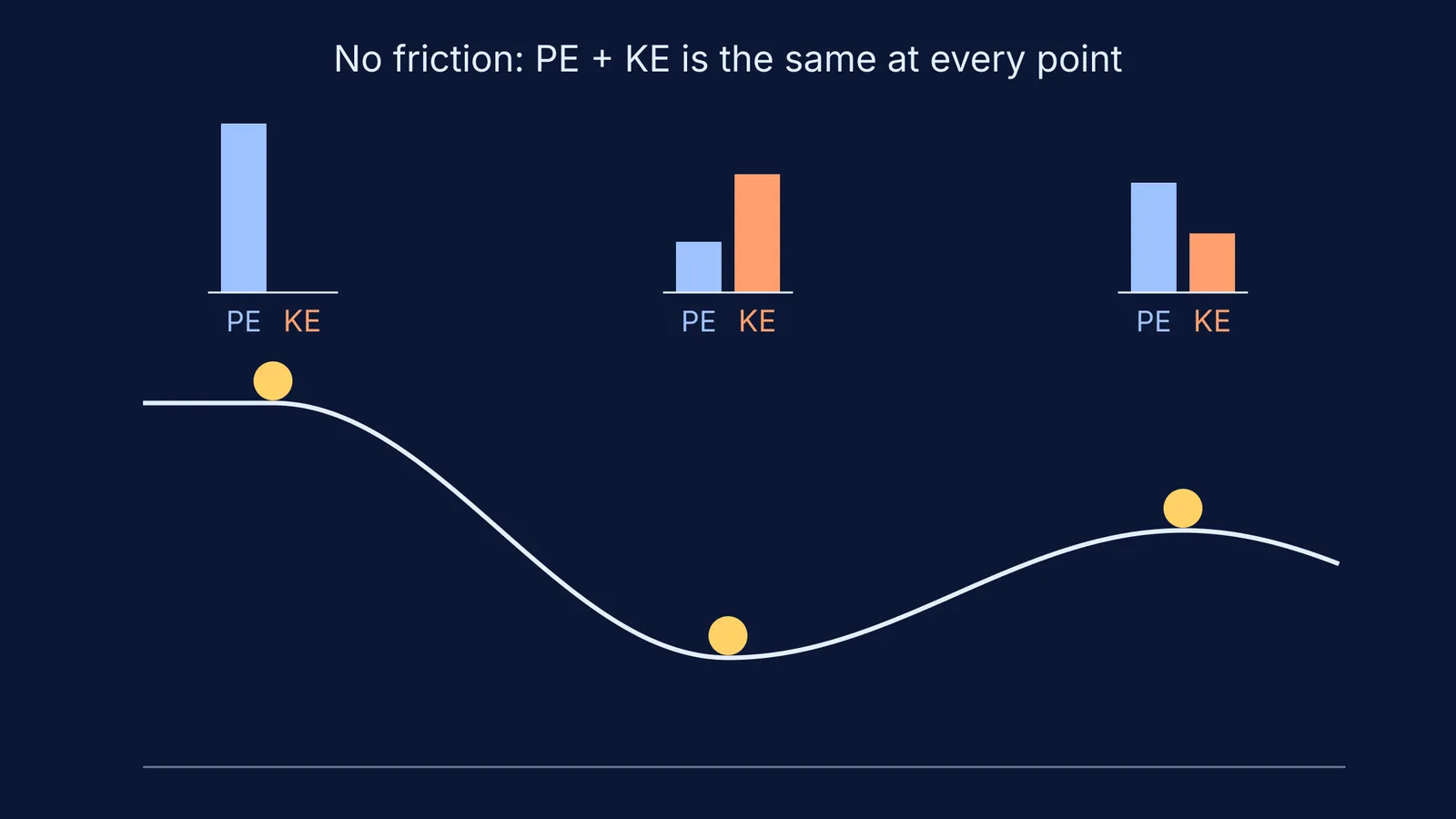
Example 1, a smooth curved track: a block is released from rest 0.8 m up a frictionless curved slope. How fast is it moving at the bottom?
The shape of the slope doesn't matter. Take the bottom as zero height: mgh = ½mv², so v = √(2gh) = √(2 × 10 × 0.8) = 4 m/s. The mass cancels, and you never needed the slope.
Example 2, the same block on a rough floor: the block now slides at 4 m/s onto a horizontal floor where μ = 0.2. How far does it go?
Friction does negative work, −μmgd. Energy is still the right method, just with that term: ½mv² = μmgd, so d = v² ÷ (2μg) = 16 ÷ 4 = 4 m.
Example 3, a spring stopping a block: a 0.5 kg block moving at 2 m/s on a smooth floor hits a spring with k = 200 N/m. What is the maximum compression?
At maximum compression the block is momentarily at rest, so ½mv² = ½kx². That gives x = v√(m/k) = 2 × √(0.0025) = 0.1 m. For more spring setups, see our walkthrough of spring-block energy problems.
What are the common traps with friction and springs?
Writing "energy is conserved" when friction acts. Total energy is conserved, but mechanical energy is not. Add the friction work as a loss, or your final speed will come out too large.
Using μmg on an incline. On a slope the normal force is mg cos θ, so the friction work over a distance d is μmg cos θ × d.
Measuring spring stretch from the wrong place. In ½kx², x is the displacement from the spring's unstretched length, not from the block's starting point or its equilibrium position.
Forgetting gravity on a vertical spring. When a block drops onto a vertical spring, gravitational potential energy changes too. Include mgh for the full fall, including the compression distance.
Assuming kinetic energy survives a collision. If the objects stick together, kinetic energy is lost. Use momentum for the impact itself.
These mistakes can survive teaching. A study in the American Journal of Physics asked students in introductory calculus-based physics courses questions after lectures, textbook work and labs, and found that failure to associate work with the change in energy of a system was widespread (Lindsey, Heron and Shaffer, 2009). If you have to stop and remember the work-energy link, practise it on purpose with our set of work-energy theorem problems.
How should you practise choosing the method?
Take ten mixed mechanics questions from a past paper. For each one, write "energy", "Newton" or "momentum then energy" in the margin before solving, plus one line saying why. Then solve it and check your choice.
If you pick the right method and still get stuck partway, the Fermi Problem Library has worked problems with a step-by-step solver that explains the reasoning rather than printing an answer, so you can see where your setup went off track.


