

On this page
When you have a single pair of massive objects, finding their gravitational potential energy is straightforward. You multiply their masses, divide by the distance between them, and multiply by the gravitational constant. But when you introduce a third object, the system becomes more complex. You cannot just add the individual energies of each mass; instead, you calculate the interaction energy of every possible pair.
In physics, the gravitational potential energy of a system is defined as the work done by an external agent in bringing the bodies from infinity to their current positions (NCERT). The universal gravitational constant that scales this force is G = 6.67 × 10⁻¹¹ N m²/kg² (NCERT). Because gravity always pulls objects together, this assembled potential energy is always negative.
What is the potential energy of three masses at corners of triangle?
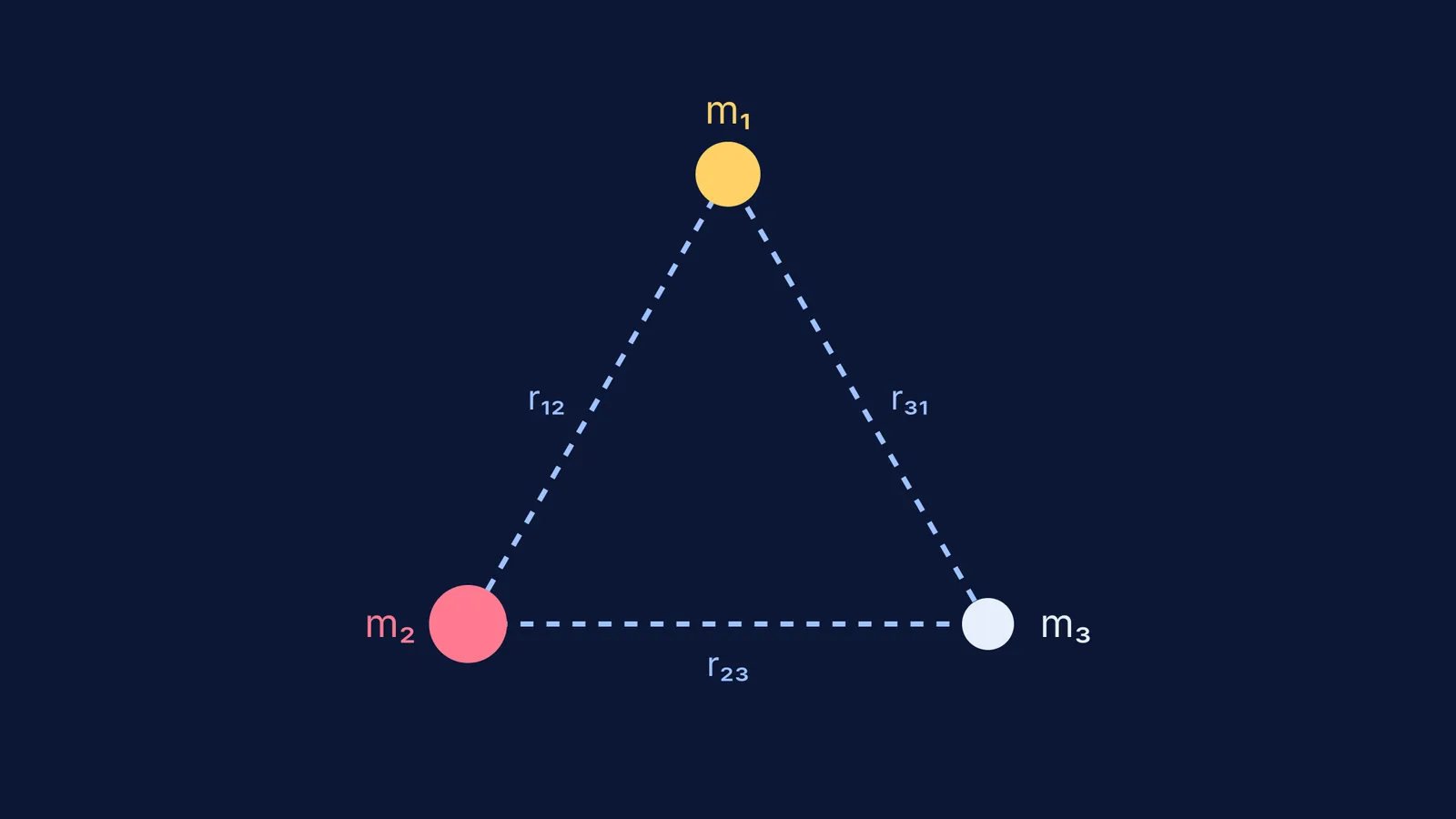
To find the total potential energy of a three-mass system, you must sum the potential energy of all three unique pairs. Think of it as counting the lines connecting the corners of a geometric shape. For a triangle, there are exactly three lines connecting the three vertices.
If you have three masses (m₁, m₂, and m₃) separated by distances r₁₂, r₂₃, and r₃₁, the total gravitational potential energy (U) is the algebraic sum of the three interactions:
U = −G(m₁m₂/r₁₂ + m₂m₃/r₂₃ + m₃m₁/r₃₁)
Every pair contributes to the total. This pairwise summation is the same principle you use to find the Work to assemble point charges in electrostatics. The difference is that electrical charges can repel each other, creating positive potential energy, whereas the gravitational force is strictly attractive.
If the three masses are identical (m) and sit at the corners of an equilateral triangle of side length L, the three pairs are exactly the same. The formula simplifies beautifully:
U = −3Gm²/L
When the triangle is not equilateral—for example, a right-angled triangle where the distances differ—you calculate each term separately. You cannot simply multiply one pair by three.
How much work is required to separate the masses?
Exam problems often flip the scenario. Instead of asking for the energy of the assembled system, they ask for the work required to pull the system apart, taking all masses to an infinite distance from one another. This is the binding energy of the system.
By convention, the potential energy of objects separated by an infinite distance is zero. To find the work done by an external force to separate them, subtract the initial energy of the bound system from the final energy (which is zero):
Work = U_final − U_initial = 0 − (−3Gm²/L) = +3Gm²/L
The work done to separate them is positive because you pull against their mutual gravitational attraction. You are actively supplying energy. It takes exactly the same logical approach to take them apart as it does to break up a uniformly charged solid sphere or any other bound field, differing only in the specific forces.
Why is the gravitational potential energy negative?
The negative sign tells you that the system is bound. Because gravity is an attractive force, the masses naturally pull towards each other. If you let them go from infinity, they would speed up as they fall together. To bring them into position without giving them kinetic energy, an external agent must pull back on them, doing negative work to lower them into their final places.
When a concept relies heavily on signs and reference points, it is easy to make a mistake by dropping a minus sign or confusing the work done by the field with the work done by you. If you find yourself guessing whether to add or subtract energy in a multi-body problem, the Concept Library maps out every concept in physics with its own lesson, helping you build a stronger intuition for why bound systems always have negative total energy.
A worked example with a right-angled triangle
Let's put this into practice with a system that is not equilateral. Imagine three objects, each with a mass of 2 kg. They are placed at the corners of a right-angled triangle with base 3 metres and height 4 metres. The hypotenuse is 5 metres.
Identify the pairs: There are three pairs, but they have different separation distances (3 m, 4 m, and 5 m).
Energy of the first pair (base): u₁ = −G × (2 × 2) / 3 = −1.33G J.
Energy of the second pair (height): u₂ = −G × (2 × 2) / 4 = −1.00G J.
Energy of the third pair (hypotenuse): u₃ = −G × (2 × 2) / 5 = −0.80G J.
Total energy: U = −1.33G − 1.00G − 0.80G = −3.13G J.
To find the final numerical value, substitute the gravitational constant: U = −3.13 × (6.67 × 10⁻¹¹) = −2.09 × 10⁻¹⁰ J.
The work required by an external force to scatter these three masses to infinity is exactly +2.09 × 10⁻¹⁰ J. By keeping your signs clear and counting every pair, you ensure no interaction is left behind.


