

On this page
When you project a body upwards from Earth's surface, its kinetic energy is converted into gravitational potential energy. At everyday speeds, we assume the acceleration due to gravity (g) remains constant at 9.8 m/s² (according to the standard gravity of Earth). This gives the familiar kinematic formula for maximum height: h = v² / 2g. However, this approximation breaks down when dealing with extreme velocities.
Why does the formula h = v² / 2g fail at large heights?
The assumption of constant g is only valid near the surface of the Earth. If you throw a ball in the air, the change in gravity over a few metres is negligible. But if you launch a rocket or a projectile at several kilometres per second, it will travel hundreds or thousands of kilometres high.
According to Newton's law of universal gravitation, gravity follows an inverse-square law, weakening as you move further from Earth's centre. Because the downward pull of gravity becomes significantly weaker at high altitudes, the projectile faces less resistance over time. Consequently, the object will travel much higher than the simple h = v² / 2g formula predicts. To get the correct answer for high-speed projectiles, we must account for this changing gravitational force.
What is the maximum height reached by a body projected with speed less than escape velocity?
To find the exact height without relying on constant acceleration, you must use the law of conservation of energy. In a closed system without air resistance, the total mechanical energy (kinetic plus potential) of the body remains constant throughout its entire flight, a principle detailed in the escape velocity mechanics.
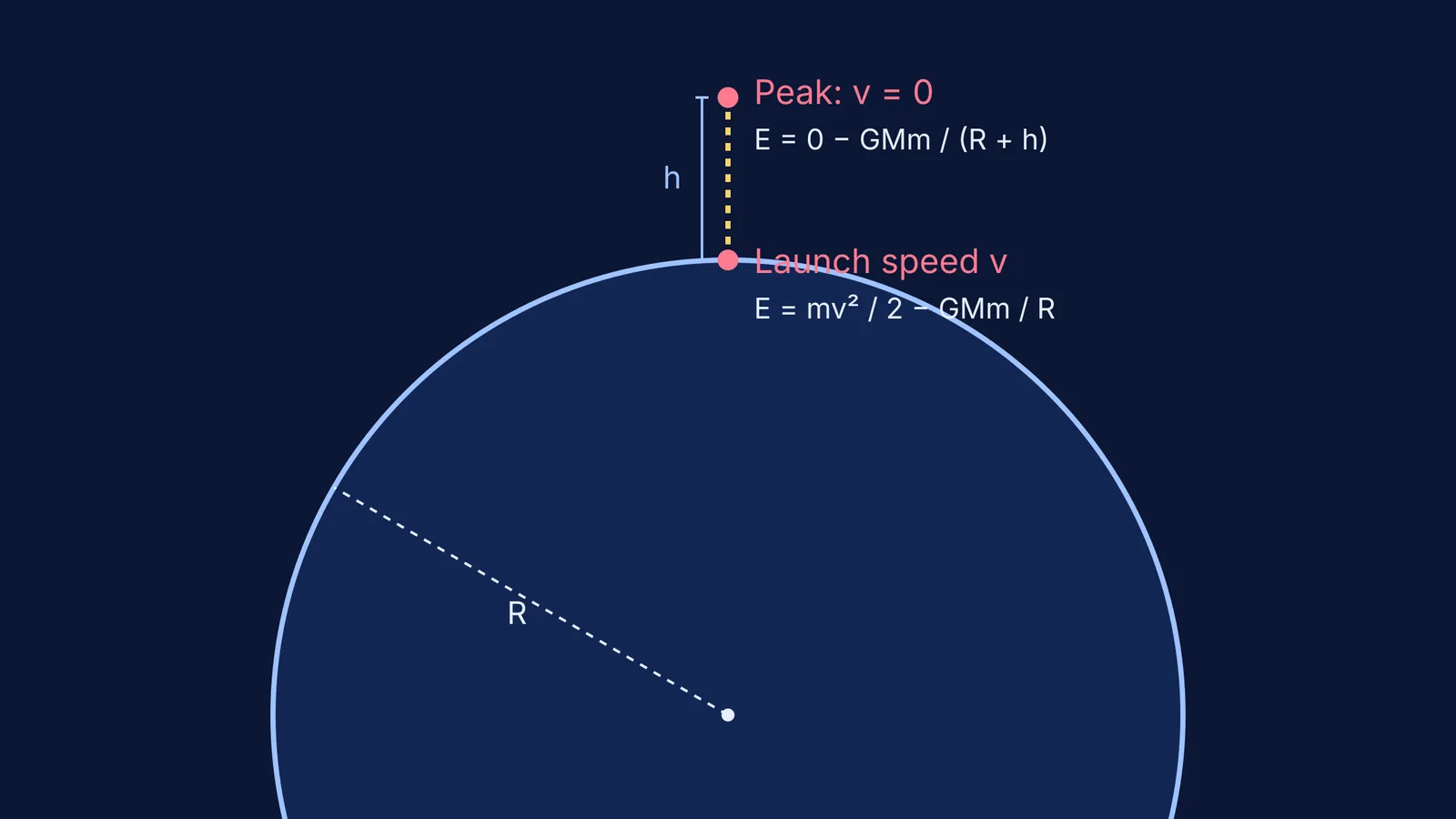
At the surface of the Earth, the object sits at a distance R (Earth's mean radius, about 6,371 km, according to Earth's physical characteristics) from the centre. Its initial energy is the sum of its kinetic energy (1/2 mv²) and its true gravitational potential energy (−GMm / R).
At the peak of its trajectory, or maximum height h, the object's upward velocity drops to zero. Its final distance from the Earth's centre is the full radius plus the height gained: R + h. At this exact moment, the final kinetic energy is zero, making the total energy purely potential: −GMm / (R + h).
Equating the initial energy to the final energy gives us our starting equation: 1/2 mv² − GMm / R = 0 − GMm / (R + h)
If you ever get stuck setting up these energy equations or keeping track of the crucial negative signs, the Fermi Problem Library has worked problems with a step-by-step solver that explains the reasoning rather than printing an answer.
How do you calculate height using energy conservation?
We can simplify the energy conservation equation to isolate and find h. First, divide every term by the object's mass m, showing that the mass of the projectile does not affect the final height: v² / 2 = GM / R − GM / (R + h)
We also know that the escape velocity v_e of a planet is defined mathematically as √(2GM / R), as shown in the conservation of energy derivation. Squaring both sides means v_e² = 2GM / R, which can be rearranged to GM = v_e² R / 2. Substituting this expression for GM into our energy equation gives: v² / 2 = (v_e² R / 2) × [ 1 / R − 1 / (R + h) ]
Next, cancel the 1/2 from both sides and find a common denominator for the fractions inside the brackets: v² = v_e² R × [ (R + h − R) / (R(R + h)) ] v² = v_e² h / (R + h)
Now, divide both sides by v_e² to group the velocity terms together: v² / v_e² = h / (R + h)
Finally, invert both sides and rearrange to solve for h. This yields the exact formula for a projectile launched at speed v: h = R / (v_e² / v² − 1)
This exact relationship confirms that as your initial launch speed v gets closer to the escape velocity v_e (which is approximately 11.186 km/s for Earth, per Earth's properties), the denominator approaches zero. As a result, the maximum height approaches infinity, which is the very definition of reaching escape velocity.
How high does a projectile go at half the escape velocity?
What happens if you launch a projectile vertically at half the escape velocity (v = 0.5 v_e)? Let's plug this scenario into our derived formula to see the difference energy conservation makes.
Launch speed ratio: v_e / v = 2
Substitute into the formula: h = R / (2² − 1)
Result: h = R / 3
The projectile reaches a maximum height equal to exactly one-third of Earth's radius. Given Earth's radius, this is roughly 2,123 km above the surface. If you had incorrectly used the constant-g formula h = v² / 2g, you would have severely underestimated this height, predicting only a quarter of Earth's radius (R / 4) because you would have ignored the weakening gravitational pull as the object climbed.
When studying gravitational physics, it is helpful to actively contrast deep-space mechanics with short-range motion. For instance, you can review the equation of trajectory of a projectile near the ground, or examine the time of flight for a horizontal projectile from a cliff.


