
On this page
Put extra charge on a metal object and it does not spread evenly. It crowds onto the corners, edges and tips. That one idea explains a classic Class 12 question and the metal rod on top of tall buildings.
Why does charge collect at sharp points on a conductor?
Start with two facts from NCERT Class 12 Physics, Chapter 2, Section 2.9. In the static situation the field inside a conductor is zero, so the whole conductor, surface included, sits at one potential. Just outside the surface the field is E = σ/ε₀, where σ is the surface charge density.
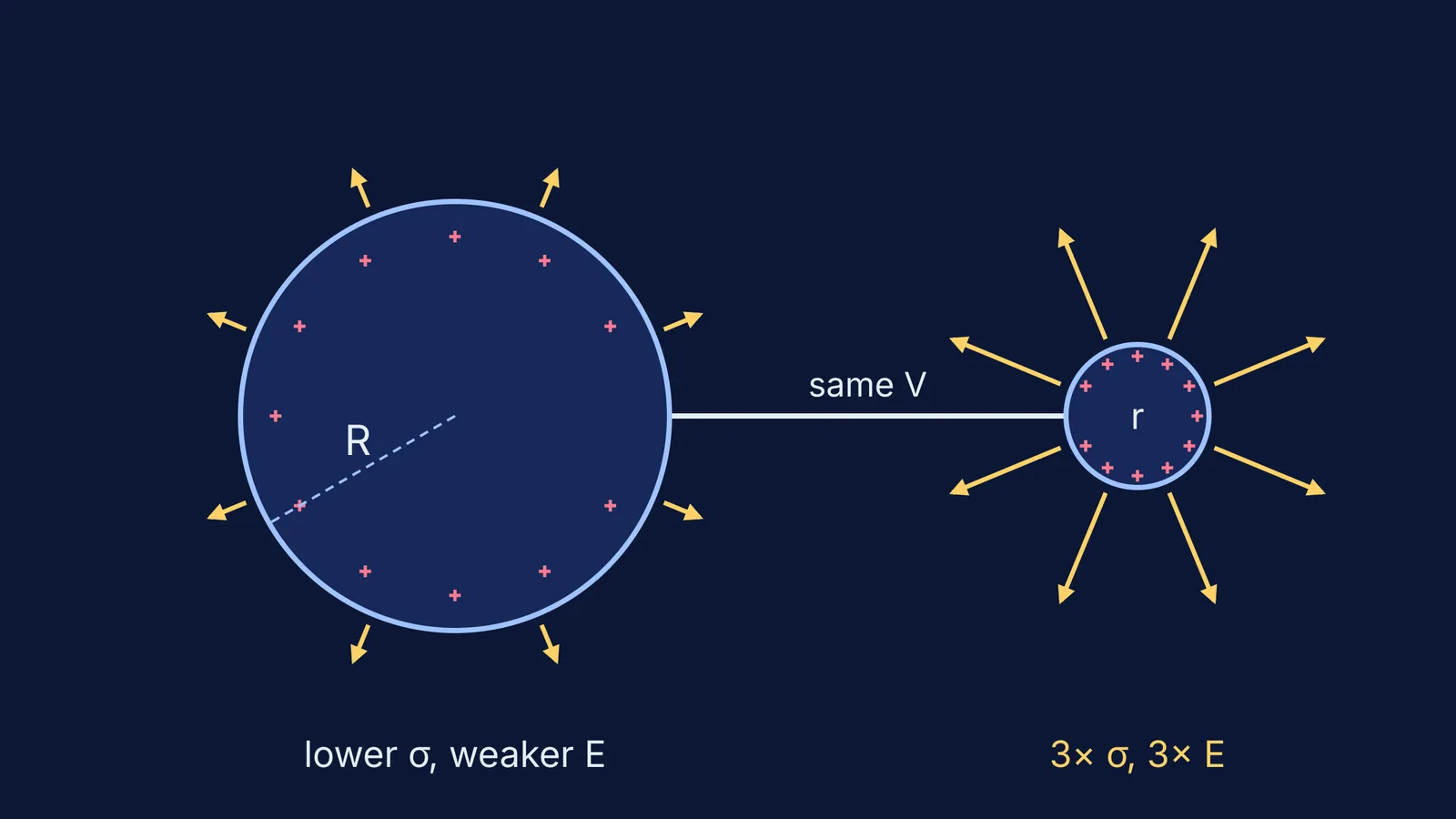
Now join a big sphere (radius R) and a small one (radius r) with a thin wire, far apart. They share one potential, so kQ₁/R = kQ₂/r and Q ∝ R. Since σ = Q/4πR², σ ∝ 1/R. The smaller sphere has the higher charge density and the stronger field.
A sharp tip behaves like a sphere with a tiny radius. OpenStax College Physics puts it plainly: excess charges on a nonuniform conductor become concentrated at the sharpest points.
Worked example: two spheres, one wire
Take R = 30 cm and r = 10 cm, sharing 40 nC in total (use k = 9 × 10⁹ N m²/C²).
Charge splits in the ratio of the radii, 3 : 1, so Q₁ = 30 nC and Q₂ = 10 nC.
Common potential: V = kQ₁/R = (9 × 10⁹)(30 × 10⁻⁹)/0.3 = 900 V, the same as kQ₂/r.
Surface fields: E₁ = kQ₁/R² = 3.0 × 10³ V/m and E₂ = kQ₂/r² = 9.0 × 10³ V/m.
One-third the radius gives three times the charge density and three times the field.
What is corona discharge?
Air is a good insulator only up to a point. The highest field it can stand without breaking down is its dielectric strength, about 3 × 10⁶ V/m, according to NCERT Section 2.11. Above that, the strong field ionises the air and charge leaks away.
For an isolated sphere at potential V, the surface field is V/r. Keep the 900 V from the example and shrink the radius to 0.3 mm, about a pin tip. The field becomes 900/0.0003 = 3 × 10⁶ V/m, roughly the dielectric strength of air. It is a rough estimate, but it shows why points leak first.
That leak of charge from a sharp point into ionised air is corona discharge. OpenStax notes that this is why high-voltage transmission lines use smooth surfaces: to avoid leaking charge into the air.
How does a lightning conductor protect a building?
Benjamin Franklin began working on the idea around 1750. He described an iron rod about 8 or 10 feet long, sharpened to a point, and hoped it would draw the electrical fire silently out of a cloud, according to the Franklin Institute. (For how the cloud gets charged in the first place, see how lightning forms in clouds.)
The modern view is more modest. The US National Weather Service says lightning protection systems do not prevent lightning from striking a structure. Instead they intercept the strike, give the current a conductive path along copper or aluminium cable, and spread it safely into the ground. A complete system also needs bonding and surge protection for power and data lines.
Field tests add a twist. Researchers at New Mexico Tech exposed sharp and blunt rods side by side under thunderclouds. After seven years, none of the sharp Franklin rods had been struck, but 12 blunt rods with tip diameters of 12.7 to 25.4 mm had, as reported in Geophysical Research Letters. Their Journal of Applied Meteorology paper explains why. The field at a sharp tip is stronger, but it falls off quickly with distance and the ions it sheds limit it. A few centimetres up, a blunt rod's field can be stronger, so the authors concluded that moderately blunt rods are better strike receptors than sharper or very blunt ones.
The physics of sharp points still holds. The rod's real job is to give lightning a safe, earthed path to the ground. For a related idea, see why you are safe inside a car during lightning.
How should you write this in a board exam?
Use this four-step chain, one line each:
A conductor's surface is an equipotential.
For connected spheres, Q ∝ R, so σ ∝ 1/R: sharper means a higher σ.
E = σ/ε₀ just outside, so the field is strongest at points and can exceed the dielectric strength of air, ionising it (corona discharge).
A lightning conductor is an earthed metal rod above the building that intercepts the discharge and carries it to the ground through a copper or aluminium cable.
If step 3 feels shaky, revise the field at a conductor's surface versus a charged sheet. For other gaps, the Fermi Concept Library gives each physics concept its own lesson and its place in the map. If you get the idea right but the number wrong, the Fermi Problem Library has worked problems with a step-by-step solver that explains the reasoning rather than printing an answer.