

On this page
A thunderstorm is essentially a giant electrostatic generator. Inside a towering cumulonimbus cloud, strong warm updrafts carry super-cooled water droplets and tiny ice crystals high into the atmosphere. As they rise, they meet falling, heavier clumps of soft hail called graupel.
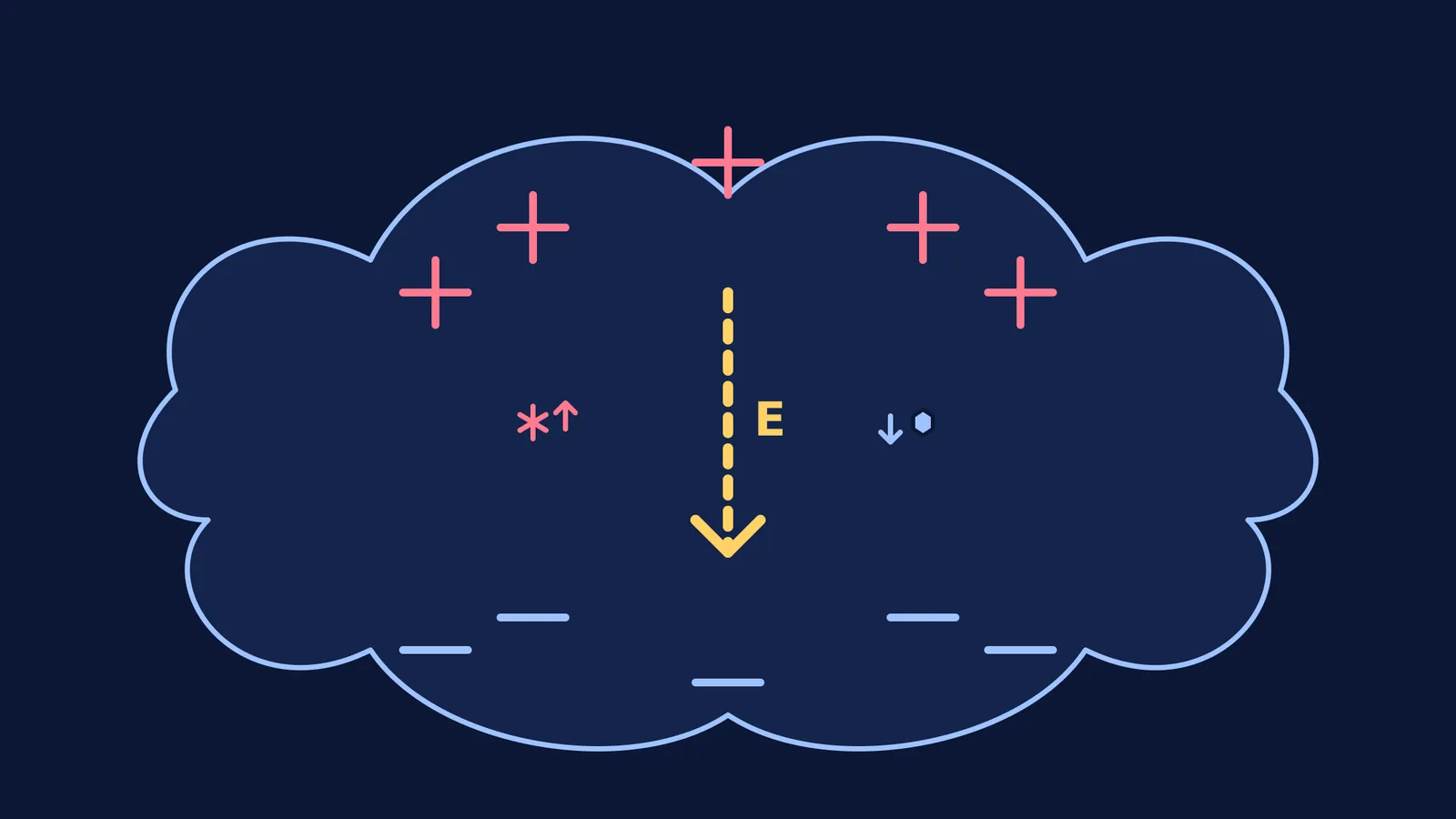
When these particles collide, they exchange electrons through the triboelectric effect, a form of charging by friction. The tiny ice crystals lose electrons, becoming positively charged, and are swept to the top of the cloud. The heavier graupel gains electrons, becoming negatively charged, and sinks to the middle and lower parts of the cloud. This separates the charges, creating a massive electric dipole within the cloud structure. Over time, this natural separation process builds up an enormous amount of stored electrical energy, turning the entire cloud into a massive floating capacitor.
How do ice and graupel separate charge?
The crucial charge separation happens in the freezing mid-levels of the cloud. Studies of thunderstorm electrification show that the most active charging occurs where temperatures range from –15 °C to –25 °C.
In this zone, every collision between rising ice and falling graupel transfers a small amount of charge. Over millions of collisions, the top of the thundercloud builds a massive positive charge, while the bottom becomes intensely negative. This is a macro-scale demonstration of the principle of conservation of charge; no new charge is created, it is merely separated by the mechanical work of the updraft.
What triggers dielectric breakdown in the air?
Air is usually a good insulator. But as the separated charges grow, so does the electric field between them. The local electric field in damp air must exceed a critical threshold of approximately 3,000,000 volts per meter (3 MV/m) for a spark to form.
At this limit, a process called dielectric breakdown occurs. The intense electric field strips electrons from air molecules, turning the insulating air into a conductive plasma channel. The first barely visible stroke, called a stepped leader, darts forward in segments of about 45 meters. Once it connects with an oppositely charged region, a brilliant return stroke surges through the channel. An average negative lightning flash transfers roughly 15 Coulombs of charge and carries a peak current of 30,000 amperes.
How does this relate to the Class 12 syllabus?
If you are studying for your Class 12 exams, the physics of lightning ties directly to your first unit on electrostatics.
Frictional electricity: The initial charging of ice and graupel is the same mechanism as rubbing a glass rod with silk.
Electric field (E = F/q): The separated charges create a region where any stray ion experiences a massive force. You can see this force in action with the Fermi Simulation Lab, which has interactive simulations for the ideas that are easier to see than to read.
Dielectric strength: The 3 MV/m breakdown limit of air is a standard textbook value. When the field exceeds this, the air ionises, much like how a capacitor fails if the voltage is too high.
To avoid Electrostatics mistakes: field vs potential, signs and superposition in exams, always remember that an electric field points from positive to negative. When you are Reading electric and magnetic field lines without common mistakes, picture the thundercloud: the lines point downwards from the positive anvil to the negative cloud base, driving negative electrons in the opposite direction.


