

On this page
In short
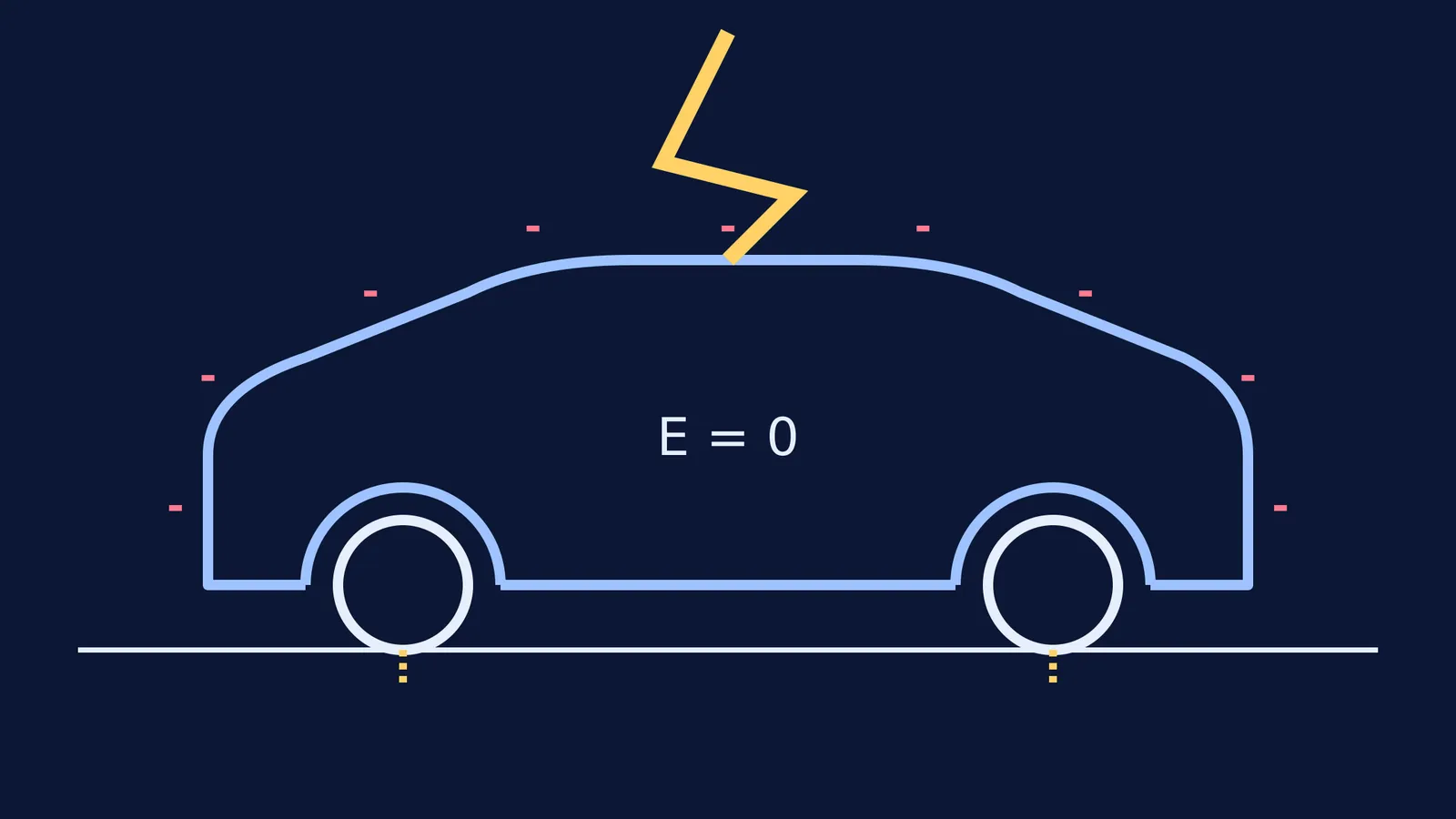
According to the National Weather Service, a hard-topped metal vehicle acts as a Faraday cage during a lightning strike, directing the electrical current around the outside of the vehicle. The metal body protects the occupants by keeping the electric field inside at zero, while the rubber tires provide no actual insulation against the massive charge.
When a thunderstorm rolls in, sitting in a car feels incredibly safe. Many people assume this is because the car is insulated from the ground by its thick rubber tires. But the physics behind this safety has absolutely nothing to do with the rubber.
According to the National Weather Service (NWS), a hard-topped metal vehicle acts as a Faraday cage during a lightning strike. The metal body—not the tires—is what actually protects the people inside.
How does a Faraday cage work?
A Faraday cage is an enclosure made of a conductive material, like the steel or aluminum body of a typical car. When an external electrical field is applied—such as a lightning strike hitting the roofline or the antenna—the free electrons in the metal redistribute themselves almost instantaneously.
According to Gauss's law, these charges spread out entirely on the outer surface of the conductor. As they do, they create an opposing electric field that exactly cancels out the external field inside the enclosure. The net electric field inside the car remains zero. The electrical current follows the path of least resistance along the "skin" of the car and jumps to the ground, leaving the passengers completely unharmed.
For students trying to picture how charges spread on conductors, the Fermi Simulation Lab provides interactive simulations for the ideas that are easier to see than to read. You can watch how charges redistribute to keep the internal field zero, much like the physics of earthing concentric spherical shells.
Why don't rubber tires protect you?
A persistent myth is that rubber tires act as an insulator, stopping the lightning from reaching the earth. This is a misunderstanding of voltage.
Lightning can heat the air it passes through to 50,000 degrees Fahrenheit (about 27,760 °C), which is five times hotter than the surface of the sun. The electrical discharge has already traveled through miles of air to reach your vehicle. Because air is a far better insulator than a few inches of rubber, the tires offer no resistance to a charge of that magnitude.
Instead of stopping the current, the lightning simply arcs over the tires or passes straight through the steel belts embedded inside them. The NWS notes that it is very common for lightning to destroy one or more tires as it forces its way to the ground. The intense heat vaporizes moisture inside the tires, causing them to blow out entirely.
What actually happens to the car?
While passengers inside are safe, the vehicle itself rarely escapes completely unscathed. The massive surge of electricity leaves a path of destruction through the frame.
A typical cloud-to-vehicle strike will hit the highest point, usually the antenna or the roofline. The heat can partially melt the antenna and cause a small explosion of sparks as fragments of metal burn. The electrical discharge can also find its way into the small defrosting wires embedded in the rear window, superheating them and causing the glass to shatter instantly.
A portion of the current also inevitably enters the vehicle's electrical system. This can completely destroy electronic components, fry the engine control unit (ECU), and leave the car totally inoperable. In some cases, the intense heat can even ignite a fire.
Are you always safe inside a car during lightning?
The Faraday cage effect is a highly reliable principle of physics, but it has strict limitations in the real world. It only works if the conductive enclosure is continuous and you do not accidentally provide an alternate path for the electrical current.
You must have a hard metal roof. Convertibles (even with the top up), fiberglass-bodied cars, and vehicles with soft or canvas tops do not act as Faraday cages. They offer almost no protection from a strike because the conductive shell is broken.
You must avoid touching metal. If you touch the steering wheel, gear shift, radio, or door handles during a strike, you become part of the conductive path to the ground. The current can easily travel through internal wiring or metal steering linkages.
The windows must be rolled up. An open window breaks the continuous surface of the Faraday cage, potentially allowing the electric field or the intense heat of the plasma channel to enter the cabin.
When learning about where potential is zero near two charges, you realise that being perfectly insulated from the charge flow is key. If you are studying the physics of electric fields and potentials, Fermi's AI tutor holds a line of reasoning across a whole session, notices where a student is stuck, and decides whether to explain, ask, or show.


