

On this page
When Michael Faraday published his 1852 treatise on lines of force in the *Philosophical Magazine* (Faraday, 1852), he gave physicists a visual language for fields that had previously existed only as abstract equations. Today, field lines remain one of the most reliable ways to visualize invisible vector fields in CBSE Class 12 physics, JEE Main, and NEET-UG.
Yet students regularly confuse electric field lines with magnetic field lines. While both share identical graphical conventions—such as tangent direction and line density—their physical origins and geometric structures reflect entirely different laws of nature.
Why do magnetic field lines form closed loops while electric field lines do not?
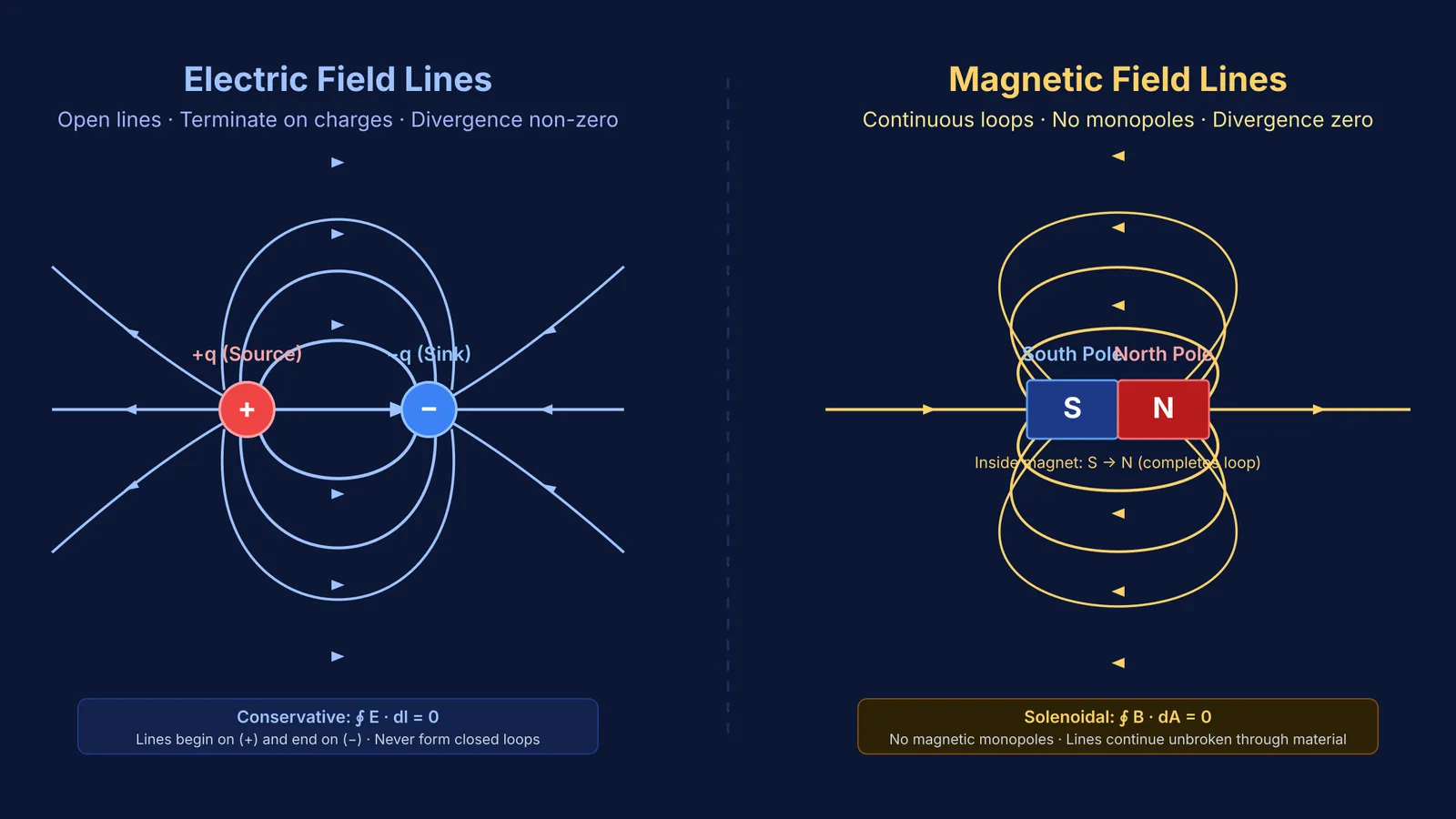
The most fundamental difference between the two fields lies in whether isolated sources exist. As explained in OpenStax University Physics, electrostatic field lines originate on positive charges and terminate on negative charges, or extend to infinity when an isolated charge is present. Because positive and negative electric charges exist independently as monopoles, an electric field line has a definite beginning and a definite end.
Furthermore, electrostatic fields are conservative. As Richard Feynman points out in The Feynman Lectures on Physics Vol. II, the circulation integral of an electrostatic field around any closed path is strictly zero: ∮ E · dl = 0. If an electrostatic field line formed a closed loop, moving a positive charge along that loop in the direction of the field would yield positive work over a complete cycle without any change in potential energy, violating the conservation of energy. For more details on field sketches, see our guide on rules for drawing electric field lines.
Magnetic fields behave differently because isolated magnetic poles have never been observed. Magnetism is dipolar by nature: cutting a bar magnet in half produces two smaller dipoles rather than separate north and south poles. According to Gauss's law for magnetism, the net magnetic flux through any closed Gaussian surface is zero: ∮ B · dA = 0. In The Feynman Lectures on Physics Vol. II, Feynman notes that because the divergence of B is zero everywhere, magnetic field lines cannot start or stop at points; they must form continuous, unbroken closed loops.
Outside a magnet, magnetic field lines emerge from the north pole and enter the south pole. Inside the magnetic material, the lines continue straight from the south pole back to the north pole, completing the continuous circuit (OpenStax University Physics). You can explore this further in our explainer on why magnetic field lines form closed loops.
Why can two field lines never cross each other?
Both electric and magnetic field lines share an essential rule: two field lines belonging to the same field can never intersect.
The direction of a field line at any point is defined by the tangent drawn to the curve at that point. If two field lines were to cross at a single coordinate, an observer could draw two different tangents at that intersection. This would imply two different directions for the net electric or magnetic field at that exact location.
Because physical fields are single-valued vector fields, the net field vector at any point in space can point in only one resultant direction. A compass needle placed at an intersection would have to point in two directions simultaneously, which is physically impossible. The same principle applies across classical physics, as seen in gravitational versus electric field lines.
How do forces and work done compare along each field line?
The relationship between the field line and the force experienced by a charged particle differs fundamentally between electricity and magnetism:
Force direction: An electric field exerts a force F = qE along the tangent to the electric field line (in the direction of E for positive charges, and opposite for negative charges). By contrast, a magnetic field exerts a Lorentz force F = q(v × B) that acts perpendicular to both the velocity vector v and the magnetic field line B.
Work done on a charge: An electric field can do work on a moving charge, accelerating it and changing its kinetic energy: W = ∫ F · dr = q ∫ E · dr. In contrast, the magnetic force is always perpendicular to instantaneous velocity (F · v = 0), meaning a static magnetic field does zero work on a free charge and changes only its trajectory, never its speed.
When you need to visualize these geometric and dynamic behaviors side by side, the Fermi Concept Library maps every concept in physics, chemistry, biology, mathematics and computing, each with its own lesson and its place in the map.
How should you solve field line questions in exams?
In CBSE board papers, JEE Main, and NEET-UG, examiners test these concepts through conceptual assertion-reason questions and diagram verification tasks. Use this four-step checklist to evaluate any field diagram:
Check line endpoints: If a line forms a closed loop in a region with only stationary charges, mark the diagram invalid. Electrostatic lines must originate on positive charges and end on negative charges.
Verify internal continuity: For magnets and solenoids, ensure field lines pass continuously through the interior from south to north. A diagram showing lines terminating on magnetic poles is incorrect.
Inspect for intersections: Check all crossings. Any diagram where lines intersect or touch is immediately unphysical.
Verify line density: Ensure the spacing between lines reflects field strength. Denser lines must correspond to regions of stronger field intensity near poles and charges.
Worked example: Consider an assertion-reason problem from a past competitive paper on field line properties:
Assertion: An electrostatic field line cannot be a closed loop.
Reason: The electrostatic field is a conservative field.
Solution: Both statements are true, and the reason correctly explains the assertion. Because ∮ E · dl = 0 for any conservative field, the existence of a closed field line would allow continuous energy extraction, violating conservation laws.
If you encounter challenging multi-concept numericals that combine electric potential with magnetic deflections, the Fermi Problem Library offers worked problems with a step-by-step solver that explains the reasoning rather than printing an answer.


