

On this page
A field-line sketch looks like easy marks in electrostatics, yet careful students lose them to a crossing line, a line starting in empty space, or equal line counts on 2q and q. Every rule below has a reason; learn the reason and the list follows.
What are the rules for drawing electric field lines?
A field line is a curve whose tangent at every point gives the direction of the electric field there, as OpenStax University Physics, section 5.6 defines it. The same section gives four rules; a fifth, about arrows, follows from the definition:
Lines start on positive charges or come in from infinity, and end on negative charges or go out to infinity.
The number of lines leaving or entering a charge is proportional to its magnitude: a 2q charge gets twice as many lines as a q charge.
Where lines are closer together the field is stronger, because line density is proportional to the field's magnitude.
Lines never cross.
Every line needs an arrowhead showing the field's direction, which is the way a small positive test charge would be pushed.
Two more rules come from electrostatics. The electrostatic force is conservative, so the field's line integral around any closed path is zero, as OpenStax section 7.1 shows. So electrostatic field lines cannot form closed loops: a loop would let the field do net work on a charge carried round it. Field lines also meet a conductor's surface at right angles and never run inside it (more on that below).
Why can electric field lines never cross?
OpenStax puts it in one sentence: if two lines crossed, the field would point in two different directions at the same point, and that can't happen (section 5.6). At every point the fields of all the charges add up to a single vector, so exactly one line passes through each point. The only exceptions are null points, where the field is zero and no line passes at all.
Why do field lines meet a conductor at right angles?
In electrostatic equilibrium the field inside a conductor is zero; if it weren't, the free electrons would move and the charges wouldn't be static (OpenStax section 6.4). The same section explains the surface: if the field had a component along the surface, the free surface charges would slide, so the field just outside must be perpendicular to it. So in a sketch, lines stop at the metal, hit it square-on, and none are drawn inside.
How do you sketch like, unlike and unequal charges?
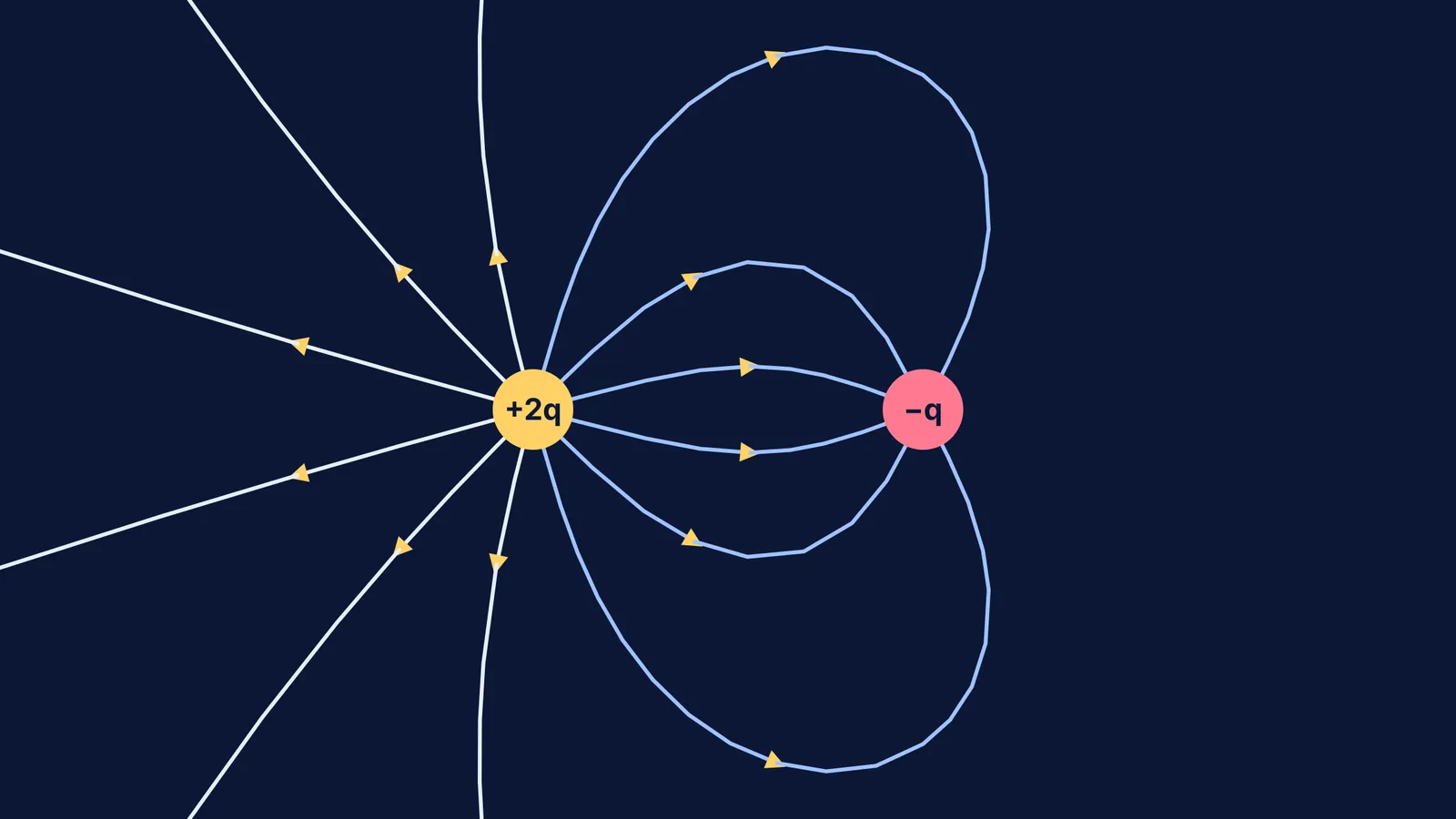
The diagram at the top is computed for +2q and −q; compare your sketch with it. This method works for any pair.
Count first. Pick a line count proportional to each charge, as OpenStax section 5.6 requires: for +2q and −q, draw 12 lines from +2q and 6 into −q.
Unlike charges. Lines leave + and curve into −. For equal and opposite charges every line from + ends on −, symmetric about the perpendicular bisector.
Unequal unlike charges. The surplus lines from the larger charge go out to infinity. OpenStax's +3q and −q example draws three times as many lines leaving +3q as entering −q (section 5.6), so two-thirds of the lines from +3q must go out to infinity. Far away, those lines look like the field of the net charge, +2q.
Like charges. Lines from each charge bend away from the other, and none join the two charges. For two equal charges, mark the null point at the midpoint, where no line passes.
Unequal like charges. The null point moves towards the smaller charge. For +4q and +q a distance d apart, setting the two fields equal, kq/x² = 4kq/(d − x)², gives x = d/3 from the +q charge.
For the numbers behind the two-charge pattern, see our worked post on the electric field of a dipole on its axis and equatorial line. If you can draw the right pattern but can't yet say why it looks that way, the Fermi Concept Library gives every physics concept its own lesson and shows its place in the map.
What are the common errors in board-exam field-line diagrams?
Run through this checklist before you move on to the next question:
Two lines crossing, or touching and splitting apart.
Lines starting or stopping in empty space, away from any charge.
Missing arrows, or arrows pointing into a positive charge.
The same number of lines on unequal charges.
Lines that join two like charges.
Lines drawn inside a conductor, or meeting its surface at a slant.
Closed loops in an electrostatic field.
Lines drawn evenly spaced in a region where the field is clearly weaker.
Next, read electric flux through flat and curved surfaces and finding E from the potential gradient. For ideas that are easier to see than to read, the Fermi Simulation Lab has interactive simulations.


