

On this page
In October 1927, two engineers at Bell Telephone Laboratories in New York described a clock with no pendulum. Warren A. Marrison and Joseph W. Horton used a piece of quartz, kept vibrating by an electric circuit, as the clock's heartbeat. Your watch and phone still count time this way, so the story is also a lesson in resonance and division.
Who was Warren Marrison?
Marrison was born in Canada in 1896 and worked on radio communications in the Royal Flying Corps during World War I, according to a history of quartz clocks by NIST's Michael Lombardi. After a Harvard master's degree he joined Western Electric and then Bell Telephone Laboratories, building quartz frequency standards with Horton, his supervisor and colleague. Marrison's notes suggest he had the clock idea by November 1924.
The pair's paper, "Precision determination of frequency", appeared in the Proceedings of the IRE in February 1928 after being presented in October 1927. It described two clocks: one referenced to a 100 Hz tuning fork, the other to the 50 kHz vibration of a quartz crystal. Lombardi calls it the first published account of a quartz clock.
Why does quartz vibrate when voltage is applied?
Quartz is piezoelectric. In 1880 Pierre and Jacques Curie showed that some crystals produce an electric charge when squeezed, and in 1881 they showed the reverse: a voltage applied to the crystal makes it strain and change shape, as Lombardi's history explains. Our post on Pierre Curie and piezoelectricity tells that story.
Apply an alternating voltage and the crystal flexes back and forth. Each crystal has a natural frequency set by its cut and size, and near that frequency it responds strongly: resonance. Walter Cady, who applied for patents in 1920 and 1921, is generally credited with the first quartz oscillator; George W. Pierce then simplified the circuit so that the crystal alone set the frequency.
How did the first quartz clock work?
The problem was counting. Some long-pendulum clocks completed half an oscillation per second (0.5 Hz), while quartz oscillators ran at thousands of hertz, Lombardi writes. Keeping time with quartz needed a way to count these much faster vibrations.
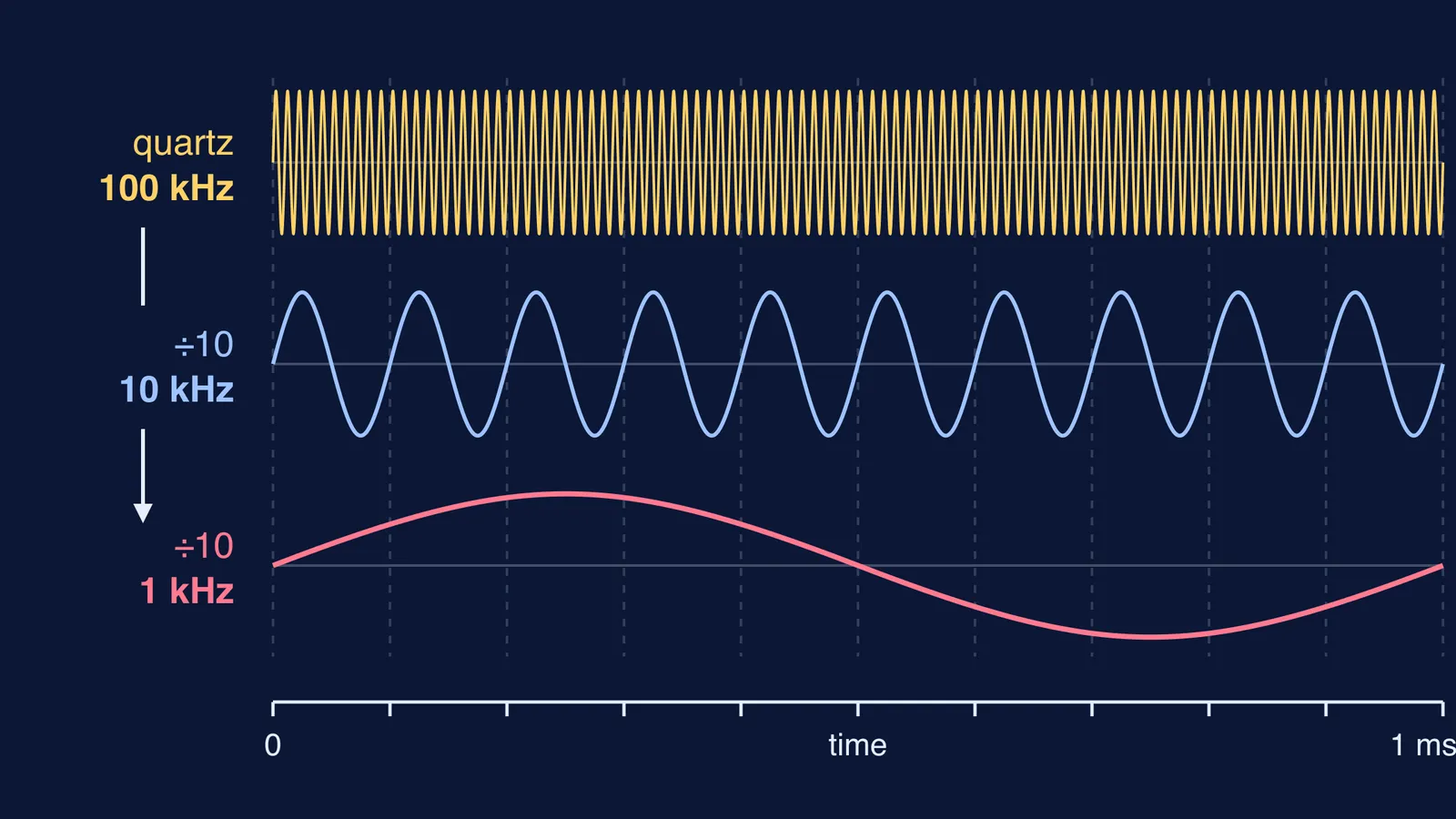
Over several years Marrison refined his clock around a frequency divider that he described as a "reducing gear":
A quartz crystal, kept vibrating by an oscillator circuit, ran at 100 kHz.
A divider cut that by a factor of 10, to 10 kHz.
A second divider cut it by 10 again, to 1 kHz, so one output cycle equalled 100 crystal vibrations.
The 1 kHz signal controlled the speed of a small 1,000-cycle synchronous motor, locking the motor to the crystal; the motor drove the clock's display.
The diagram at the top shows steps 1 to 3 over one millisecond.
How accurate was Marrison's quartz clock?
Marrison compared his clock with US Naval Observatory time signals in December 1929 and January 1930. It was accurate to within 0.2 seconds per day or less, about 2 parts in a million, according to Lombardi, citing Marrison's 1930 PNAS paper. Its time error changed by a total of 0.14 seconds over about 47 days, which Marrison correctly blamed on crystal "aging".
How do you turn a frequency error into seconds per day?
A day has 86,400 seconds, and a clock's daily error is 86,400 × (Δf ÷ f).
Lombardi's example: at 100 kHz, a frequency change of 1.16 mHz gives Δf ÷ f = 0.00116 ÷ 100,000 = 1.16 × 10⁻⁸.
Daily error = 86,400 × 1.16 × 10⁻⁸ ≈ 0.001 s, or 1 millisecond a day.
Now reverse it: 0.2 s a day means Δf ÷ f = 0.2 ÷ 86,400 ≈ 2.3 × 10⁻⁶, so a 100 kHz crystal would be about 0.23 Hz off.
The same reasoning explains how many seconds a pendulum clock gains or loses per day. If ratios like Δf ÷ f trip you up, the Fermi Problem Library has worked problems with a step-by-step solver that explains the reasoning rather than printing an answer.
How does your quartz watch use the same idea?
Your watch uses the same reducing gear, with halving instead of tenths. By 1972 Girard-Perregaux had introduced the GP350 movement, which ran at 32,768 Hz (2¹⁵) with a 15-stage divider, and 32,768 Hz became the standard for the watch industry, Lombardi records. He adds that even the least expensive quartz watches are usually accurate to within 0.5 seconds a day.
Try it yourself:
Halve 32,768 until you reach 1: 15 steps, one per divider stage.
Convert 0.5 s a day to parts per million: 0.5 ÷ 86,400 ≈ 5.8 × 10⁻⁶, about 6 ppm.
If resonance is easier to grasp when you watch it, the Fermi Simulation Lab has interactive simulations for the ideas that are easier to see than to read.
The next leap came from atoms: read about Louis Essen and the caesium atomic clock.


